
Skylon
Skylon was a futuristic steel tensegrity structure with a slender, vertical, cigar-like form, located near the River Thames in London. Created for the 1951 Festival of Britain, it gave the illusion of floating above the ground and became one of the event’s most memorable structures. Despite its popularity, it was dismantled in 1952 when the rest of the exhibition was taken down. Its removal was ordered by Winston Churchill, who saw the Festival and its buildings as symbols of the previous Labour government’s vision for a new socialist Britain. The base is preserved at the Museum of London, while some vent covers survive in a private collection. The former site is now part of a riverside promenade near the London Eye and Jubilee Gardens.
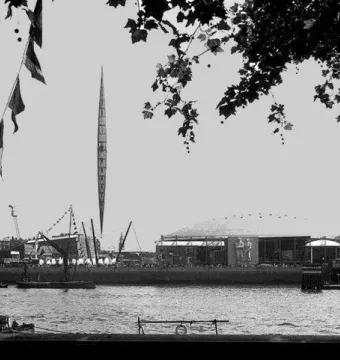
August 1951 © Peter Benton · CC BY-SA 2.0
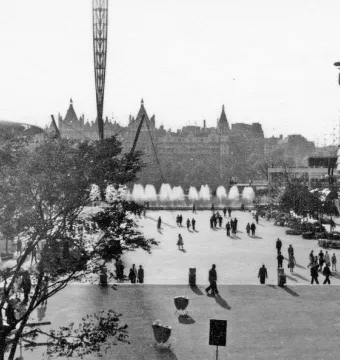
July 1951 © Ben Brooksbank · CC BY-SA 2.0
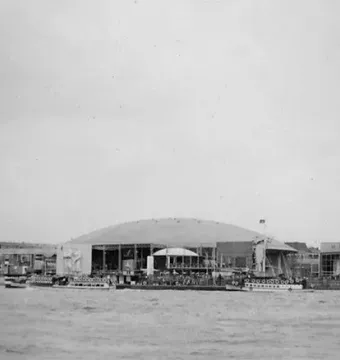
July 1951 © John Ritchie Addison · CC BY-SA 2.0
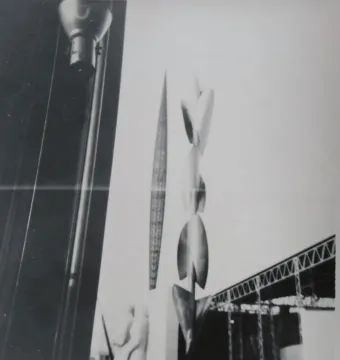
August 1951 © David Hawgood · CC BY-SA 2.0
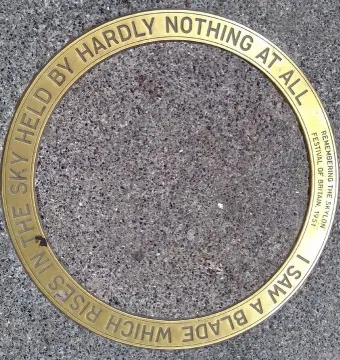
October 2025 © AndyScott · CC0
Identification | |
| Title | Skylon |
| Type | futuristic steel tensegrity sculpture and festival structure |
Historical context | |
| Associated event | Festival of Britain |
| Role | constant vertical-line symbol of the Festival of Britain |
| Public reception | popular with the public |
| Historical reference | The name and form most likely referenced the Trylon feature of the 1939 New York World's Fair |
Creator | |
| Designers | Hidalgo Moya, Philip Powell, and Felix Samuely |
| Structural engineer | Felix Samuely |
| Fabricator | Painter Brothers of Hereford, England |
Discovery and provenance | |
| Name origin | Moya said it combined suggestions of Pylon, Sky, and Nylon; he described Nylon as a fascinating new material in 1951 and considered the resulting name wonderfully descriptive |
| Name suggested by | A. G. S. Fidler, wife of the chief architect of the Crawley Development Corporation |
Physical characteristics | |
| Shape | slender, cigar-shaped, pointed at both ends |
| Structure | steel frame with latticework |
| Support system | suspended by cables between three steel pylons or beams |
| Dimensions | approximately 300 feet high, with the base nearly 15 metres (50 feet) above the ground |
Materials | |
| Material | steel |
| Cladding | aluminium louvres or slats |
Technique | |
| Construction method | partially built on the ground, then raised vertically and completed in situ |
Appearance | |
| Visual effect | gave the illusion of floating above the ground |
| Style | futuristic-looking |
Location and ownership | |
| Original location | South Bank, London, by the River Thames between Westminster Bridge and Hungerford Bridge |
| Original site | Festival of Britain site, including the South Bank and the former Discovery Dome area |
| Current status | removed in 1952 |
History and restoration | |
| Incident | In May 1951, Philip Gurdon, a Birkbeck College student, climbed the Skylon at midnight and attached a University of London Air Squadron scarf near the top; police constable Frederick Hicks later retrieved it |
| Paper-knife inscription | "600"; "Made from the aluminium alloy roof sheets which covered the Dome of Discovery at the Festival of Britain, South Bank. The Dome, Skylon and 10 other buildings on the site were dismantled by George Cohen and Sons and Company Ltd during six months of 1952." |
| Commemorative reuse | some metal fragments were made into paper knives and other commemorative artefacts |
| Preserved parts | the base is kept at the Museum of London; the wind scoops are in a private collection |
| Possible fate after removal | variously said to have been thrown into the River Lea or the Thames, buried under Jubilee Gardens, turned into souvenirs, or sold as scrap |
| Dismantling duration | six months in 1952 |
| Dismantling and sale | sold to George Cohen and Sons, scrap dealers of Wood Lane, Hammersmith, and dismantled at their works in Bidder Street, Canning Town, on the banks of the River Lea |
| Churchill's view | he saw the Festival and its architectural structures as a symbol of the previous Labour government's vision of a new socialist Britain |
| Removal reason | re-erection elsewhere was judged too expensive in post-war austerity |
| Removal | dismantled in 1952 when the rest of the Festival of Britain exhibition was removed, on Winston Churchill's orders |
| Built | 1951 |
Significance | |
| Significance | an abiding symbol of the Festival of Britain |
Other | |
| Samuely's role at the time | lecturer at the Architectural Association School of Architecture in Bedford Square, Bloomsbury |
| Public concern | questions were raised in Parliament about the danger to visitors from lightning |
| Lightning precaution | it was roped off at one point in anticipation of a forecast thunderstorm |
| Investigation | BBC Radio 4 Front Row investigation broadcast on 8 March 2011 found that the Skylon and the roof of the Dome of Discovery had been sold to George Cohen, Sons and Company scrap metal dealers of Wood Lane, Hammersmith |