
Berlin
Berlin is a sculpture created in 1987 by Brigitte Matschinsky-Denninghoff and Martin Matschinsky. It is installed in the central parterre of Tauentzienstraße in Berlin. The work was erected for the “Boulevard of Sculptures” initiative, supported by the city administration for the 750th anniversary of the city’s founding. Made of intertwined and broken nickel-chrome steel tubes, the sculpture represents the two halves of Berlin, then divided by the Wall, as both joined and separated. The Gedächtniskirche forms its perspectival backdrop.
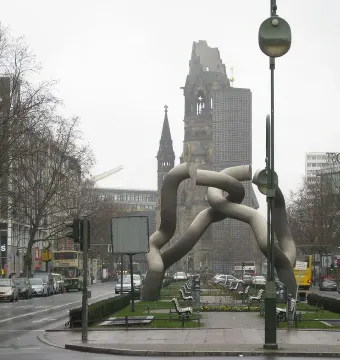
March 2009 © Kamahele · CC BY-SA 3.0
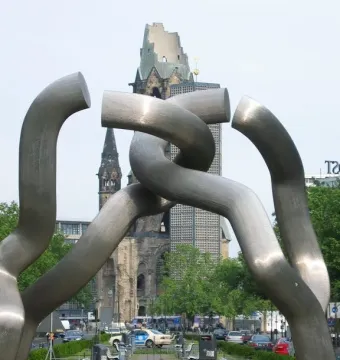
March 2005 © Nelson Minar · CC BY-SA 2.0
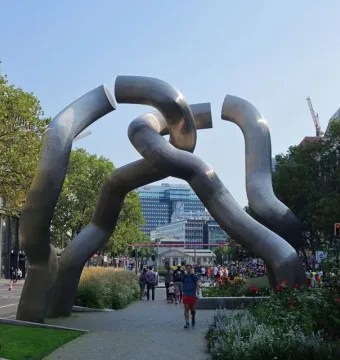
September 2021 © Dosseman · CC BY-SA 4.0
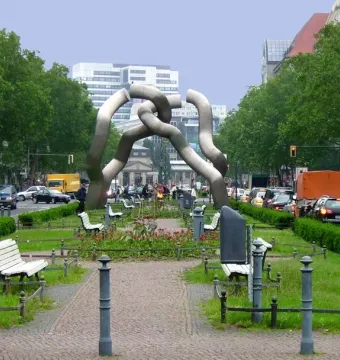
© Modris Putns · CC BY-SA 3.0
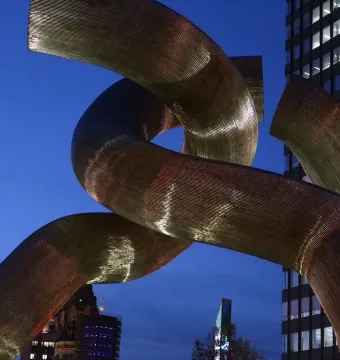
November 2016 © Schelbypicture · CC BY-SA 4.0
Identification | |
| Type | sculpture |
| Title | Berlin |
Historical context | |
| First conceived | 1985 |
| Created / unveiled | 1987 |
Creator | |
| Artists | Brigitte Matschinsky-Denninghoff and Martin Matschinsky |
| Artist relationship | husband-and-wife sculpting team |
Discovery and provenance | |
| Commissioned for | the Boulevard delle sculture initiative for Berlin's 750th anniversary in 1987 |
| Commissioned by | the city of West Berlin |
| Patronage | sponsored by the city administration |
| Acquisition history | after the original lease expired, it was acquired by the city and Deutsche Bank |
| Historical context | after the Berlin Wall was dismantled, the sculpture was bought by the city from Matschinsky-Denninghoff to commemorate this period in German history |
Location and ownership | |
| Event year | 1987 |
| Sculpture allowed to remain past anniversary year | yes |
| Number of sculptures in event | eight |
| Other sculptures allowed to remain | Pyramide and Cadillacs in Form der nackten Maja |
| Event | Skulpturenboulevard Kurfürstendamm (Boulevard of Sculptures: Kurfürstendamm) |
| Site condition | the Kaiser-Wilhelm-Gedächtniskirche was heavily damaged during the Bombing of Berlin in World War II |
| Associated monument | Kaiser-Wilhelm-Gedächtniskirche (Gedächtniskirche) |
| Chosen site | Tauentzienstraße in front of the Kaiser-Wilhelm-Gedächtniskirche |
| Current location | central median of Tauentzienstraße, Berlin, Germany |
Physical characteristics | |
| Structure | four steel tubes extending upwards |
| Tube diameter | about two meters each |
| Base | reinforced with a concrete base |
| Overall shape | double arch |
| Form | on each side, one of the two ends tilts for about half a meter, then changes direction completely, looping but not touching |
Materials | |
| Material | interwoven and broken nickel-chrome steel tubes |
| Surface material | chrome nickel steel |
Appearance | |
| Surface appearance | can darken or shine depending on the time of day |
| Visibility | accessible from all sides and perceivable from all sides |
| Described as | a big, organically grown gate |
Iconography and meaning | |
| Principal motif | broken chain |
| Meaning | represents the two halves of Berlin, then divided by the Wall, as simultaneously united and separated; symbolizes the severed connections between West and East Berlin caused by the construction of the Berlin Wall; expresses the closeness and isolation between the two sides of Berlin |
| Directional emphasis | West-East and East-West |
| Artist statement | the sculpture is specifically designed to communicate something of Berlin's situation in a symbolic way |
| Functional intent | not just necessary and practical, but an invigorating emphasis |
| Backdrop | the Gedächtniskirche serves as the perspective backdrop |