
Equestrian Statue of William III
The equestrian statue of William III by John Bacon Junior stands in St James's Square in central London. It was modelled on an earlier statue of the king by John Michael Rysbrack in Queen Square, Bristol. Funding for the London monument was provided in the 1724 will of Samuel Travers, M.P., though the project did not move forward for about seventy years. A design was prepared in 1794 by John Bacon Senior, but the commission later passed to Bacon Junior, under whose direction the statue was finally erected in 1808. The statue is a Grade I listed structure.
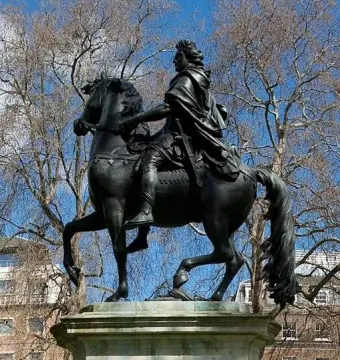
January 2010 © St_James's_Square,_London_-_April_2009.jpg · CC BY-SA 3.0

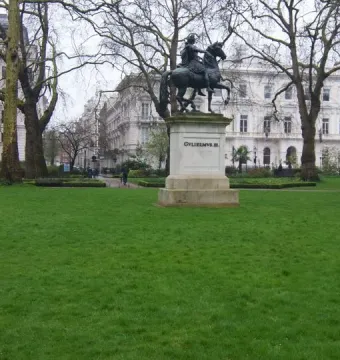
April 2018 © ukmoose · CC BY-SA 4.0
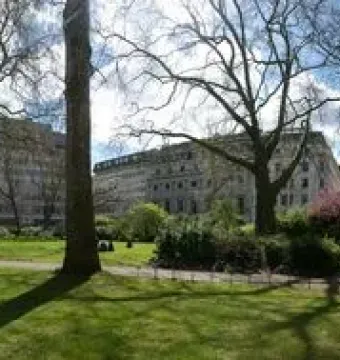
April 2009 © Diliff · CC BY-SA 3.0
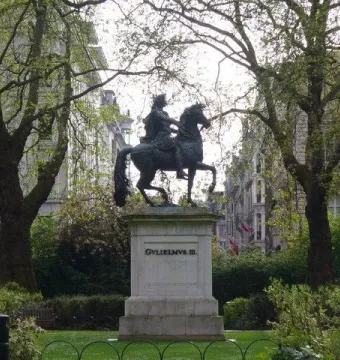
April 2008 © Colin Smith · CC BY-SA 2.0
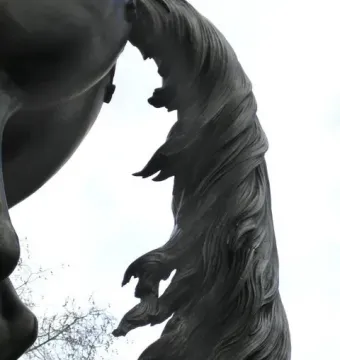
January 2010 © mira66 · CC BY 2.0
Identification | |
| Title | equestrian statue of William III |
| Subject | William III of Orange-Nassau |
| Type | equestrian statue |
Creator | |
| Sculptor | John Bacon Junior |
| Design prepared by | John Bacon Senior |
Historical context | |
| First proposal date | 1697 |
| Revival attempts | 1710 and 1721 |
| Bequest date | 1724 |
| Purpose of bequest | to fund the construction of an equestrian statue in brass to the glorious memory of William III |
| Historical context | The statue was planned after William III's reign and many decades after the first proposal |
Discovery and provenance | |
| Commission date | 1794 |
| Erected | 1808 |
| Commission transferred to | John Bacon Junior |
| Commission status | John Bacon Senior's design was not executed |
| Modelled on | the earlier equestrian statue of William III by John Michael Rysbrack in Queen Square, Bristol |
| Alternative proposed location | Cheapside Conduit |
| Original proposed location | St James's Square |
| Bequest donor role | Member of Parliament and Crown official |
| Bequest donor | Samuel Travers |
Physical characteristics | |
| Material | bronze |
| Original setting | in the middle of an octagonal pool |
| Later alteration to setting | the pool was drained in the 19th century |
Appearance | |
| Inscription 2 | I. BACON, IVNR. SCVLPTR. 1807 |
| Inscription 1 | GVLIELMVS III |
| Hairstyle | Despite the Classical dress, William's hairstyle follows late 17th-century fashion |
| Plinth inscriptions | Panels on either side of the plinth carry inscriptions in bronze lettering |
| Horse depiction | William is depicted astride a spirited horse |
| Depiction style | William is shown in the style of a Roman general |
Iconography and meaning | |
| Dedication | to the glorious memory of William III |
| Base interpretation | Jo Darke suggests that the base includes a depiction of the molehill over which William's horse Sorrel stumbled at Hampton Court, leading to the king's death from complications of pneumonia |
Location and ownership | |
| Current location | centre of St James's Square, London |
| Listed status | Grade I listed structure |
| Listing date | 1958 |
| Listed structure type | building and structure |
Other | |
| Grade I meaning | the highest grading given to buildings and structures of exceptional interest |