
Subiaco Ephebe
Subiaco Ephebe is a headless marble statue of a young man found at Nero’s Villa Sublaquensis in Subiaco, in the upper Aniene valley of Lazio, Italy. It is a copy of a lost Greek bronze, identified by its tree-trunk support and the awkward way the figure is contained within a single block of stone. The athlete is shown in mid-step, with one arm reaching forward and one leg advancing, while the twisted torso carries no weight on the bent supporting leg. The sculpture is preserved in the Palazzo Massimo alle Terme, near the Baths of Diocletian in Rome. Copies include a marble version by Eugène Désiré Piron and another in Subiaco, where it was found in 1883.
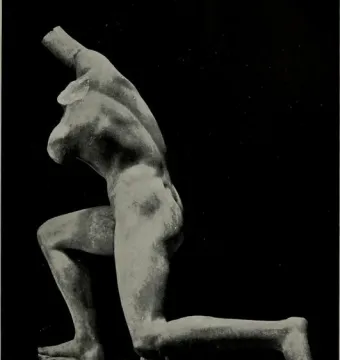
1915 © Gardner, Ernest Arthur, 1862-1939 · No restrictions
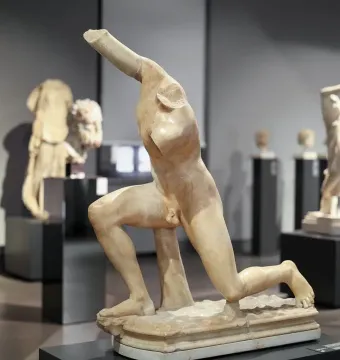
November 2024 © Fabrizio Garrisi · CC0
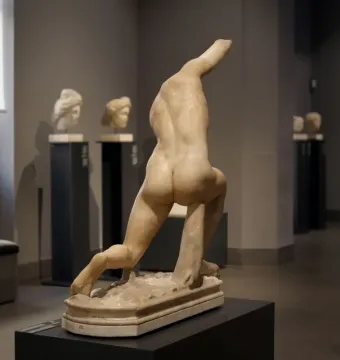
November 2024 © Fabrizio Garrisi · CC0
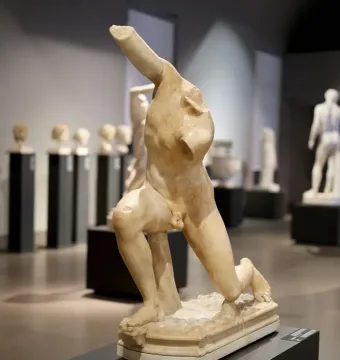
November 2024 © Fabrizio Garrisi · CC0
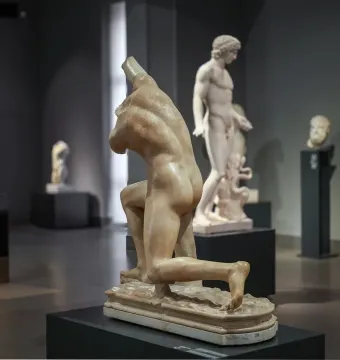
November 2024 © Fabrizio Garrisi · CC0
Identification | |
| Title | Subiaco Ephebe |
| Type | Sculpture |
| Subject | Young adolescent man; athlete |
| Alternative names | El Efebo de Subiaco; El joven de Subiaco; Youth from Subiaco |
Historical context | |
| Original prototype | Copy of a lost Greek bronze original |
| Date of bronze original | Contested; proposed dates range from the 60s or 70s of the 5th century BC to the early 5th century BC, late 4th century BC, or 1st century BC |
| Dating note | The text rejects the attribution/date of the original bronze |
Creator | |
| August Kalkmann dating | Early 5th century BC |
| Pre-World War II dating opinion | Late 4th century BC, toward the transition to the Hellenistic style |
| Rhys Carpenter dating proposal | 60s or 70s of the 5th century BC |
| Brunilde Sismondo Ridgway dating proposal | Classicising work of the 1st century BC |
Physical characteristics | |
| Right arm | Extends upward and forward |
| Torso | Violently twisted and not bearing weight on the left side |
| Left knee | Does not touch the ground |
| Right leg | Advances with a bent knee |
| Pose | Shown in mid-stride, in an archaic convention of running |
| Left arm | Missing; formerly brushed the right knee |
| Composition note | The silhouette is distorted and does not resolve as a whole within a single block of stone |
| Support | Unusual tree-trunk-shaped support |
| Material | Headless marble |
Iconography and meaning | |
| Comparative interpretation | Rhys Carpenter compared the lower half of the figure to the stumbling Niobid |
Location and ownership | |
| Current location | Palazzo Massimo alle Terme, next to the Baths of Diocletian, Rome |
| Place of discovery | Villa Sublaquensis of Nero, Subiaco (Roman Sublaqueum), upper valley of the Aniene River, Lazio, Italy |
| Discovery context | Found at the site associated with Nero's villa |
| Findspot implication | Unlikely to be later than Nero because of where it was found |
| Other copies | A marble copy made by Eugène Désiré Piron in 1905 is preserved at the ENSBA in Paris; another copy is in contrada Sant'Angelo on the edge of state road SS411 in Subiaco and was found in 1883 during excavations of Nero's villa on the left bank of the Aniene River |
Other | |
| Literary reference | Jean Louis Curtis wrote a novel titled L'Éphebe de Subiaco |
| Film adaptation reference | Philippe de Broca filmed Chère Louise in 1972, starring Jeanne Moreau, released in Spanish as Pecados de otoño |