
John Cockerill Monument
The John Cockerill Monument is a group of statues erected in Brussels, Belgium, in memory of the Belgian-British industrialist John Cockerill. It also honours the industrial workers of Belgium. Cockerill was a pioneer of the steel industry and the railways in Belgium during the 19th century. The monumental group was designed in 1872 by a sculptor in an eclectic style. It stands in the centre of Place du Luxembourg/Luxemburgplein in Ixelles, with its back to the former Brussels-Luxembourg railway station entrance and to the postmodern buildings of the Espace Léopold, seat of the European Parliament in Brussels.
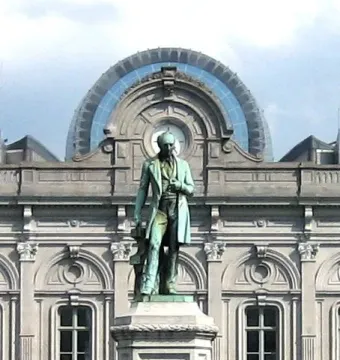
August 2009 © JLogan · CC BY-SA 3.0
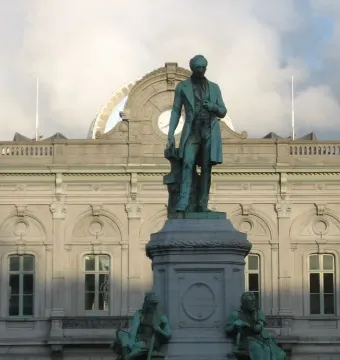
© Zinneke · CC BY-SA 3.0 lu
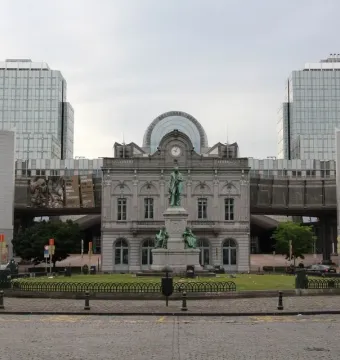
© Fred Romero · CC BY 2.0
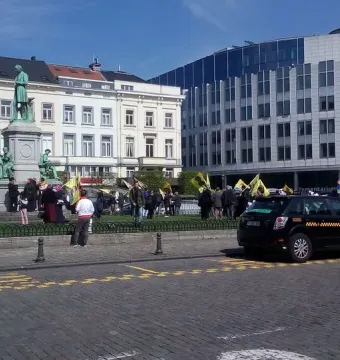
April 2019 © MatteoNL97 · CC BY-SA 4.0

July 2016 © Nivent2007 · CC BY-SA 4.0
Identification | |
| Title | Monument to John Cockerill |
| Commemorated people | John Cockerill and the industrial workers of Belgium |
| Type | Monumental group |
| Subject | John Cockerill |
Historical context | |
| Date inaugurated | 1872 |
| Date designed | 1872 |
Creator | |
| Designer | Unnamed in the source fragment |
| Worker figures maker | Compagnie des Bronzes de Bruxelles |
Discovery and provenance | |
| Financier | Willem Rau, a collaborator of Cockerill |
| Relation to earlier monument | Near copy of the monument erected in 1871 in Seraing |
| Earlier monument location | Outside Seraing's Town Hall, Liège Province, Wallonia |
| Earlier monument context | At the heart of John Cockerill's industrial empire |
| Creation authorization | The creation of the monument was authorised by the sculptor |
Location and ownership | |
| Nearby building architect | Gustave Saintenoy |
| Nearby complex function | Seat of the European Parliament in Brussels |
| Nearby complex style | Postmodern |
| Nearby complex | Espace Léopold |
| Placement | In the centre of Place du Luxembourg, opposite Brussels-Luxembourg railway station |
| Nearby building date | 1854–1855 |
| Nearby building | Former Brussels-Luxembourg station |
| Orientation | With its back to the former Brussels-Luxembourg station and the Espace Léopold buildings, seat of the European Parliament in Brussels |
| Current location | Place du Luxembourg, Ixelles, Brussels, Belgium |
Physical characteristics | |
| Number of worker figures | Four |
| Worker figures material | Bronze |
| Worker figures pose | Seated |
| Worker figures placement | Around the industrialist, flanking the corners of the pedestal |
| Pedestal shape | Rectangular |
| Pedestal ornamentation | Medallions on each face; some once contained bronze effigies of Cockerill's collaborators |
| Main figure placement | At the summit of the monument |
| Main figure pose | Leaning on an anvil |
| Overall composition | A bronze statue of John Cockerill atop a rectangular blue stone pedestal, with four seated bronze worker figures around the corners |
| Pedestal material | Blue stone |
Materials | |
| Main figure material | Bronze |
| Worker figures material | Bronze |
Appearance | |
| Style | Eclectic |
Iconography and meaning | |
| Meaning | It honors John Cockerill and the industrial workers of Belgium; Cockerill is presented as a pioneer of steelmaking and railways in Belgium |
| Collaborators named on pedestal | Rau, Pastor, Poncelet, Memminger, Alexander, Wéry, and Brialmont |
| Inscriptions | Front: 'To John Cockerill, the father of workers'; right: 'Intelligence'; left: 'Work'; rear: '1790-1840' |
| Dedication | In memory of John Cockerill |
| Worker figures represented | The glass-blower or blacksmith Lognoul, the mechanic Beaufort, the puddler Lejeune, and the coal miner Jacquemin |
| Main figure depiction | John Cockerill leaning on an anvil |
History and restoration | |
| Vandalism date | 1 February 2024 |
| Vandalism context | Vandalised during a farmers' protest in front of the European Parliament |
| Damaged figure | The statue of the mechanic Beaufort |
| Damage description | Torn from the pedestal and left on the ground amid burning wooden pallets; reported damage included cracks in the arm, leg and lower back, a melted tool, and patina removed by extreme heat |
| Damage assessment source | Yves Rouyet, Ixelles' Heritage Councillor |
| Restoration | The damaged statue of the mechanic Beaufort was sent to Ghent for restoration and restored during 2024; the worker's compass was fully restored as well |
| Reinstallation date | 13 December 2024 |
| Documentation | The missing medallion effigies and other details can be seen on old postcards |
Significance | |
| Historical significance | John Cockerill was a pioneer of the steel industry and railways in Belgium in the 19th century |
| Comparative note | Unlike the Seraing monument, the workers are seated and made of bronze rather than cast iron |