
Monument to Catherine II of Russia, Saint Petersburg
The Monument to Catherine II of Russia in Saint Petersburg was the result of a long project initiated during the reign of Alexander II. Early designs by Mikeshin were refined into a much grander composition, eventually featuring Catherine II more than four meters high and a series of surrounding statues of important figures such as Suvorov, Rumyantsev, Potemkin, Derzhavin, and others. The monument was designed for a site near the Alexandra Theatre, with David Ivanovich Grimm preparing the terrain and Opekushin carrying out the sculpture. Construction took more than seven years because of funding difficulties. Cast in bronze and set on a granite pedestal, the monument was finally unveiled to the public on Saint Catherine’s Day in the presence of the Emperor.
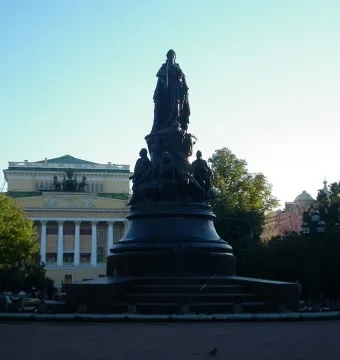
© Антон Фандофан · CC BY-SA 3.0
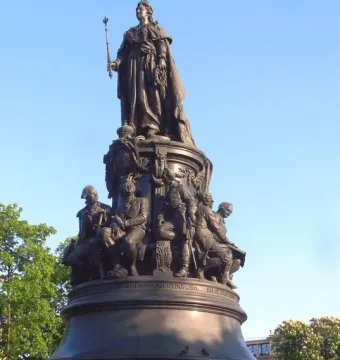
May 2010 © Fingalo · CC BY-SA 2.0 de
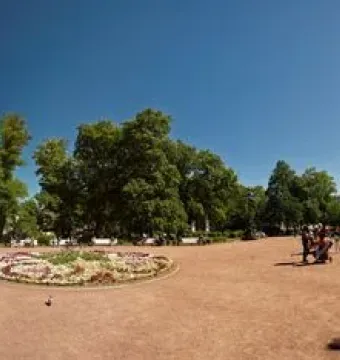
June 2015 © Txllxt TxllxT · CC BY-SA 4.0
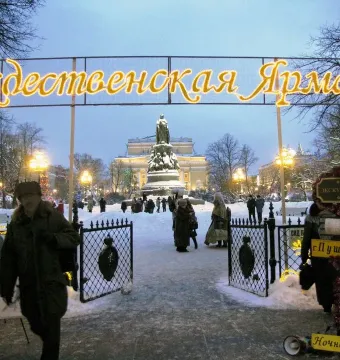
© Natalia Semenova · CC BY 3.0
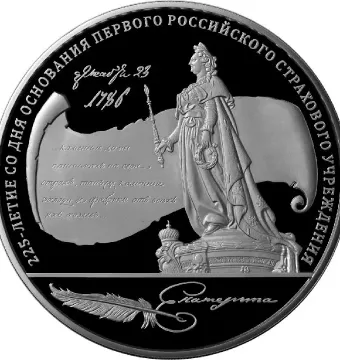
December 2011 © Банк России · Public domain
Identification | |
| Title | Monument to Catherine II of Russia, Saint Petersburg |
| Subject | Catherine II of Russia (Catherine the Great) |
| Type | Monument / statue |
Historical context | |
| Commission purpose | A monument to Catherine II, originally timed to the 100th anniversary of her accession to the throne |
| Initial competition | Announced in early 1861; about 8 projects were submitted |
Creator | |
| Designer | M. O. Mikeshin |
| Main sculptor | Mikhail Opekushin |
| Site preparation | David Ivanovich Grimm prepared the site |
Discovery and provenance | |
| First design reception | Exhibited in London, awarded a medal for technical quality, and approved by Alexander II |
| Additional figures added | Bezborodko and Betskoy were added in 1865; later the monument included nine figures around Catherine II |
| Project approval | Mikeshin's revised project was approved by the emperor despite skepticism from the Academy of Arts |
| Model display locations | London and Tsarskoye Selo; a life-size model was displayed at Tsarskoye Selo in 1862 and later purchased for the Tsarskoye Selo palace near the Cameron Gallery |
| First design pedestal decoration | Four medallions representing Alexander Suvorov, Rumyantsev, Grigori Potemkin, and Derzhavin |
| First design | A graceful woman wearing a laurel wreath and holding a lyre |
| Final location | Catherine Garden, Saint Petersburg, in front of the Alexandrinsky Theatre |
| Original intended location | Near Catherine Palace in Tsarskoye Selo |
Physical characteristics | |
| Main figure attributes | Scepter in the right hand and a laurel wreath in the left hand |
| Base inscription | For Empress Catherine II during the reign of Emperor Alexander II, 1873 |
| Base decoration | Bronze decorations showing a book of law surrounded by symbols of science, art, military and naval art, and agriculture |
| Clothing | Long ermine mantle with a moire ribbon and the chain of the Order of Saint Andrew the First-Called attached to her dress |
| At feet | The crown of the Russian Empire lies at her feet |
| Figures beneath the statue | Nine bronze figures of prominent people from Catherine the Great's reign, shown as if alive, conversing, some seated and others standing |
| Main figure appearance | A majestic, voluptuous empress |
| Main figure expression | Majestic, with a slight smile rather than a severe or grave expression |
| Main figure pose | Standing upright on the pedestal |
| Composition | Catherine II standing on a pedestal with nine prominent figures from her reign beneath her |
| Overall scale | About 15 meters high in the project; the statue of Catherine II is more than 4 meters high |
Materials | |
| Main material | Bronze |
| Pedestal material | Granite, including Karelian Isthmus granite and granite of different varieties |
| Bronze used | About 50 tonnes |
| Transport materials | The granite was transported by water from the Karelian Isthmus to the Neva embankment near the Summer Garden, then delivered by a special portable railway made at the San-Galli plant |
Technique | |
| Consecration | The monument was consecrated, but the date is not specified |
| Opening | Opened in 1873 |
| Completion and unveiling | Completed and unveiled on Saint Catherine's day in 1873, 140 years after the empress's birth, in the presence of the emperor |
| Foundation stone laying | 24 November 1869, in the presence of Alexander II and members of the imperial family |
| Workshop production | The details were sculpted in a factory in the city during an unspecified period |
| Construction period | 1862 to 1873; construction took more than 10 years and was delayed by financial problems |
History and restoration | |
| Cost | 316,000 rubles; total cost including medals, the opening ceremony, and square redevelopment was 456,896 rubles |
| Landscaping | About 200 trees were planted around the monument |
| Later protection and reconstruction | Since December 1988 Catherine Garden has been under state protection, and in 1989–2001 it underwent reconstruction with major redevelopment and restoration of the 1878 layout |
| Vandalism and theft | From the late 1960s through the 1990s vandals repeatedly stole the sword from Suvorov and removed bronze chains, orders, swords, and other accessories; in one incident the empress was reported to have been dressed in a sailor shirt and holding a bottle, with glass fragments found even on her head |
| Restoration | In 2003 the stolen items were returned to their places |
Significance | |
| Depicted figures | The figures beneath Catherine represent prominent people of her reign: Rumyantsev, Potemkin, Suvorov, Derzhavin, Dashkova, Bezborodko, Betskoy, Chichagov, and Orlov |
| Figure identifications and roles | Rumyantsev was a general and governor of Ukraine; Potemkin was the empress's lover and colonizer of southern Ukraine; Suvorov was a famous general; Derzhavin was a poet and statesman; Dashkova founded the Imperial Academy of Arts; Bezborodko was chancellor and minister of foreign affairs; Betskoy was president of the Imperial Academy of Arts; Chichagov was an explorer and general in the Russo-Turkish War; Orlov was commander of the Russian naval forces |
| Figure attributes | Derzhavin holds a scroll and looks into the distance like an orator; Suvorov carries a sword; Dashkova reads a book; the figures have their attributes and names inscribed beneath them |
| Order of Saint Andrew | The imperial Order of Saint Andrew the First-Called was created by Peter of Russia, was the highest distinction in Russia, and included members of the royal family and some influential figures |
Other | |
| Legends and rumors | A legend says untold treasures are buried under the monument; at the laying a lady allegedly threw her ring into the pit followed by other ladies; city rumors claimed Soviet authorities once considered excavations in Catherine Garden, but nothing came of the discussions |
| Coin depiction | The monument was depicted on a Bank of Russia commemorative 100-ruble silver coin issued on 13 December 2011 for the 225th anniversary of the founding of the first Russian Insurance Society; the coin had a mintage of 250 and weighed 1083.74 grams |