
Seventh Regiment Memorial
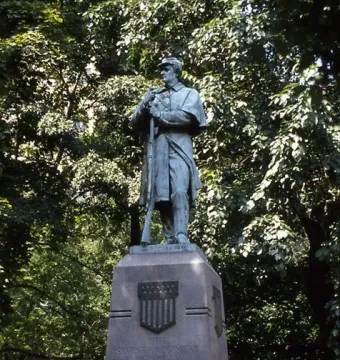
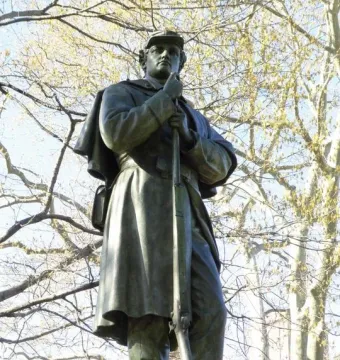
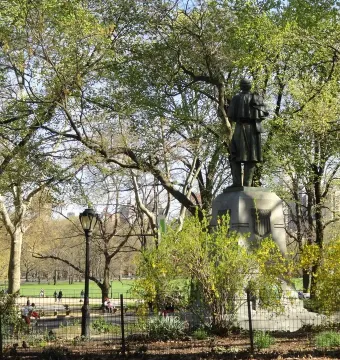
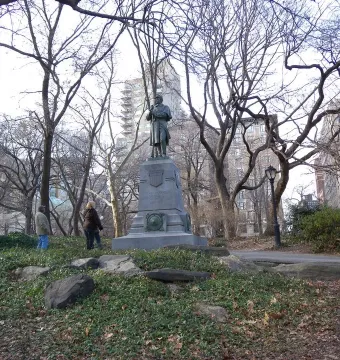
The Seventh Regiment Memorial is an outdoor bronze sculpture in Central Park in New York City, United States. It is dedicated to the members of the Seventh Regiment who died during the American Civil War. The statue was designed by John Quincy Adams Ward, and the base was designed by Richard Morris Hunt. Although the statue dates to 1869, the monument was not unveiled until June 22, 1874. The soldier depicted in the work was modeled on the actor and veteran Steele MacKaye, who posed in his own uniform.
© User:Carptrash · CC BY-SA 3.0
April 2012 © Daderot · CC0
April 2012 © Daderot · CC0
December 2009 © Jim.henderson · CC0
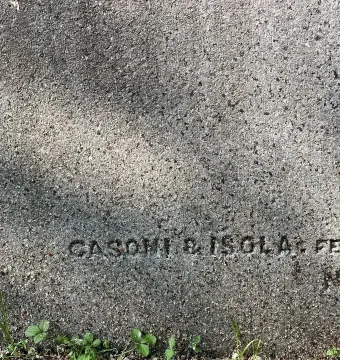
© Rosebudd56 · CC0
Identification | |
| Title | Seventh Regiment Memorial |
| Type | Outdoor sculpture |
| Alternative name | Seventh Regiment Memorial (in English) |
Historical context | |
| Model completion | By spring 1868 |
| Unveiling date | June 22, 1874 |
| Date on statue | 1869 |
| Broader unbuilt scheme | A series of Beaux-Arts entrances to Central Park |
| Original intended design | A much larger monument with at least five figures, part of Hunt's 'Warrior Gate' entrance scheme for Central Park |
| Reduced design | The original grand scheme was reduced to the present monument after conflicts with Frederick Law Olmsted and Calvert Vaux over aesthetic matters |
| Dedicated to | Members of the Seventh Regiment who died during the American Civil War |
| Commission date | Probably 1867 |
| Commissioned by | The Seventh Regiment Monument Association |
Creator | |
| Model for the soldier figure | Steele MacKaye, actor and veteran of the regiment |
| Pose reference | MacKaye posed in his own uniform |
| Base designer | Richard Morris Hunt |
| Architect | Richard Morris Hunt |
| Sculptor | John Quincy Adams Ward |
Physical characteristics | |
| Location of sculpture | Atop a granite base |
| Figure represented | A soldier |
| Base material | Granite |
| Material | Bronze |
Location and ownership | |
| Location | Central Park, New York City, New York, United States |
Iconography and meaning | |
| Subject | Members of the Seventh Regiment who died during the Civil War |
Significance | |
| Art-historical assessment | E. Wayne Craven considered the work a failure, but also regarded it as a work of art |
| Craven's interpretation of the failure | He argued that neither the 'Shakespeare' nor the 'Seventh Regiment Soldier' were portrait statues in the usual sense, and that this explained their failures |
| Craven's assessment of Ward's ability | Ward often lacked the vision to create a successful imaginary portrait, but his images of men who could actually stand before him were usually stronger as works of art |