
Soldiers' and Sailors' Monument
Soldiers' and Sailors' Monument is a major Civil War memorial in Cleveland, Ohio, honoring more than 9,000 people from Cuyahoga County who served the Union during the war. It was dedicated on July 4, 1894, and stands in the southeast quadrant of Public Square in downtown Cleveland. The monument was designed by architect and Civil War veteran Levi Scofield, who also created its sculptures. It is regularly open to the public free of charge.
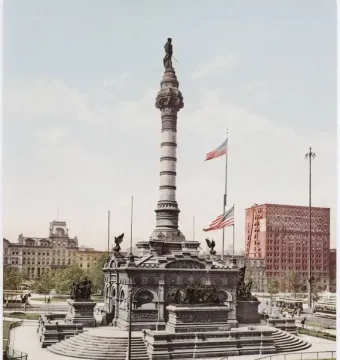
© Unknown authorUnknown author · Public domain
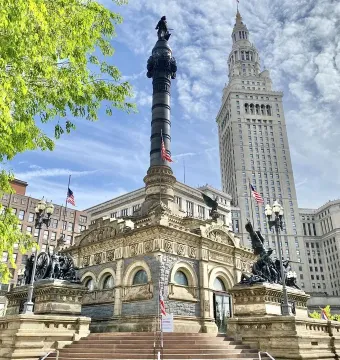
© Warren LeMay · CC BY-SA 2.0
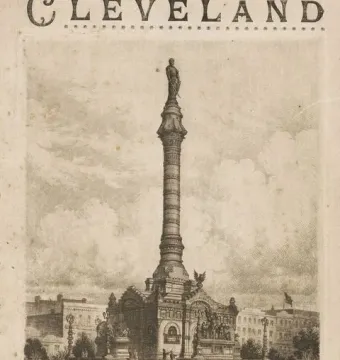
1890 © Mansell, Hunt, Catty, & co., ld., London · Public domain
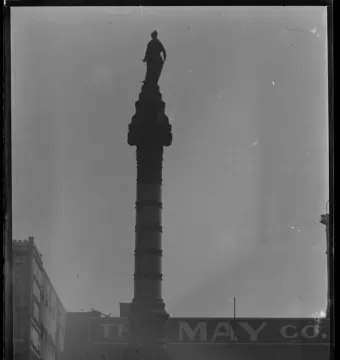
1901 © Ketteringham, George H., 1876-1954 · Public domain
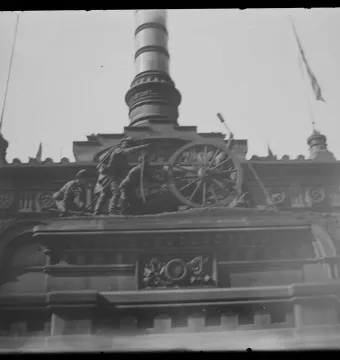
1901 © Ketteringham, George H., 1876-1954 · Public domain
Identification | |
| Title | Soldiers' and Sailors' Monument |
| Type | Civil War monument and architectural sculpture |
| Official name | Cuyahoga County Soldiers' and Sailors' Monument |
Historical context | |
| Funding authorization | April 2, 1880, when Ohio law authorized Cuyahoga County commissioners to levy a tax to erect a memorial monument or tombstone and acquire a suitable site |
| Design decision | 1886 |
| Construction authority | Granted in April 1888 by Ohio House Bill 462, creating a 12-member Board of Monument Commissioners for Cuyahoga County |
| Veterans' convention | Held on October 30, 1879, with about 1,200 attendees who elected a seven-member committee to seek funding from the Ohio General Assembly |
| Planning began | October 22, 1879 |
| Dedicated to | Union soldiers and sailors from Cuyahoga County who served in the American Civil War, especially those killed in battle or who died from wounds or disease contracted in service |
Creator | |
| Designer | Levi T. Scofield |
| Designer background | Architect and Civil War veteran |
| Other creator | Elizabeth Scofield compiled the names of the veterans honored on the tablets |
Discovery and provenance | |
| Site selection | Initially proposed for the intersection of Ontario Street and Superior Avenue in Public Square; the selected site was the southeast quadrant at the end of Euclid Avenue |
| Alternative proposed sites | Lake View Cemetery, Wade Park, and the corner of Erie and Summit Streets (roughly the present location of Willard Park) |
| Legal dispute over site | The City of Cleveland and the Public Square park commissioners resisted construction in the southeast quadrant; the monument commission sued on April 15, 1891, and Gleason et al. v. Cleveland was decided on June 21, 1892 in favor of the commission |
| Legal effect | The Ohio Supreme Court ruled that the Monument Commission had authority to begin construction on the southeast quadrant without city permission |
Physical characteristics | |
| Central shaft height | 38.1 m |
| Design concept | A unique combination of a memorial tablet hall and an obelisk |
| Style | Late 19th-century architecture with traditional architectural elements infused with militaristic imagery and symbolism |
| Location | Southeast quadrant of Public Square, downtown Cleveland, Cleveland, Ohio, United States |
Materials | |
| Central shaft material | Quincy granite |
| Plaza material | Red Medina sandstone |
| Statue group pedestals | Berea sandstone |
| Main materials | Marble memorial tablets and Amherst sandstone |
Appearance | |
| Support details | Upturned cannons beneath the arched windows; column edges depicted as ramrods with capitals fashioned from ammunition pouches |
| Statue group theme | Scenes showing the four branches of the armed forces at the time of the Civil War |
| Statue groups | Four bronze groups on the upper esplanade: Mortar Practice, At Short Range, The Color Guard, and The Advanced Guard |
| Garden designs | Original flowerbeds were decorated with corps insignia and other military imagery; north and west beds still include corps insignia, while south and east beds now include a GAR badge, a patriotic swoosh, and an anchor |
| Mid-shaft inscriptions | Bands inscribed with the names of major battles of the American Civil War |
| Top decoration | Carved stone corps badge emblems along the top of the structure |
| Door ornaments | Large bronze eagles above the north and south doors |
| Corner flagpoles | Four flagpoles at the corners of the structure, decorated to resemble stacked cannonballs |
| Shaft capital | Features militaristic imagery |
| Crowning figure | Personification of Liberty in a military frock coat, holding a sword and shield, facing north |
Iconography and meaning | |
| The Advanced Guard | Honors the Cavalry; shows a Union detachment encountering enemy troops, including a trooper on a wounded horse firing his pistol at close range, another soldier aiming his carbine southward, and a bugler calling for help |
| The Color Guard | Honors the Infantry; depicts the Battle of Resaca, Georgia; it is the only group representing a known battle; Scofield chose to depict his regiment there as a memorial to his regiment and the men lost in the battle; all figures are dead or wounded; the battle was largely a Union defeat |
| At Short Range | Honors the Artillery; shows an officer trying to aim a cannon while two of his men have fallen |
| Mortar Practice | Honors the Navy; shows an officer and five men loading a mortar near Island No. 10 on the Mississippi River in preparation for bombardment; no casualties are depicted |
Location and ownership | |
| Public access note | Regularly open to the public free of charge |
| USGS marker | Installed on the northwest side of the esplanade, probably around the turn of the century, at 668 feet above sea level |
| Public access | Free to visit; about 40,000 visitors pass through the tablet hall each year |
History and restoration | |
| 2017 filming | American Ninja Warrior was filmed on the redesigned Public Square just outside the monument |
| 2016 demonstrations | The monument and Public Square were the site of numerous demonstrations during the 2016 Republican National Convention |
| Public Square renovation | A $32 million renovation of Public Square began in March 2015 and was completed on June 30, 2016, significantly changing the area around the monument and restoring the four-quadrant New England-style layout originally drawn by Moses Cleaveland in 1796 |
| Names added | On June 19, 2019, 107 members of the United States Colored Troops were officially added after more than a decade of research |
| Omitted names discovered | In 2011, researchers found that the names of 140 Black soldiers from the area had been omitted from the tablets |
| Reopening | Reopened in December 2009 and officially rededicated on June 5, 2010 |
| Restoration assistance | The Cleveland Museum of Art and the Cleveland Museum of Natural History helped restore the original interior coloring |
| Restoration leadership | Directed by Monument Commission President Neil K. Evans |
| Restoration funding | Federal, state, and county sources, plus local corporations, foundations, businesses, veterans' groups, and private individuals |
| Restoration cost | About $2 million |
| Restoration proposal | In 2006, Cuyahoga County commissioners recommended a modest $1 million restoration |
| Trustee | Berj Shakarian became a monument trustee in 2011 |
| 1988 redesign | Berj Shakarian led an extensive redesign of the southeast quadrant, changing the layout and position of the gardens |
| Repair estimate | In 1983, county architect Berj Shakarian estimated structural repairs would cost more than $150,000; later estimates rose to more than $512,000 |
| Construction start | Spring 1893 |
| Controversy period | The monument faced stylistic and ideological criticism in the 1960s and 1970s and was the site of Vietnam War protests and demonstrations |
| Construction period | Throughout 1893 |
| Construction cost | Over $272,800 at completion, equivalent to more than $7 million today |
| Plaques production | The marble plaques for the memorial hall began production in the second half of 1891 |
| Removal of Perry statue | On December 2, 1892, Scofield supervised the removal of the Commodore Oliver Hazard Perry Monument from the site; it was relocated to Wade Park |
| Water pipe relocation | Completed in spring 1893 in four days for $1,248.68 |
| Dedication date | July 4, 1894 |
| Dedication ceremony | Included a hundred-gun salute, speeches, and a large patriotic gathering despite rain |
| Dedication speakers | Former Ohio governor Joseph Foraker and Ohio governor William McKinley |
| Early public role | A focal point for Cleveland's 1896 centennial celebration and the 1901 Grand Army of the Republic National Encampment |
| Mourning display | The monument and much of downtown Cleveland were draped in dark fabric after President McKinley's assassination in 1901 |
| Cleaning and preservation | Proposed for relocation in 1930; first cleaned in 1932; formally cleaned again in 1946 |
| 1959 alteration | An acid cleaning stripped the original painted interior colors, leaving the interior seriously altered for more than half a century |
| 1982 damage | Demolition of the nearby Cuyahoga and Williamson Buildings covered the monument and its statues in dust |
Significance | |
| Centennial celebration | Celebrated on July 2, 1994, with historian James McPherson speaking and Governor George V. Voinovich attending |
| 125th anniversary | Celebrated on July 4, 2019, with opening remarks by Major General John C. Harris Jr., adjutant general of the Ohio Army National Guard |