
Sacred Cod of Massachusetts
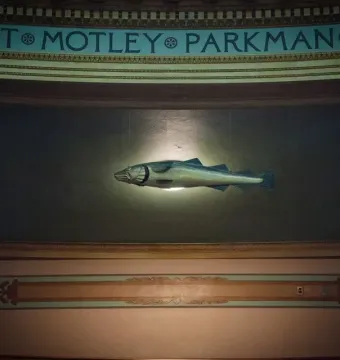
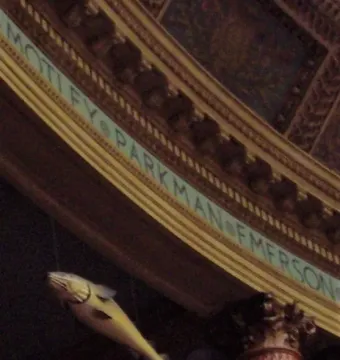
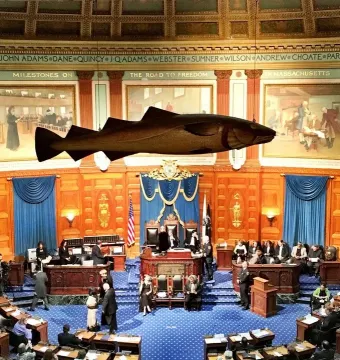
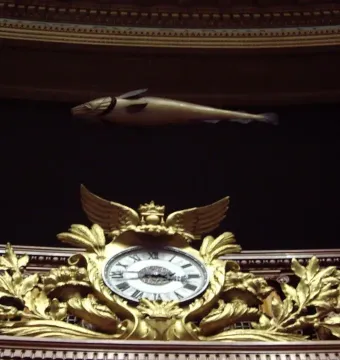
The Sacred Cod of Massachusetts is a carved-wood effigy of an Atlantic codfish, painted to look lifelike and hanging in the House of Representatives chamber of the Boston State House. It was described as a memorial to the importance of the cod fishery to the welfare of Massachusetts, where the cod is the historic and continuing symbol. The object has had as many as three versions over three centuries: an early one was lost in a 1747 fire, a second disappeared during the American Revolution, and the third, installed in 1784, is still displayed today. The nickname “Sacred Cod” appeared in 1895 and later came to refer to codfish more broadly. The carving was briefly stolen in 1933 and again in 1968.
December 2011 © Eric Haynes for the Office of the Governor of Massachusetts · Public domain
January 2013 © Found5dollar · CC BY-SA 3.0
December 2017 © Liberma · CC BY-SA 4.0
January 2013 © Found5dollar · CC BY-SA 3.0

January 2013 © Eric Haynes for the Office of the Governor of Massachusetts · Public domain
Identification | |
| Title | Sacred Cod of Massachusetts |
| Role | Emblem of the Commonwealth of Massachusetts |
| Original-language title | La Morue sacrée |
| Subject | Atlantic cod |
| Type | Wooden codfish sculpture and emblem |
Historical context | |
| Versions | Three successive versions, with the first possibly legendary, the second lost during the American Revolution, and the third installed in 1784 |
| First version | Its existence is uncertain; if it existed, it was lost in the 1747 fire at Boston's Old State House |
| Second version | Created sometime between 1748 and 1773 and disappeared during the American Revolution |
Creator | |
| Second version attribution | Attributed by the 1895 committee to John Welch, though the attribution is uncertain |
| Third version creator | Unknown |
| Third version donor | John Rowe, Boston merchant |
History and restoration | |
| 1933 recovery | Recovered in the early hours of April 29, 1933 in West Roxbury woods and returned to the House the same day |
| 1968 theft | Stolen on November 14, 1968 by students from the University of Massachusetts Boston as a protest against the legislature |
| 1933 repair | Three damaged fins were repaired before reinstallation |
| 1933 theft aftermath | The theft caused public alarm, extensive police searches, and widespread news coverage |
| Repainting | Painted by Walter M. Brackett in 1894 and repainted again in 1965 |
| 1933 theft | Stolen on the evening of April 26, 1933 by members of the Harvard Lampoon in an event later called the 'Cod-napping' or the 'Great Cod Heist' |
| Security change after 1933 theft | Rehung higher than before, beyond the reach of an individual |
| Display method | Hung from wires |
| Orientation change | After the 1965 repainting it was at least temporarily rehung in the opposite direction |
| 1968 recovery | Found three days later behind one of the doors of the House of Representatives |
| 1895 research | The committee spent nearly two months researching the sculpture and concluded there had been at least two, and possibly three, successive incarnations |
| Movement history | Moved in 1798 to the new State House, then in 1850s to the back of the House chamber, and in 1895 to the new House chamber |
| World War II incident | In 1941 aluminum-drive officials mistakenly thought the sculpture was made of aluminum and asked for it to be donated to the war effort; Speaker Christian Herter replied that it predated aluminum and suggested the Senate's Holy Mackerel instead |
| 1895 committee | Committee on History of the Emblem of the Codfish, appointed by the Massachusetts House of Representatives |
| Current status | Extant and displayed today in the Massachusetts House of Representatives chamber in the Massachusetts State House, Boston |
| Earlier placement | Originally hung over the Speaker's desk in the old House chamber; moved to the rear of the chamber in the 1850s |
| House installation | Installed in the Massachusetts House of Representatives chamber on January 2, 1895 after being moved from the old chamber |
| Donation date | Later in 1784 |
| Third version date | 1784 |
Location and ownership | |
| Current placement | Suspended between the two sets of central columns, under the names 'Motley' and 'Parkman', above the chamber clock |
| Current location | Massachusetts House of Representatives chamber, Massachusetts State House, Boston, Massachusetts, USA |
| Orientation | Faces north, or leftward as seen from the Speaker's rostrum |
Physical characteristics | |
| Appearance | A carved codfish figure; painted to look lifelike |
| Height | About 1.5 meters (4 feet 11 inches) |
Materials | |
| Material | Single piece of pine wood |
Technique | |
| Finish | Painted naturalistically; later repainted in 1894 and 1965 |
Iconography and meaning | |
| Title meaning | The title refers to the cod as a sacred or symbolically important fish |
| Symbolism | Represents the historical importance of fishing to Massachusetts and New England |
| Cultural significance | A longstanding New England symbol closely associated with Massachusetts and Boston |
| Meaning | Memorial of the importance of the cod fishery to the welfare and economy of Massachusetts |
Significance | |
| Geographic association | Massachusetts, especially coastal areas including Gloucester, Boston, Cape Cod, Plymouth, and Salem, and the wider New England region |
| Social term | The term 'cod aristocracy' referred to wealthy merchant families whose fortunes came from the cod trade |
| Symbolic usage | Cod imagery appeared on coins, stamps, seals, crests, weather vanes, and other emblems in colonial and later Massachusetts and New England |
| Associated industries | Supported salt mining, ice harvesting, and shipbuilding |
| Export importance | Described in an 1895 report as the region's leading export source |
| Trade importance | Used as a medium of exchange in early commercial transactions and in trade for European goods and West Indies rum and molasses |
| Historical significance | Codfishing was a major early industry in Massachusetts and the cod became tied to the state's economy, trade, and identity |
| State symbol designation | Chosen as one of the official symbols of Massachusetts in 1974 |
| Official significance | Massachusetts officially regards cod as a historic and continuing symbol |
Other | |
| Related sculpture | A brass casting called the Holy Mackerel is displayed in the State House Senate chamber above the central chandelier |