
Saint Andrew
Saint Andrew is a marble statue by the Flemish sculptor François Duquesnoy, created between 1629 and 1633. It is located in one of the niches of St. Peter's Basilica in Vatican City, Rome. The monumental figure depicts Andrew the Apostle leaning on the crux decussata of his martyrdom. Duquesnoy's Saint Andrew is one of the four colossal statues beneath the dome of St. Peter's and faces Bernini's less restrained Saint Longinus. The four colossi were installed in the niches within the four piers supporting the dome between 1639 and 1640.
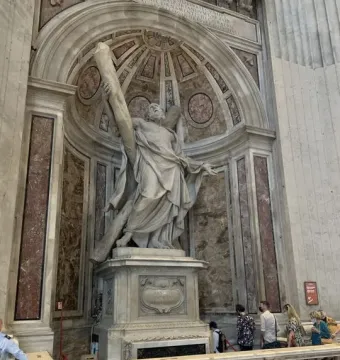
August 2021 © Chabe01 · CC BY-SA 4.0
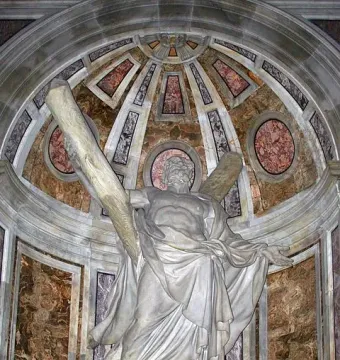
September 2011 © Jean-Pol GRANDMONT · CC BY 3.0
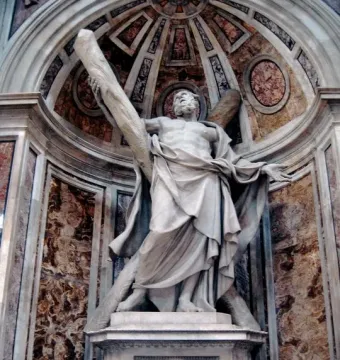
© Use the force · Public domain
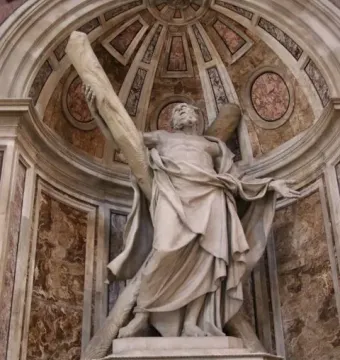
August 2019 © Gary Todd · Public domain
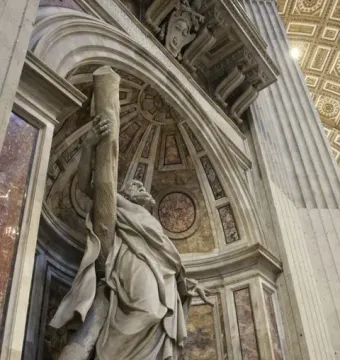
June 2025 © Álvaro de la Paz Franco · CC0
Identification | |
| Title | Saint Andrew |
| Type | Statue |
| Subject | Andrew the Apostle |
| Original title | Sant'Andrea |
Creator | |
| Artist | François Duquesnoy |
| Artist nationality | Flemish |
Historical context | |
| Redesign date | 1631 |
| Approval body | Congregation of the Fabric of St. Peter |
| Approval date | May 1628 |
| Date of creation | 1629–1633 |
Discovery and provenance | |
| Commissioning context | Possibly recommended to the confraternity overseeing works at Santa Maria di Loreto by Cardinal Biscia after he admired the life-size model of Saint Andrew |
| Related work | Saint Susanna |
| Presentation of model | A life-size stucco model was unveiled in its intended niche on 19 December 1629 before the pope and attending cardinals |
| Cardinal present | Cardinal Biscia, cardinal protector of the confraternity of the bakers |
| Basis for commission hypothesis | Existing documentary evidence |
| Attribution history | Earlier biographers and some 20th-century scholars thought a model by Duquesnoy was approved in May 1628, but modern scholars reject that; Irving Lavin (1968) stated that the pope chose Bernini's model for Saint Andrew |
| Commission sequence | Whether Saint Andrew was commissioned before Saint Susanna is disputed; modern scholars tend to think it was, based on documents, but the question is unresolved |
| Rubens letter | Peter Paul Rubens referred to the fame of Saint Andrew but did not mention Saint Susanna |
Physical characteristics | |
| Scale | Larger-than-life; one of the four colossal statues beneath the dome of St. Peter's Basilica |
Materials | |
| Material | Marble |
| Preparatory model material | Stucco |
Technique | |
| Style | Baroque with Duquesnoy's maniera greca, described as an almost direct reference to ancient sculpture |
| Model type | Life-size stucco model |
Appearance | |
| Anatomy | Broad, muscular torso, compared to the Laocoön |
| Drapery | Still, motionless drapery |
| Pose | The saint stands leaning on the crux decussata (saltire cross) of his martyrdom |
Iconography and meaning | |
| Iconography | Saint Andrew is shown with the crux decussata of his martyrdom |
| Interpretation | The sculpture's meaning is interpreted as shifting from Saint Andrew's adoration of the resurrected Christ to his emulation of the Crucifixion |
| Original design | Bernini's original plan set Saint Andrew and Saint Longinus in contrasting postures of adoration, looking toward the resurrected Christ originally planned above the Baldachin |
| Redesign | In 1631 the resurrected Christ was replaced by the globe and cross of the Baldachin |
Location and ownership | |
| Current location | One of the niches in the four piers supporting the dome of St. Peter's Basilica, Vatican City, Rome |
| Relative placement | Faces Bernini's Saint Longinus |
| Part of | The four colossal statues in St. Peter's Basilica approved by the Congregation of the Fabric of St. Peter in May 1628 |
History and restoration | |
| Payments | Installment payments were interrupted in summer 1633; final marble blocks were received in April 1633; payments were made in April and May 1633, stopped until March 1634, then continued monthly for several years |
| Completion assistance | Duquesnoy completed Saint Andrew with help from Vincenzo Giustiniani, who advanced him 300 scudi for a Virgin sculpture he had commissioned |
| Delay explanation | According to Sandrart, payments were delayed by intrigues against Duquesnoy, leaving him desperate |
Reception | |
| Reception | At its inauguration, the statue was closely scrutinized by critics and other artists at St. Peter's and was well received |