
Rock on Top of Another Rock
Rock on Top of Another Rock is a sculpture by Peter Fischli and David Weiss. It was shown outside the Serpentine Gallery in Kensington Gardens in 2013 and consists of one large rock balanced on top of another. An earlier version of the work was installed on the Valdresflya plateau as part of Norway’s 18 scenic routes. The first incarnation was commissioned by the Norwegian Public Roads Administration, which asked artists to create works for each route. For the London installation, the two granite boulders were natural glacial deposits from northern Wales, each weighing nearly 30 tons. Their exact shapes were mapped with LiDAR and 3D models were used to find a stable balance. The London display was temporary and was planned to move to Doha after a year.
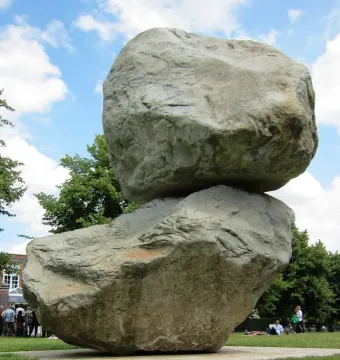
June 2014 © Andrew Davidson · CC BY-SA 3.0
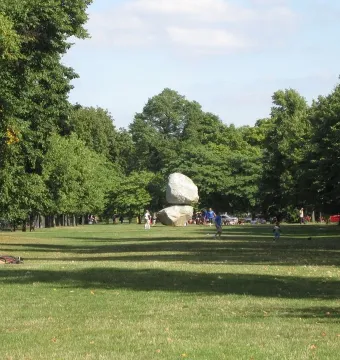
August 2013 © Mark L MacDonald · CC BY-SA 3.0
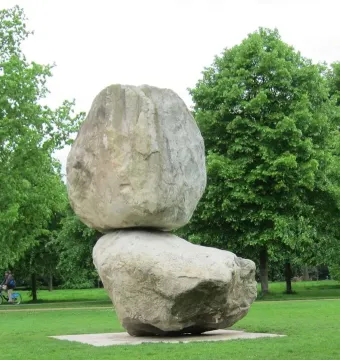
© User:Andrew Davidson · CC BY-SA 3.0
Identification | |
| Title | Rock on Top of Another Rock |
| Original-language title | Roca Encima de Otra Roca |
| Type | Sculpture |
Creator | |
| Artists | Peter Fischli and David Weiss |
Historical context | |
| Associated exhibition | Equilibres/Quiet Afternoon / Equilibrios / Tarde Tranquila |
| Earlier incarnation | A similar sculpture on the Valdresflya plateau, one of the artworks installed on Norway's eighteen scenic routes |
| Commission context | Commissioned for the administration's 18 tourist routes |
| Commissioned by | Norwegian Public Roads Administration |
| Date | 2013 |
Location and ownership | |
| Installation status | Temporary installation in London, planned to move to Doha after one year |
| Relation to nearby structure | The London exhibition complemented the new Serpentine Pavilion by Smiljan Radic, which also features large rocks |
| Exhibited location | Outside the Serpentine Gallery in Kensington Gardens, London |
Physical characteristics | |
| Number of boulders | Two |
| Description of stones | Natural glacial erratic rocks |
| Stone origin | North Wales |
| Weight of each boulder | Almost 30 tonnes each |
| Material | Granite |
| Composition | Two large rocks balanced one on top of the other |
Technique | |
| Surveying method | The exact shape of the rocks was mapped using LiDAR |
| Digital modeling | 3D models were built to determine a position in which the rocks would balance without assistance |
History and restoration | |
| Exhibition status | Still on display at the gallery |
| London exhibition end date | September 2014 |
| First installation method | The lower rock was already in place, and a real crane was used to place the second rock on top |
| Technical direction | Directed by Alice Blair of Arup |
Iconography and meaning | |
| Visual reference used in proposal | An image of a Playmobil toy crane lifting a large rock |
| Stylistic reference | A cairn-like monument, but on a grand, monumental scale |
| Artist statement about the work | In Norway and here, placing one rock on top of another in the wilderness is the first thing you do if you want to make a mark; when you walk and want to find your way back, you make this mark |
| Description of the gesture | A very archaic, simple thing |
| Reference / allusion | The Venturi duck |
| Artist intention | To make something that would force people to stop their car and get out to take a photograph |
| Motto | "Am schönsten ist das Gleichgewicht, kurz bevor's zusammenbricht" — "Balance is most beautiful just before it collapses." |
| Initial concept | Placing one large rock on top of another large rock |
Significance | |
| Hans-Ulrich Obrist's view | He saw it as a meeting point where people could gather under the rocks and talk about the work |
| Critical praise | John Costella praised its sheer dynamics of size and balance |