
Niobid from the Gardens of Sallust
Niobid from the Gardens of Sallust, also known as the Wounded Niobid, is a Greek marble sculpture 149 cm high. It was discovered in 1906 in the Horti Sallustiani, in a cubiculum 11 meters below ground, perhaps hidden there for protection during barbarian invasions. The figure shows one of Niobe’s daughters falling to the ground after being struck by an arrow lodged between her shoulder blades, which she vainly tries to remove. The work is kept in the National Roman Museum, at Palazzo Massimo alle Terme in Rome. It is considered an original work attributable to the 4th century BC and is linked to Greek sculptures transferred to Rome in antiquity.
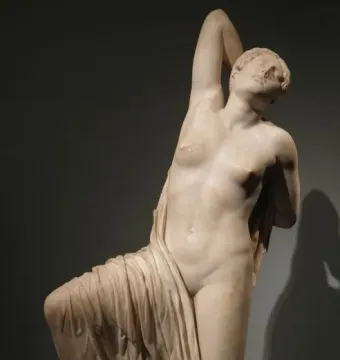
February 2013 © Carole Raddato · CC BY-SA 2.0
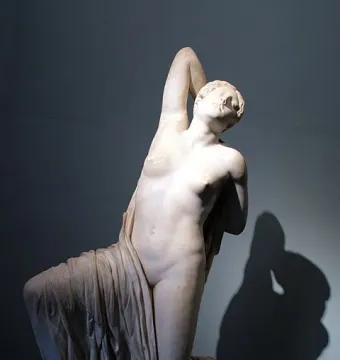
October 2011 © Jean-Pol GRANDMONT · CC BY 4.0
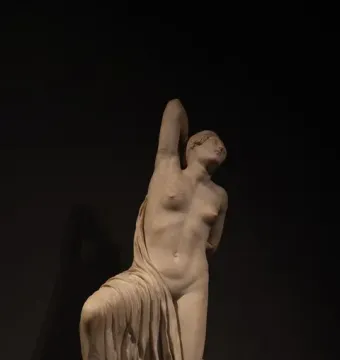
November 2024 © Fabrizio Garrisi · CC0
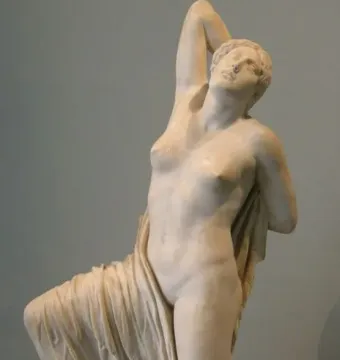
· CC BY-SA 3.0
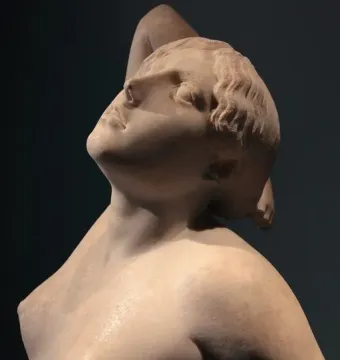
April 2012 © Stephen Hardisty · CC BY-SA 4.0
Identification | |
| Title | Niobid from the Gardens of Sallust |
| Alternative names | Niobid of the Horti Sallustiani; Wounded Niobid; La Niobide degli Horti Sallustiani |
| Type | Statue |
Historical context | |
| Date | 5th century BC (attributed) |
| Original status | Original work |
Creator | |
| Attribution basis | Considered part of, or at least analogous to, the figures from the pediment of the Temple of Apollo at Eretria |
| Historical transfer from Greece | Probably from a group transferred to Rome by order of Augustus from the Temple of Apollo at Eretria |
Discovery and provenance | |
| Discovery location | Gardens of Sallust (Horti Sallustiani), Rome; also described as found in Via Sallustio, Rome |
| Discovery date | 1906 |
| Discovery context | Found during excavations in a cubiculum about 11 meters below ground level |
| Possible concealment history | May have been hidden to protect it from destructive barbarian invasions in the 5th century AD |
| Provenance hypothesis | Likely one of many works brought to Rome from Greece as war booty |
| Related works | Probably shares the same origin as the Dying Niobid and the Running Niobid in the Ny Carlsberg Glyptotek, Copenhagen |
| Comparison and distinction | Not comparable to the Niobe in the Uffizi Gallery, which is a copy of a Hellenistic original found in Rome in 1582 in the garden of Villa Medici and later taken to the Uffizi |
Physical characteristics | |
| Height | 149 cm |
Materials | |
| Material | Marble |
Appearance | |
| Subject | One of the daughters of Niobe (a Niobid) |
| Pose / action | Falling to the ground after being wounded by an arrow lodged between her shoulder blades, trying in vain to remove it |
Iconography and meaning | |
| Mythological context | The scene refers to the myth in which Apollo or Artemis shot the arrow to avenge Leto after Niobe mocked her for having only two children while boasting of her own fertility and twelve children; by Leto's order, all the Niobids were killed by Apollo and Artemis |
Location and ownership | |
| Current location | National Roman Museum, Palazzo Massimo delle Terme, Rome, Italy |
History and restoration | |
| Recovery and legal history | Found on building land purchased by Banca Commerciale Italiana; after the bank took possession, Francesco Di Carlo reported that the sculpture was being organized for transfer to Germany |
| Legal action | Judge Mauro Del Giudice ordered the seizure of the sculpture and appointed Rome’s mayor, Ernesto Nathan, as judicial custodian |
| Transport incident | The planned shipment was stopped at Milan station |
| Public controversy | The bank’s allied press campaign claimed the seizure had been ordered by a southern, regionalist judge to offend Milan’s dignity and sow discord with Rome |
| Public reaction to Ernesto Nathan | When he went to Milan to take custody of the statue, Nathan was met by a hostile crowd that whistled at him and threw snowballs |
| Political reaction | Filippo Turati sharply attacked Del Giudice during a Milan municipal council meeting |
| Defense of Del Giudice | Filomusi Guelfi, a scholar at the Roman university, defended Del Giudice in a letter to Giornale d'Italia |
| Municipal support | The Rome city council approved the handling of the operation |
| Outcome of seizure | Del Giudice said the seizure prevented the clandestine transfer of a valuable work of art from Italy to Germany |
Significance | |
| Art-historical significance | Imported Greek works played an important role in the evolution of taste and style in Roman artistic production |