
Sultanganj Buddha
The Sultanganj Buddha is a Gupta–Pala transitional period sculpture and the largest substantially complete copper Buddha figure known from the time. It is dated to between 500 and 700 AD and measures 2.3 m high and 1 m wide, weighing over 500 kg. Found in Sultanganj, Bhagalpur district, Bihar, in 1861 during railway construction, it is now held by the Birmingham Museum and Art Gallery in Birmingham, England. Its style is linked to earlier Sarnath stone Buddhas, with smoothly rounded forms, a very thin clinging garment, and an animated stance created by its sweeping silhouette.
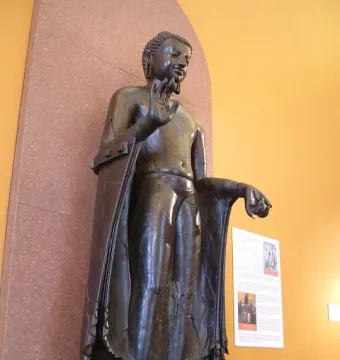
November 2009 © Taken by Kaptain Kobold · Public domain
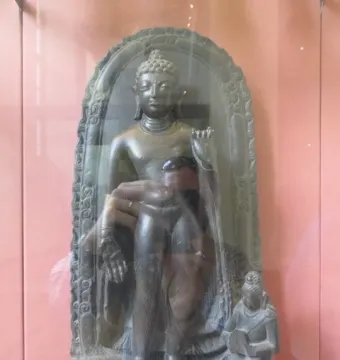
June 2014 © Jononmac46 · CC BY-SA 3.0
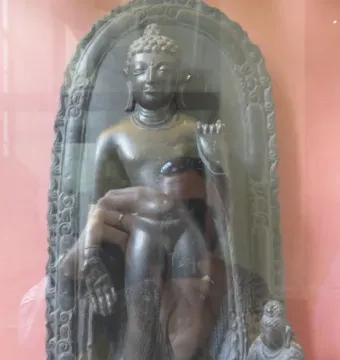
June 2014 © Jononmac46 · CC BY-SA 3.0
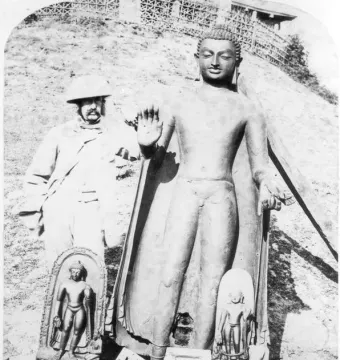
1861 © Photographer unknown 1861/1862 · Public domain
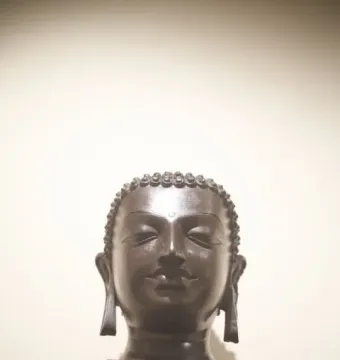
October 2024 © Lukas Large · CC BY-SA 2.0
Identification | |
| Title | Sultanganj Buddha |
| Type | Standing Buddha statue |
Historical context | |
| Period | Gupta–Pala transitional period |
| Date | c. 500–700 AD, with alternative datings ranging from around 400 to as late as 800; radiocarbon dating gives 600–650 |
Creator | |
| Discovered by | E. B. Harris, a British railway engineer |
Discovery and provenance | |
| Transport to England | 1863 |
| Museum acquisition | Acquired by Birmingham Museum and Art Gallery in 1864 as a foundation donation |
| Donation to Birmingham | Offered to the Borough Council for their proposed Art Museum in 1864 |
| Transport sponsor | Samuel Thornton, Birmingham manufacturer of ironmongery and former mayor of Birmingham, paid the transport costs |
| Original placement | Apparently deliberately buried in a pit or beneath a floor within the remains of a Buddhist monastery complex, perhaps after being toppled from its former place |
| Associated smaller finds | Two much smaller standing stone Buddhas, now in the British Museum and the Asian Art Museum of San Francisco, and a stone Buddha head now in the Victoria and Albert Museum, London |
| Depth found | About 3 meters below the surface; the right foot was found ten feet under the surface |
| Discovery context | Found during earthworks/excavations for the East Indian Railway station and railway construction |
| Discovery location | Near Sultanganj station, Sultanganj, Bhagalpur district, Bihar, East India |
| Discovery date | 1861 or 1862 |
| Associated report | E. B. Harris published a detailed account of the discovery with a site plan and photographs |
Location and ownership | |
| Current location | Birmingham Museum and Art Gallery, Birmingham, England |
| Current display context | Displayed in a new gallery at Birmingham Museum and Art Gallery on the theme of the range of faiths practiced in Birmingham, together with other Buddhist art and loans from other British museums |
| Religious use | Used for religious ceremonies; regular Vesak celebrations have been held in its presence since the early 2000s in cooperation with the museum |
Physical characteristics | |
| Height | About 2.3 m |
| Structure | Hollow figure |
| Scale | Colossal, over life-size |
| Weight | Over 500 kg |
| Width | About 1 m |
Materials | |
| Material | Copper; described in some sources as pure, unrefined copper and more generally as metal |
| Inner core | Clay core with rice husks and other organic inclusions |
Technique | |
| Casting technique | Hollow-cast lost-wax (cire perdue) technique |
| Scientific dating method | Radiocarbon dating and thermoluminescence dating of the clay core with organic inclusions |
Appearance | |
| Body treatment | Smoothly rounded attenuation of the body and limbs |
| Original surface appearance | Probably bright, light, gold-like metal over the whole surface except the hair, achieved by intensive polishing after casting |
| Surface appearance | Dark metal surface with a black encrustation of fine clay minerals over much of the surface; the fingertips of the proper left hand are brightly polished and light, gold-like in colour from visitor contact |
| Robe handling | The end of the monastic robe is held between the thumb and forefinger of the left hand |
| Robe | Thin monastic robe clinging closely to the body and following its shape in flowing lines |
| Left hand gesture | Varada mudra, with the left hand lowered and palm outward |
| Depicted figure | Buddha |
| Pose | Standing, in the 'Fearless Posture' |
| Hair | Hair knot depicted |
| Right hand gesture | Abhaya mudra, with the right hand raised |
| Facial expression | Calm face with a lowered gaze |
| Earlobes | Elongated |
Iconography and meaning | |
| Hand gesture meaning | The left-hand gesture is said to indicate granting a favour |
| Interpretation of original brilliance | Linked to early Buddhist scriptural references to the radiance and colour of the Buddha's body; other Buddha images were gilded |
History and restoration | |
| Burial interpretation | Modern interpretations suggest it was hidden during a period of religious threat to protect it from destruction |
| Surface alteration | Long exposure to atmospheric agents and burial caused the black encrustation |
| Visitor wear | Museum visitors touched the fingers of the proper left hand, wearing away the coating |
| Display history | Displayed in different prominent locations in Birmingham Museum and Art Gallery; since 1998 it has had its own gallery |
| Post-casting work | Various repairs were carried out to complete and perhaps maintain the statue; a secondary casting was executed at a rather lower level of skill |
Significance | |
| Stylistic features | Its animation is created by the unbalanced stance and the sweeping silhouette of the enveloping robe |
| Technical challenge | The statue's sheer size meant the workshop worked at the limit of its technical capabilities |
| Collection history | One of the earliest objects in the newly emerging municipal museum collections and one of the central collection objects since the 19th century |
| Stylistic comparison | Comparable to slightly earlier stone Buddha figures from Sarnath |
| Related comparable object | A copper Buddha in Guita Bahī monastery, Lalitpur, Nepal, about 1.8 metres tall, of Nepali make and style, dating to about the 9th or 10th century |
| Comparative notes | The metal Brahma from Mirpur-Khas is older but about half the size; the Jain Akota bronzes and similar finds are much smaller, probably household shrine figures for well-off homes |
| Museum significance | One of Birmingham Museum and Art Gallery's most treasured, visually distinctive, and central collection objects; it is the only object in the museum permanently used for religious ceremonies |
| Significance | The largest surviving copper statue of a standing Buddha from the Gupta–Pala transition period and one of the best-known examples of early medieval Indian metal art in Europe |
Other | |
| Restitution status | No official restitution request has been made so far |