
Cristo Yacente of El Pardo
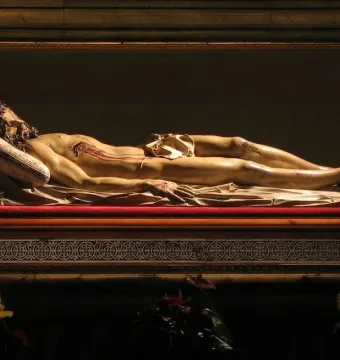
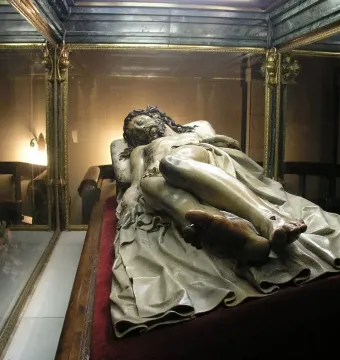
Cristo Yacente of El Pardo is a life-size polychromed sculpture by the Spanish artist Gregorio Fernández, executed between 1614 and 1615. It was commissioned by King Philip III to celebrate the birth of his son, Philip IV. The sculpture is housed in a chapel of the Capuchin Monastery of El Pardo in Madrid. It is the most famous of the fourteen Christ figures produced by Fernández and his workshop. Like other devotional images of the period, it was created to be used in Holy Week processions and reflects Counter-Reformation ideals that sought realism to move the faithful.
April 2016 © Hontañon3 · CC BY-SA 4.0
© Xauxa · CC BY 2.5
© Xauxa · CC BY 2.5
April 2018 © Zarateman · CC0
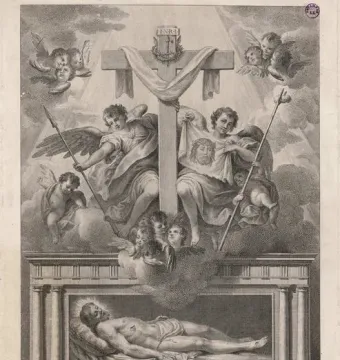
January 1804 © Manuel Salvador Carmona · CC BY-SA 4.0
Identification | |
| Title | Cristo Yacente of El Pardo |
| Type | Life-size polychromed reclining Christ sculpture |
| Subject | Jesus Christ lying on a shroud after the Crucifixion, laid in the Holy Sepulchre |
| Alternative names | Cristo Yacente; Cristo yacente; Cristo de El Pardo |
Historical context | |
| Date | Traditionally 1605; other historians place it around 1614–1615 |
| Commissioned by | King Philip III |
| Commissioned for | An offering to celebrate the birth of his first male child, later Philip IV |
| Cultural context | Created in line with Counter-Reformation demands for realism in religious images |
Creator | |
| Artist nationality | Spanish |
| Alternative attribution | Attributed to Gregorio Fernández and his workshop |
| Workshop involvement | Gregorio Fernández and his workshop |
| Artist | Gregorio Fernández |
Discovery and provenance | |
| Place of execution | Valladolid, according to the traditional hypothesis |
| Donation date | 1615 |
| Donated to | the Madrid convent where it is currently displayed |
| Number of related works | One of fourteen or fifteen reclining Christs attributed to Gregorio Fernández and his workshop |
Physical characteristics | |
| Scale | Life-size |
| Viewing orientation | Designed to be viewed from the side |
| Pose | The head tilts to the right, the right leg is slightly more raised than the left, and the arms extend over the bed separated from the trunk |
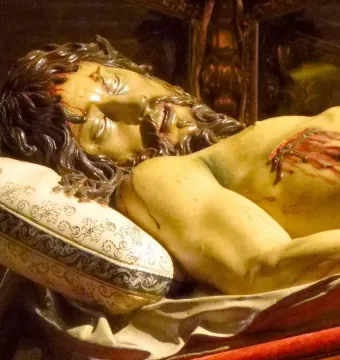
| Support | The head and part of the chest rest on a pillow |
| Hair treatment | Several locks of hair are spread on both sides of the pillow |
| Expression of death | Death is conveyed through the wounds and sores from the Way of the Cross and the Crucifixion, with no visible rigor mortis except for a slight swelling of the body |
Materials | |
| Material | Polychromed wood |
Appearance | |
| Composition | The composition seeks a certain sense of symmetry |
Iconography and meaning | |
| Meaning | A devotional image processed during Holy Week with other pasos |
Location and ownership | |
| Current location | A lateral chapel in the Church of the Convent of the Capuchin Fathers, El Pardo, Madrid, Spain |
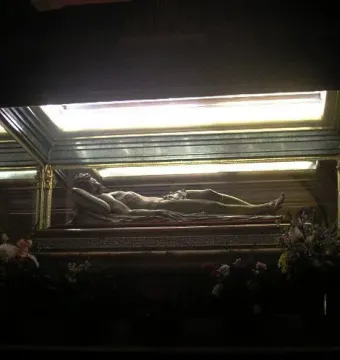
| Display container | A bronze and marble urn |
| Urn maker | Félix Granda |
| Urn date | 1940 |
| Urn donor | Francisco Franco Bahamonde |
| Urn donor residence | Royal Palace of El Pardo |
History and restoration | |
| Lateral chapel architect | Isidro González Velázquez |
| Lateral chapel built | 1830–1833 |
| Returned to convent | October 1939 |
| Spanish Civil War | Taken to the Prado Museum, San Francisco el Grande, the Royal Palace of El Pardo, and the Basilica of Jesús de Medinaceli |
| Peninsular War | Hidden by the residents of El Pardo at an unknown location |
| Displayed there since | 1615, except for periods linked to wars |
| Convent patronage | Promoted under Philip III |
| Convent foundation date | 1612 |
Significance | |
| Assessment | Considered one of Gregorio Fernández's masterpieces |
| Historical interpretation | Some authors consider it an early work, while José Ignacio Martín González argued it is more consistent with an artist in maturity |
| Quality-based dating argument | Its artistic quality suggests a mature phase of Gregorio Fernández's career |
| Series attribution note | Possibly one of the last works in the series of reclining Christs attributed to Gregorio Fernández and his workshop |
| Prototype status | It does not seem to be the head model or first example of the series |
| Art historical context | A recurring theme in Spanish sculpture of the 16th and 17th centuries |
| Precedents | Juan de Juni, Gaspar Becerra, and Francisco de la Maza, among other Renaissance sculptors |