
Cloud Fortress (World Trade Center Plaza Sculpture)
Cloud Fortress, also known as World Trade Center Plaza Sculpture, was created in 1972 by Japanese artist Masayuki Nagare. It stood near the World Trade Center, in a small plaza between 4 and 5 World Trade Center that connected Church Street to Austin Tobin Plaza. The sculpture measured 4.3 meters high, 10 meters wide, and 5.2 meters deep, and depicted two abstract pyramids joined at their bases and tilted upward. Although it appeared solid, it was made of black Swedish granite veneer over a steel and concrete frame. Nagare used his ware hada technique to contrast smooth and rough surfaces. The sculpture survived the September 11 attacks but was later demolished during emergency rescue and debris removal operations.
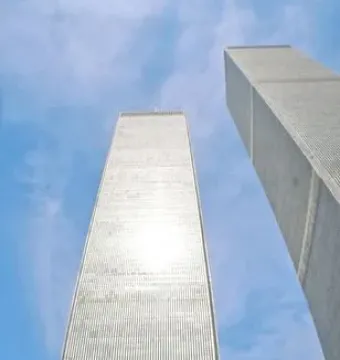
July 1997 © LBM1948 · CC BY-SA 4.0
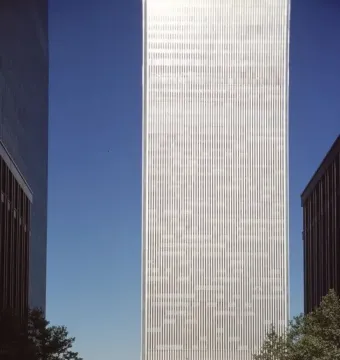
1976 © Balthazar Korab · Public domain
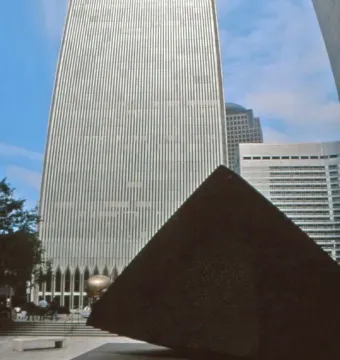
July 1997 © LBM1948 · CC BY-SA 4.0
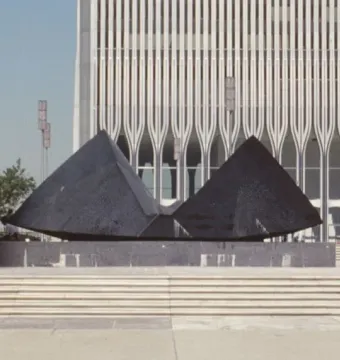
1976 © Balthazar Korab · Public domain
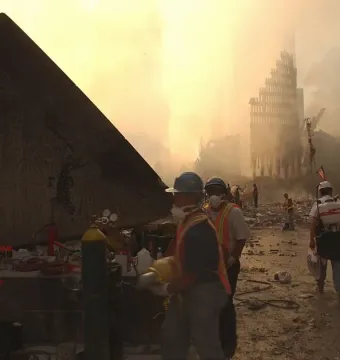
September 2001 © Andrea Booher · Public domain
Identification | |
| Title | World Trade Center Plaza Sculpture |
| Alternative name | Cloud Fortress |
| Alternative name | La fortaleza de la nube |
| Type | abstract sculpture |
Historical context | |
| Completion year | 1975 |
Creator | |
| Artist | Masayuki Nagare |
| Artist nationality | Japanese |
Discovery and provenance | |
| Commissioning context | The Port Authority of New York and New Jersey allocated up to 1% of the World Trade Center construction budget for artworks and established an advisory group to recommend and commission works for the complex |
Location and ownership | |
| Original location | World Trade Center complex, in a small plaza between 4 World Trade Center and 5 World Trade Center at the Church Street entrance to Austin J. Tobin Plaza |
| Site context | The plaza provided access from Church Street to Austin J. Tobin Plaza, which in turn gave access to the World Trade Center complex |
Physical characteristics | |
| Dimensions | 4.3 m high, 10 m wide, 5.2 m deep |
Appearance | |
| Appearance | Appearing solid |
| Form | An abstraction of two pyramids joined at their bases and tilted upward |
Materials | |
| Material | Black Swedish granite veneer (gabbro) |
| Structure | Steel and concrete frame |
Technique | |
| Surface technique | Ware hada |
| Surface technique meaning | Literally "cracked skin" or "broken texture" |
| Surface treatment effect | Creates a strong contrast between polished and rough surfaces |
History and restoration | |
| Survival after September 11 attacks | It survived the September 11, 2001 attacks and the collapse of the Twin Towers and 7 World Trade Center |
| Fate | Demolished during subsequent emergency operations to access and clear the disaster area |
| Reason for demolition | To clear and excavate the area and provide a stable surface for heavy machinery so access to Austin J. Tobin Plaza could be reached more quickly |
| Aftermath | Its remains were removed from Ground Zero along with the rest of the rubble |
| Recovery status | None of its remains have been identified or recovered |
Other | |
| Replica made by the artist | In 2004, Nagare created a half-size replica titled Cloud Fortress Jr. (雲の砦Jr.) at the Hokkaido Museum of Modern Art |