
King Johann Memorial in Dresden
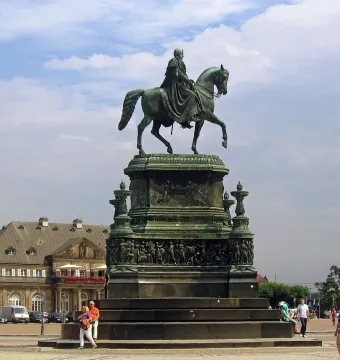
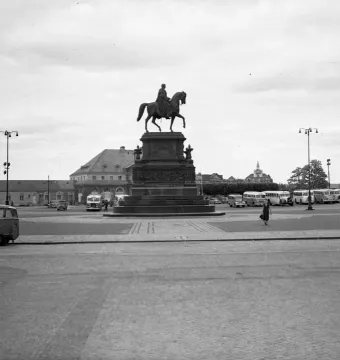
The King Johann Memorial on Dresden’s Theaterplatz commemorates King Johann of Saxony (1801–1873). Designed by sculptor Johannes Schilling and erected in 1889 in the Neo-Renaissance style, it features an equestrian statue of the ruler in his coronation mantle above extensive allegorical reliefs. The monument is about six metres high without its base and 13.5 metres high with it. Its stepped granite and black-green microgabbro base carries figural decoration representing themes such as trade, agriculture, art, science, military affairs, industry, and transport. The three-metre postament bears the name Johann, dates linked to his golden wedding, and inscriptions describing his character.
© Natalia Semenova · CC BY 3.0
1960 · CC BY-SA 3.0
September 2024 © Bybbisch94 · CC BY-SA 3.0 de
August 2025 © Sandro Halank, Wikimedia Commons · CC BY-SA 4.0
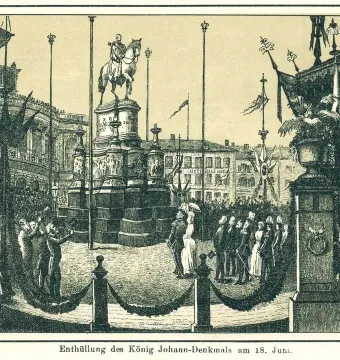
1889 © Unknown authorUnknown author · CC BY-SA 4.0
Identification | |
| Title | König-Johann memorial |
| Type | Equestrian memorial |
| German name | König-Johann-Denkmal |
| Alternative name | Monument to John of Saxony |
Historical context | |
| Commemorated person | King Johann of Saxony (1801–1873) |
| Earlier intended square monument | A monument by Ernst Rietschel to King Frederick Augustus I was proposed for the square but remained in the Dresden Zwinger |
| Site development context | Theaterplatz was shaped from 1840 onward after parts of the 'Italian Village' were demolished for construction projects, including the Dresden Court Theatre and later the Semper Gallery; the square gained new impetus after the reconstruction of the Semper Opera completed in 1878 |
Creator | |
| Sculptor | Johannes Schilling |
| Pedestal designers | Karl Weißbach and Carl Barth |
Discovery and provenance | |
| Funding | 30,000 marks from the city of Dresden and 105,000 marks from the Saxon art fund |
| Cost | 286,000 marks |
| Presence at inauguration | King Albert |
| Inauguration occasion | Wettin celebration for the 800th anniversary of the enfeoffment of the Wettins with the Margraviate of Meissen |
| Inauguration date | 18 June 1889 |
| Erection year | 1889 |
| Casting date | 1889 |
| Model completion | Early May 1888 |
| Creation start | 1882 |
| Chosen sculptor process | Ernst Hähnel was considered but declined in favor of Johannes Schilling |
| Commission date | 1 July 1882 |
| Commissioning organization | Dresden Military Association, later supported by a Dresden citizens' committee |
| Foundry | C. Albert Bierling foundry |
Location and ownership | |
| Location | Theaterplatz, Dresden, Germany |
| Placement | Placed on Theaterplatz at the intersection of the central axes of the Semper Opera and the Semper Gallery; originally intended as the center of the square |
| Suggested location | Theaterplatz |
Physical characteristics | |
| Pedestal height | 3 meters |
| Pedestal lower base height | 1.75 meters |
| Height with pedestal | 13.50 meters |
| Height without pedestal | 6 meters |
Materials | |
| Figure material | Bronze |
| Pedestal material | Lower step of Lusatian granite; upper part of black-green microgabbro ('Lausitzer Lamprophyr') |
| Base includes | Base |
Appearance | |
| Depicted figure | King Johann of Saxony on horseback, bareheaded, wearing a coronation mantle over a general's uniform and holding a sceptre |
| Figure expression | Mild expression; portrait likeness described as highly successful |
| Style | Neo-Renaissance |
| Compositional tradition | Baroque tradition; the equestrian statue serves as a point de vue |
Iconography and meaning | |
| Zwinger-side allegory | Nature framed by a horn of plenty and a bull as fertility symbols, with groups for viticulture, sheep breeding, fruit growing, agriculture, harvesting, forestry, hunting, and a girl fetching water from the talkative spring |
| Industry personification | Female figure with apron and hammer, accompanied by a railway track, a nymph turning a water wheel, ceramics, and lace-making |
| Science personification | Instruction of a boy, with theology, law, medicine, philosophy, and background natural sciences including mathematics, chemistry, and biology |
| Military personification | Infantry, artillery, cavalry, and a female figure symbolizing the city of Dresden handing over a wreath |
| Art personification | Dance, acting, poetry, music, architecture, sculpture, and painting |
| Corner groups | Rounded corner projections show art, military, science, and industry |
| Elbe-side allegory | Mercury and Prosperity with a horn of plenty, with groups for mining, raw materials trade, book trade, photography, transport, telegrams, shipping, chain tow shipping, the Elbe, bridge building, and fishing |
| Long-side program | The two long sides symbolize economy and trade |
| Merchandise and trade scene | Mercury as god of trade with a miner, boatman, fisherman, and Prosperity with a horn of plenty |
| Relief decoration | Figural reliefs with an elaborate artistic program |
| Pedestal side figures | Genii on both long sides carrying tablets with inscriptions characterizing the king |
| Back-side pedestal elements | A book with a portrait of Dante, the regnal years 1854–1873, and a shield with the year of erection of the monument |
| Pedestal inscriptions | Front: 'Johann' under the royal crown; date inscription 1822–1872; Elbe side: 'Be faithful until death, and I will give you the crown of life'; Zwinger side: 'To be pious and truthful protects the king, and his throne stands by piety' |
| Allegorical figures beneath the horse | Military, economy, art, industry, trade, and science |
| Main theme | Equestrian statue of King Johann accompanied by allegorical figures and reliefs celebrating his rule and the arts, sciences, economy, industry, and trade |
History and restoration | |
| Survival | Survived Nazi bronze collection campaigns, the 1945 destruction of Dresden, and dismantling or destruction in the GDR era |
| Reason for survival in GDR era | Johann was highly esteemed as a Dante translator |
| Restoration date | 2013 |
| Restoration work | Thorough cleaning and restoration |
| Vandalism date | 2015 |
| Vandalism | Paint-bucket attack on the monument |