
The Nubians
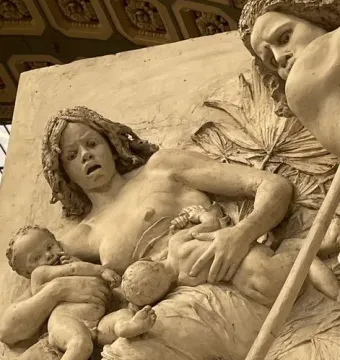
The Nubians is a haut-relief sculpted in 1894 for the façade of the anthropology gallery of the National Museum of Natural History in Paris. It shows a man thrusting a spear into the mouth of an alligator that is about to devour a young woman and her two infants, with a possible third woman fainting nearby. Barrias used figures of Nubians, echoing ethnographic sculpture by Charles Cordier, and rendered the reptile scales and cactus spines with naturalistic precision. The work reflects the stereotypes and colonial context of its time. Cast in bronze by Thiébaut frères, it was later assigned to the École nationale supérieure des arts et industries textiles in Roubaix and is now associated with the Musée d'Orsay.
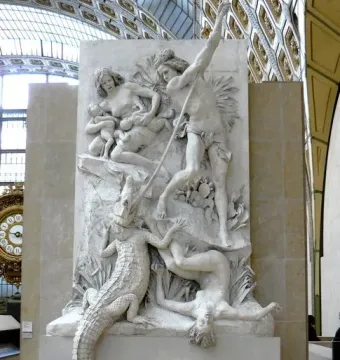
© Siren-Com · CC BY-SA 3.0
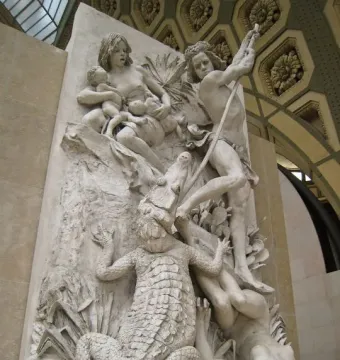
© Sharon Mollerus · CC BY 2.0
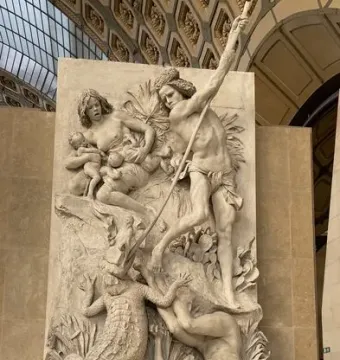
January 2022 © Chris93 · CC BY-SA 4.0
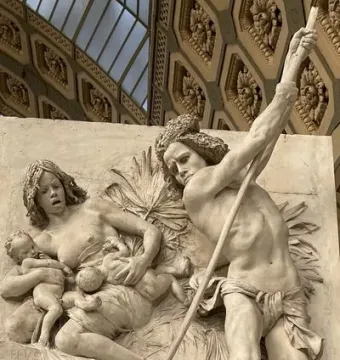
January 2022 © Chris93 · CC BY-SA 4.0
January 2022 © Chris93 · CC BY-SA 4.0
Identification | |
| Title | The Nubians |
| Original title | Le razze umane |
| Type | High relief sculpture |
Historical context | |
| Date | 1894 |
| Context | Contemporary with the first colonial exhibitions |
Creator | |
| Artist | Barrias |
Discovery and provenance | |
| Commissioned | 1893 |
| Commission price | 12,000 francs |
| Original intended location | Facade of the anthropology gallery of the National Museum of Natural History in Paris |
| Acquired by | The French State in 1893 for the Natural History Museum |
| Delivered by | Thiébaut frères |
| Delivered to | the Dépôt des marbres |
| Delivery date | 1897 |
| Assigned to | the Musée d'Orsay |
| Assignment date | 1903 |
| Transferred by decree | 26 March 1986 |
| Intended purpose | To represent the "human races" |
Materials | |
| Material | Bronze |
Appearance | |
| Setting | On the banks of a river |
| Vegetation depicted | Palms, cacti, and swamp reeds |
| Composition detail | The alligator's tail extends out of the relief and touches the ground |
| Style | Naturalistic rendering of animal and botanical details, with reptile scales and cactus spines rendered with naturalist precision |
| Costume of figures | The figures are represented wearing loincloths |
| Depicted scene | A scene meant to evoke the races of Africa, showing a man in a loincloth thrusting a spear into the mouth of an alligator that is about to devour a young woman and her two infants, with possibly another unconscious woman nearby |
Iconography and meaning | |
| Ethnographic influence | Barrias chose African-type figures in echo of the ethnographic sculptures of Charles Cordier |
| Historical reference | The figures recall a 1878 attraction at the Jardin d'Acclimatation where Nubians in loincloths mimicked hunting scenes |
| Interpretation | The work echoes the stereotypes of the era about African populations |
| Title reference | The title refers to the Nubians, an ancient African people who lived in present-day Sudan; in 19th-century France, the term was also widely used for contemporary peoples living in that part of sub-Saharan Africa |
Location and ownership | |
| Current display relation | Exhibited on the reverse side of Jules Coutan's high relief The Eagle Hunt |
| Current location | Musée d'Orsay |
| Earlier location | Designed for the anthropology gallery of the Muséum national d'histoire naturelle in Paris |
| Exhibition history | Shown at the Salon of 1894 |