
Equestrian Statue of the Duke of Wellington
The Equestrian statue of the Duke of Wellington is a bronze equestrian monument by the Austrian-British sculptor Joseph Boehm. It depicts the British field marshal Arthur Wellesley, 1st Duke of Wellington, seated on horseback and stands at Hyde Park Corner in London. The statue was unveiled in 1888 and placed opposite Apsley House, so Wellington faces the house that served as his London residence. It was created to replace an earlier Wellington statue by Matthew Cotes Wyatt, which had stood on Wellington Arch but was later removed because it was considered too large for the arch. The bronze was cast from captured French cannon and is listed as Wellington Monument, Hyde Park Corner SW1.
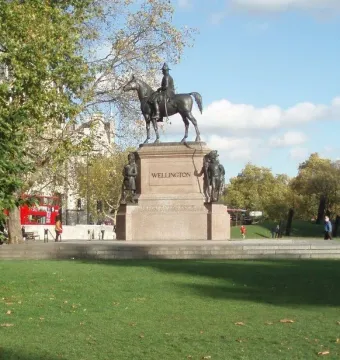
November 2009 © Paul Gillett · CC BY-SA 2.0
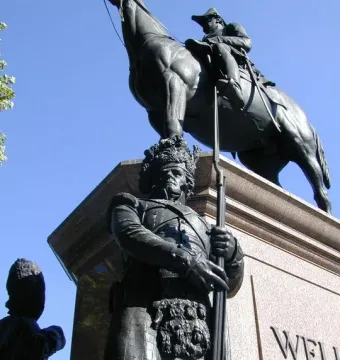
© Rob-Metternich · CC BY-SA 3.0
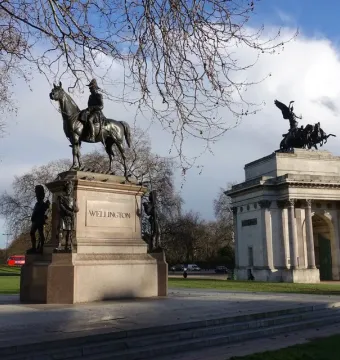
January 2018 © CrisNYCa · CC BY-SA 4.0
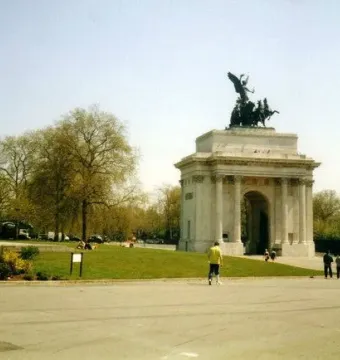
1999 © Oast House Archive · CC BY-SA 2.0
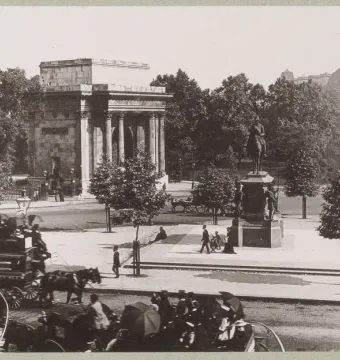
© Rijksmuseum · CC0
Identification | |
| Title | Equestrian statue of the Duke of Wellington |
| Subject | Arthur Wellesley, 1st Duke of Wellington |
| Type | Equestrian statue |
Creator | |
| Sculptor | Joseph Boehm |
| Sculptor nationality | Austrian-British |
Historical context | |
| Unveiled | 1888 |
| Commissioned reason | To replace Matthew Cotes Wyatt's earlier equestrian statue of the Duke, which was removed from Wellington Arch |
Location and ownership | |
| Location | Hyde Park Corner, London, England, opposite Apsley House |
| Faces | Apsley House, Wellington's London home |
Physical characteristics | |
| Pedestal | Massive rectangular granite pedestal |
| Size | About life-size |
| Pose | Wellington is seated on horseback; the horse stands with all four hooves on the ground |
| Depicted horse | Copenhagen |
| Depicted person | Arthur Wellesley, Duke of Wellington |
Appearance | |
| Corner figures | Four British soldiers: a Grenadier of the Grenadier Guards, a Royal Scots Highlander, an Irish dragoon of the 6th (Inniskilling) Dragoon Regiment, and a fusilier of the Royal Welch Fusiliers |
| Inscription on plinth | WELLINGTON; 1769–1852 in raised bronze characters |
| Wellington's clothing | Military uniform, sabre, boots with spurs, bicorne (Wellington hat), and a sash with long fringes tied around the hips |
| Wellington's accessories | Holding the horse's reins in his left hand and a telescope in his right hand |
| Figure attitude | He appears to have his back turned on the processional way through the open space where the statue stands |
Materials | |
| Bronze source | Captured French cannons |
| Pedestal material | Pink Peterhead granite from Stirlinghill quarry near Boddam, Aberdeenshire, Scotland |
| Base material | Grey Aberdeen granite from the Rubislaw quarry, Aberdeen |
| Statue material | Bronze |
History and restoration | |
| Earlier related statue | Matthew Cotes Wyatt's 1846 equestrian statue of the Duke, once on Wellington Arch at Hyde Park Corner, removed in 1882–83 and re-erected at Aldershot Camp, Hampshire in 1883 |
| Other related statue | Francis Leggatt Chantrey and Henry Weekes's bronze Wellington equestrian statue of 1844, formerly in front of the Royal Exchange in the City of London |
| Other related statue | John Steell's Wellington statue of 1852 in Edinburgh |
| Other related statue | Carlo Marochetti's Wellington statue of 1844 in Glasgow |
Significance | |
| Heritage listing | Listed on 14 January 1970 as Wellington Monument, Hyde Park Corner SW1, number 1231514 |