
Monument Demba et Dupont
Monument Demba et Dupont is a war memorial in Dakar, Senegal, created in 1923. It consists of two bronze statues on a pedestal, depicting an African soldier and a French soldier. The work was made by the French sculptor Paul Ducuing and unveiled on 30 December 1923. Originally placed at the Rond-point de l’Étoile in Dakar, it later carried the official title Monument aux créateurs disparus et à la gloire de l’armée noire de l’AOF. In 1983 it was moved to the Catholic cemetery of Bel Air, and in 2004 it was transferred to its current location in the city center. At that time, several portrait reliefs on the base were removed.
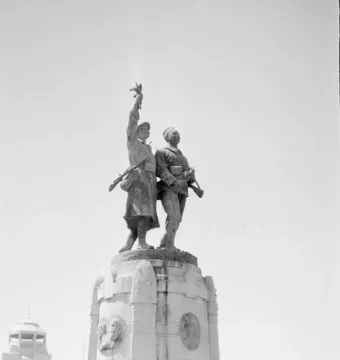
© Leendert Adriaan van Es · CC BY-SA 4.0
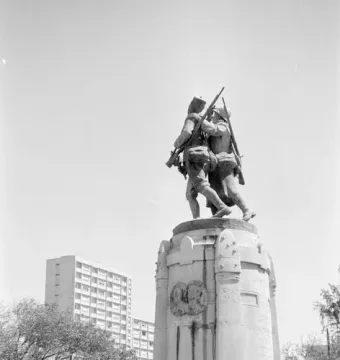
© Leendert Adriaan van Es · CC BY-SA 4.0
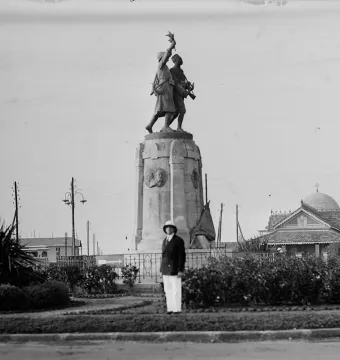
© Carta, Caterina. Auteur du texte · Public domain
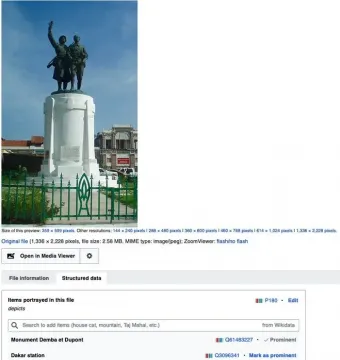
May 2019 © Sandra Fauconnier · CC BY-SA 4.0
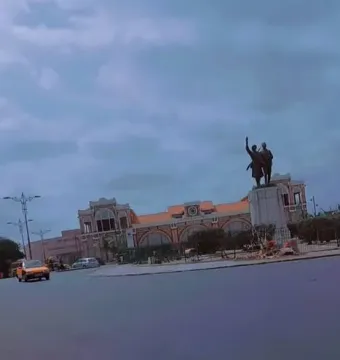
May 2024 © Fatoumata Diariou Bah · CC BY 4.0
Identification | |
| Title | Demba and Dupont monument |
| Alternative title | Monument Demba et Dupont |
| Original official name | Monument aux créateurs disparus et à la gloire de l’armée noire de l’AOF |
| Original official name translation | Monument to the departed creators and to the glory of the Black Army of French West Africa |
| French title | Monument aux morts Demba et Dupont |
Historical context | |
| Type | War memorial monument |
| Unveiling date | 30 December 1923 |
| Original unveiling name | À la gloire des troupes noires et aux créateurs disparus de l’Afrique-Occidentale française |
Creator | |
| Artist lifespan | 1867–1949 |
| Artist | Paul Ducuing |
| Artist nationality | French |
Discovery and provenance | |
| Inscription date reference | The date refers to the day of the liberation of Toulon by colonial troops that landed on [date not given] |
| Associated inscription nearby | A nearby commemorative monument bears an engraved inscription referring to the liberation of Toulon by colonial troops |
| Classification date | The Place du Tirailleur sénégalais, the Monument Demba et Dupont, and the Square du Souvenir were classified as historical monuments by the Ministry of Culture of Senegal on [date not given] |
| Political context of 1983 relocation | President Abdou Diouf sought to influence public opinion toward his government, which was accused of closeness to French neocolonialist ambitions |
| Commissioned relocation by | President Abdoulaye Wade |
| Relocated in connection with | Commemoration events for the Tirailleurs sénégalais |
| Protected status | Listed as a protected monument in the Dakar region |
| Historical context of relocation | The 1983 relocation was linked to the crisis affecting President Abdou Diouf’s government and accusations that it encouraged neo-colonialism |
| Reinstallation date | 2004, in connection with the launch of Tirailleur Day |
| Relocation date | Moved during the night of 13 [day and month/year not given] |
| Current location | Place du Tirailleur Sénégalais, in front of Dakar railway station, Dakar, Senegal |
| Relocation | Moved in 1983 from near the National Assembly in Dakar-Plateau to the Catholic cemetery of Bel Air on the outskirts of the city |
| Original location description | a centrally located crossroads of roads named after pioneers of the French colonial empire |
| Original location | Rond-point de l’Étoile, Dakar |
| Restoration/repositioning justification | Repositioned by President Abdoulaye Wade in 2008 |
Physical characteristics | |
| Depicted figures | A Senegalese tirailleur and a French soldier |
| Individual names of the figures | The Senegalese tirailleur is named Demba and the French soldier is named Dupont |
| Pose / action | The two soldiers are symbolically marching together toward victory |
| Composition | Two bronze statues standing on a masonry pedestal |
| Base | Masonry pedestal |
| Figures | Two bronze statues |
Materials | |
| Material | Bronze |
Appearance | |
| Base decoration | Effigies of five figures of French West Africa: Louis Faidherbe, Marie-Théophile Griffon du Bellay, William Merlaud-Ponty, François Joseph Clozel, and Joost Van Vollenhoven |
| Former reliefs on the base | Portrait reliefs of General Louis Faidherbe and the governors Marie-Théophile Griffon du Bellay, François Joseph Clozel, William Ponty, and Joost van Vollenhoven |
History and restoration | |
| Fate of former reliefs | Removed during the reinstallation |
Iconography and meaning | |
| Symbolic interpretation | The two soldiers looking in the same direction, with the French soldier raising an olive branch, suggests a common destiny for the two brothers-in-arms |
| Alternative interpretation | The French soldier’s hand on the tirailleur’s shoulder can be read as paternalistic and as a reminder of colonialism |
| Gesture interpretation | Dupont placing a hand on Demba’s shoulder is interpreted as a paternalistic gesture |
| Reason for the names | The names were chosen because of their wide распространation in West Africa and Metropolitan France respectively |
Location and ownership | |
| Facing landmarks at new location | Dakar-Niger station and the Gorée ferry terminal |
| New site symbolism | The site was a passage point for soldiers leaving for the front in Europe and is significant in the memory of veterans |
Significance | |
| Associated colonial-era commemorative movement | One of the most important monuments created from private and public funds for soldiers from the French colonies in sub-Saharan Africa |
| Associated monument compared in the text | The monument to the heroes of the Black Army, built identically in Bamako and Reims |
Other | |
| Sculptor's other work | Paul Ducuing created numerous monuments in public squares, especially in southern France |