
Temperance Fountain
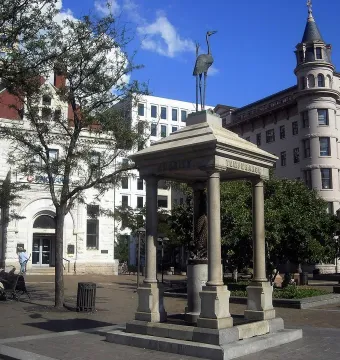
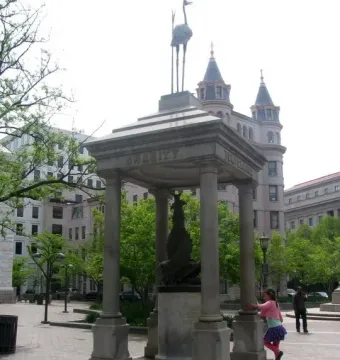
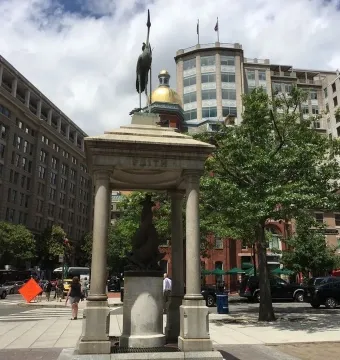
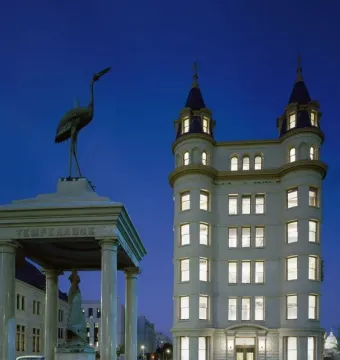
Temperance Fountain in Washington is part of a series of fountains installed in the United States. The Washington example was made possible by a donation to the city in 1882 from Henry D. Cogswell, a San Francisco dentist who was considered one of the crusaders of the Temperance League. The temperance movement, which campaigned against alcohol consumption, emerged in the United States in the 18th century and grew in the following century. By providing easy access to drinking water, Cogswell hoped to discourage people from drinking alcoholic beverages. He donated similar fountains to several American cities, some of which were later removed after being installed.
August 2008 © AgnosticPreachersKid · Public domain
© Eden, Janine and Jim · CC BY 2.0
© NPS Photo · Public domain
© Carol M. Highsmith · Public domain
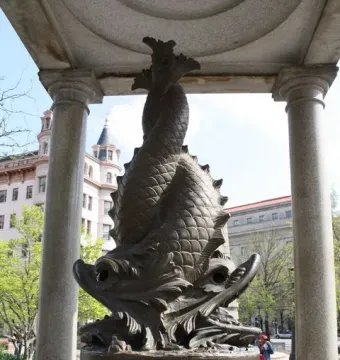
April 2011 © Elvert Barnes · CC BY-SA 2.0
Identification | |
| Title | Temperance Fountain |
| Type | Fountain |
Historical context | |
| Associated movement | Temperance movement |
| Part of series | One of a series of temperance fountains installed in the United States |
| Purpose | To provide easy access to drinking water and discourage alcohol consumption, especially whiskey |
| Donation date | 1882 |
Creator | |
| Donor | Henry D. Cogswell |
| Donor occupation | Dentist from San Francisco, California |
| Donor role | Temperance crusader |
| Designed and commissioned by | Henry D. Cogswell |
Discovery and provenance | |
| Destroyed examples | Buffalo; Rochester; Boston Common; Fall River, Massachusetts; Pacific Grove, California; San Francisco (California and Market Streets) |
| Surviving examples | Washington, D.C.; Tompkins Square Park, New York City; Washington Square, San Francisco; Rockville, Connecticut |
| Later status of some fountains | Some of the fountains were later dismantled after being erected |
| Donation campaign | Cogswell donated these fountains to several American cities |
Location and ownership | |
| Later location | For many years after National Prohibition, in front of the Apex Liquor Store in the ground floor of the Central National Bank Building |
| Current location | Corner of Seventh Street and Indiana Avenue NW, across from the National Archives and Navy Memorial, Washington, D.C. |
| Relocation date | 1987 |
| Relocation distance | About 100 feet north |
| Relocation reason | During renewal by the Pennsylvania Avenue Development Corporation; the statue was regarded as undesirable from the start |
| Original location context | Near the halfway point between the Capitol and the White House, in an area with many saloons along Pennsylvania Avenue |
| Original location | Seventh and Pennsylvania Avenue, across from Center Market and near Hooker's Division (now the Federal Triangle), Washington, D.C. |
| Associated development project | Pennsylvania Avenue Development Corporation created Indiana Plaza during the relocation |
History and restoration | |
| Modification | The city disconnected the supply pipes |
| Historical controversy | In April 1945, Senator Sheridan Downey of California introduced a Senate resolution to remove the fountain, but it died in committee |
| Swap with another monument | In 1987, it swapped locations with the monument to the Grand Army of the Republic, which was considered historically more significant |
| Maintenance issue | The city tired of replenishing the ice in the reservoir |
Physical characteristics | |
| Top figure | A life-sized heron |
| Central motif | A pair of entwined heraldic scaly dolphins |
| Support structure | Four stone columns supporting a canopy |
| Overflow handling | A trough for horses |
| Cooling system | A reservoir underneath the base for ice |
| Drinking accessory | A brass cup |
Appearance | |
| Canopy inscription | Faith, Hope, Charity, and Temperance |
| Base inscription | Presented by Dr. Henry D. Cogswell of San Francisco, Cal. |
| Main imagery | A heron atop the fountain and dolphins inside the enclosure |
Iconography and meaning | |
| Subject | Temperance; intended to encourage people to drink water instead of alcohol |
Significance | |
| Public reputation | Has been called 'the city's ugliest statue' |
| Critical assessment | NBC correspondent Bryson Rash wrote in Footnote Washington (1981) that these unusual and awkward structures spurred city fine arts commissions across the country to screen such gifts before funding |