
Sarcophagus of Louis the German
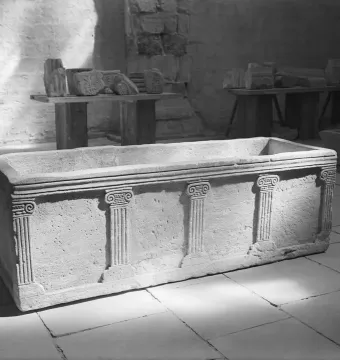
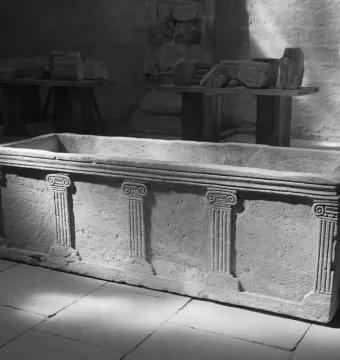
The Sarcophagus of Louis the German is the name given to a sarcophagus discovered in 1800 during archaeological excavations at Lorsch Abbey. Because of where it was found and the significance of the object, it is generally linked with one of the burials in the royal crypt, although it can no longer be identified with certainty as belonging to Louis the German, his son Louis III the Younger, or his grandson Hugh. Dating from the second half of the 9th century, it is one of the most important sculptural testimonies of the Carolingian period. It is now displayed in the former Electoral House, opposite the Torhalle.
© Unknown authorUnknown author · CC BY-SA 4.0
© Unknown authorUnknown author · CC BY-SA 4.0
© Unknown authorUnknown author · CC BY-SA 4.0
© Unknown authorUnknown author · CC BY-SA 4.0
Identification | |
| Title | Sarcophagus of Louis the German |
| Type | Sarcophagus |
Historical context | |
| Period | Carolingian period |
| Date | Second half of the 9th century, probably around 876 |
Creator | |
| Creator | Unknown |
Discovery and provenance | |
| Findspot and burial place | The findspot and the burial place coincide |
| Burial context | Louis the German was reportedly transferred from Frankfurt am Main to Lorsch after his death on 28 August 876 and buried there the following day |
| Evidence for attribution | No written or unequivocal proof exists; attribution is supported by the find spot, date, workmanship, stylistic parallels, and the burial goods and remains |
| Attribution | Traditionally and probably attributed to Louis the German, but not securely proven; alternative proposed occupants include Louis III the Younger, Hugh, and earlier Count Cancor |
| Original location | The grounds of the former royal crypt of Lorsch Abbey, the Ecclesia varia |
| Associated finds | Found with four or eight other sarcophagi or masonry coffins |
| Surviving status | Only surviving piece from the group found at the site; the others were dispersed |
| Excavator | Baron von Hausen, forestry superintendent / Oberforstmeister |
| Discovery context | Found during archaeological excavations, probably private excavations |
| Discovery place | Lorsch Abbey, in the area of the former royal crypt |
| Discovery date | 1800 |
Physical characteristics | |
| Dimensions | 2.05 × 0.73 × 0.67 m |
| Wall thickness | 7 cm throughout |
Materials | |
| Material | Sandstone |
| Construction | Carved from a single sandstone block |
Technique | |
| Tool marks | Worked with a special stone axe with a working width of exactly 4 cm |
Appearance | |
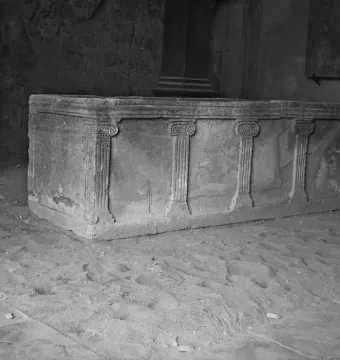
| Decoration | Three inner pilasters on each long side, with matching corner pilasters at the corners |
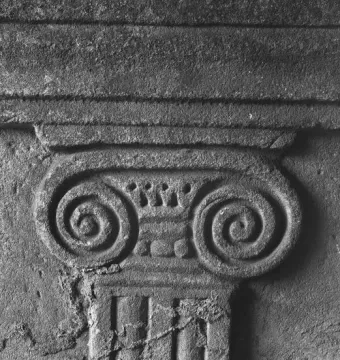
| Style | Ionic order, used as a motif complementary to the Roman Ionic order |
| Workmanship | Pillars were carved and the surfaces smoothed with a special stone axe |
Iconography and meaning | |
| Interpretation | The Ionic-order decoration is read as a symbolic reference to imperial authority and continuity with Roman tradition, and as supporting royal legitimacy in the Carolingian context |
| Burial contents | Eyewitnesses reported the remains of a man wearing a silk robe edged with gold, with boots and spurs |
| Burial significance | The burial goods suggest a person of Carolingian rank and importance greater than that of the abbots of Lorsch |
Location and ownership | |
| Museum role | One of the central pieces in the Lorsch museum exhibition route |
| Current display | Permanently exhibited inside the Elector's House |
| Current location | Former Elector's House (Kurfürstliches Haus), opposite the Torhalle / King's Hall, Lorsch |
History and restoration | |
| Transfer date | 1934 |
| Reason for transfer | Transferred in connection with the restoration campaign of the Torhalle |
| Earlier display | Displayed for decades at the site of the former royal crypt, but in progressively deteriorating condition and without adequate museum display |
| Museum adaptation | The Elector's House was adapted into a museum space to house important works from the abbey site |
Significance | |
| Art historical significance | One of the most important sculptural testimonies of the Carolingian period |
| Historical significance | The similarity to the Torhalle suggests a unitary Carolingian project intended to enhance the memory of a sovereign |
| Scholarly assessment | Attribution to Louis the German has been treated with increasing caution in later studies; Wilfried Hartmann judged it much more cautiously in 2002 and 2004 |