
Elephant Fountain
Elephant Fountain is a 10th-century water fountain, or aquamanile, from the height of the Caliphate of Córdoba. Made of gray limestone, it once decorated the top of a square-section pillar, with traces still visible at the animal’s legs. Its original location was probably near Santa María de Trassierra, suggesting it may have belonged to the Valdepuentes aqueduct or Aqua Vetus system that supplied Madinat al-Zahra. The fountain is now in the courtyard of the Episcopal Palace of Córdoba. Documented in 1884 as Fuente del Caño-Escaravita, it was moved there in 1988 for the opening of the Diocesan Museum the following year.
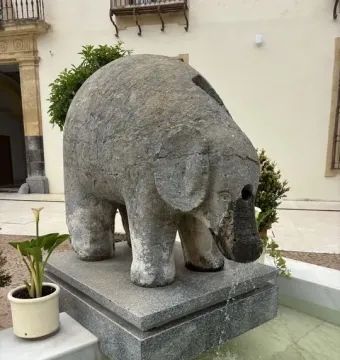
April 2026 © JamesNarmer · CC BY-SA 4.0
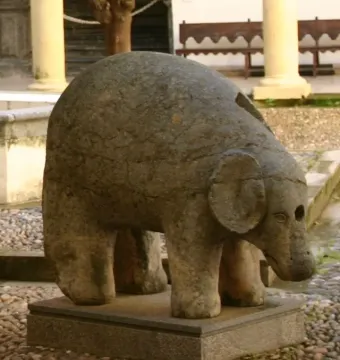
February 2013 © José Luiz · CC BY-SA 3.0
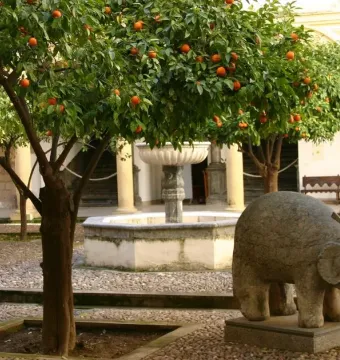
February 2013 © José Luiz · CC BY-SA 3.0
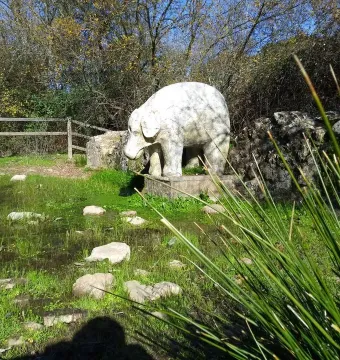
December 2018 © Berman007 · CC BY-SA 4.0
Identification | |
| Title | Fuente del Elefante |
| Type | Elephant fountain |
| Original language title | La fontaine de l'Éléphant |
Historical context | |
| Date | 10th century; Carbon-14 evidence suggests use between 982 and 1193 |
| Historical period | Caliphate of Córdoba |
| Historical context | Linked to the construction of Madinat al-Zahra during the apogee of the Caliphate of Córdoba |
Creator | |
| Commissioned by | Maslama ben Abdallah, master builder of Madinat al-Zahra |
| Creator | One of the sculptors who worked for Maslama at Madinat al-Zahra |
Discovery and provenance | |
| Recorded in | The 1884 ordinances |
| Relocated to | Courtyard of the Episcopal Palace of Córdoba |
| Relocation year | 1988 |
| Reason for relocation | Moved for the 1989 inauguration of the Diocesan Museum because the land belonged to the Bishopric of Córdoba |
| Documented name in 1884 ordinances | Fuente del Caño-Escaravita |
| Comparable works | The Fountain of the Court of the Lions or the Cervatillo of Madinat al-Zahra |
| Alternative historical interpretation | It may instead have belonged to a palatial complex of Abd al-Rahman III or another Andalusi noble of the Caliphal period |
| Probable original function | A fountain, probably part of the Valdepuentes aqueduct (Aqua Vetus) carrying water to Madinat al-Zahra |
| Original location | The outskirts of Santa María de Trassierra, near the Baños de Popea, at the spring site near Medina Azahara |
Physical characteristics | |
| Original placement | On the top of a square-section pillar |
| Physical traces | Marks of the animal's feet remain visible at the level of the legs, indicating the pillar it stood on |
Materials | |
| Material | Gray limestone |
Iconography and meaning | |
| Location context | Placed where it is currently found after Maslama learned of the hermit's death near the spring while searching the mountain for materials for the palatine city |
| Related person mentioned in the legend | A hermit from the Sierra de Córdoba |
| Purpose | Installed in memory of the hermit and the legend Maslama heard as a child |
| Legendary origin | According to Manuel Pimentel's Leyendas de Medina Azahara, an old elephant struck the ground at the present spring site and caused the water to emerge |
| Legend depicted | During a drought, the oldest elephant struck the ground with its foot and water sprang from the place |
| Subject | An elephant |
Location and ownership | |
| Current location | Courtyard of the Episcopal Palace of Córdoba |
| Associated site | Madinat al-Zahra |
| Function in the landscape | Marks and commemorates the spring site associated with the legend |
History and restoration | |
| Replicas | Two replicas exist, one in the original location and one in Santa María de Trassierra |
| Replica maker | Martín Lagares |
| Replica installation date | 1 December 2013 |