
Scenes from Genesis by Wiligelmo
Scenes from Genesis is a Romanesque frieze composed of four bas-relief plaques, each divided into several scenes from Genesis. It decorates the lower part of the western façade of Modena Cathedral in Emilia-Romagna. Considered a masterpiece of Romanesque art, the work is attributed to the sculptor Wiligelmo and his workshop, though its date of execution is unknown. Its vivid realism and strong narrative power were likely intended to make it understandable to all the faithful, turning the sculpture into a kind of “stone Bible.” The figures of God are rendered physically and tangibly, sometimes smaller than those being reprimanded, emphasizing the work’s distinctive expressive style.
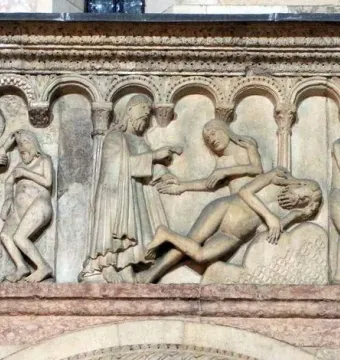
January 2016 © Sailko · CC BY 3.0
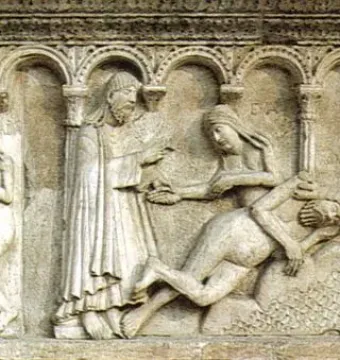
July 2007 © Sailko · Public domain
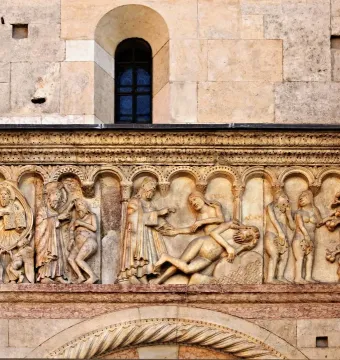
May 2023 © Photo: Mongolo1984. Corrections: Paolo Villa (light, perspective, crop) · CC BY-SA 4.0
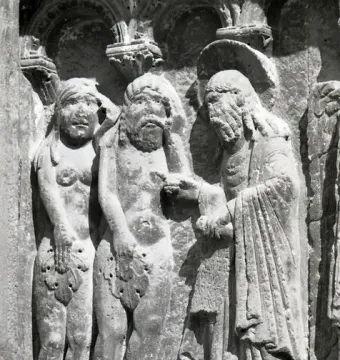
© Paolo Monti · CC BY-SA 4.0
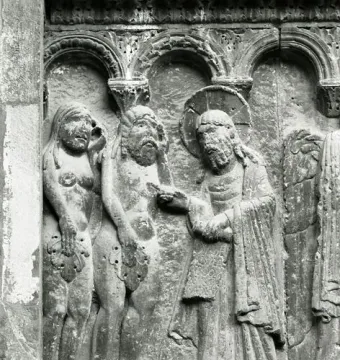
© Paolo Monti · CC BY-SA 4.0
Identification | |
| Title | Scenes from Genesis (Storie della Genesi) |
| Type | Frieze of four stone relief slabs |
| Subject | Episodes from the Book of Genesis |
Historical context | |
| Style | Romanesque art |
| Date | c. 1099; sometimes described as unknown |
Creator | |
| Artist | Wiligelmo and his workshop |
| Attribution | Attributed to Wiligelmo; described as his work |
Discovery and provenance | |
| Reassembly on facade | They were then reassembled on the facade by the architect Lanfranco |
| Associated architect | Lanfranco |
| Associated scholar | Arturo Carlo Quintavalle |
| Recovery after damage | According to the same hypothesis, they were recovered after the earthquake of 1117 together with other sculptures from the altar and the pulpit |
| Later relocation | Two reliefs were probably moved later when the side portals were opened |
| Original arrangement | Probably placed on both sides of the central portal in Wiligelmo's time |
| Alternative original function | Arturo Carlo Quintavalle proposed that the four slabs originally belonged to the cathedral's pontile (choir screen/pulpit structure) |
Physical characteristics | |
| Detail treatment | Highly refined, especially in the Genesis panels |
| God's mandorla | Heavy and laboriously carried, by angels or by a telamon |
| Depiction of God | God is shown in a firm, physical, and relatively non-transcendent manner; his head fits within the arch frame and his garment widens downward into a triangular form |
| Garment treatment | The Creator's robe falls in cordoned folds |
| Expressive qualities | Varied and realistic expression of character and emotion |
| Medium | Relief sculpture |
| Figure style | Human figures are somewhat clumsy |
| Narrative style | Strongly narrative, immediate, and vivid |
| Material | Stone |
| Setting of scenes | Under a gallery of small arches supported by corbels or small columns |
| Narrative structure | Read from left to right |
| Form | A complex sculptural cycle of four slabs, each subdivided into several scenes |
| Relative scale of figures | God is shown smaller than Adam, Eve, or Cain when reproaching them |
Appearance | |
| Ending scene | Noah and his family leaving the ark |
| Specific scenes mentioned | Creation of Woman; expulsion of Adam and Eve by an angel with a drawn sword |
| Subject emphasis | Creation, the fall, condemnation to labor, Cain's fratricide and death, the flood, and Noah's departure from the ark |
Iconography and meaning | |
| Thematic interpretation | Creation stories are intertwined with the announcement of Christ's redemption |
| Overall meaning | Hope for salvation and the new evangelical covenant |
| Program interpretation | Interpreted as a unified scheme representing the Ordo representationis Ade (Le Jeu d'Adam), a semi-liturgical drama |
| Dramatic effect | The sacred story is presented with the persuasive force and evocative quality of a staged performance |
| Intended audience | The faithful in general, including many illiterate viewers, rather than an ecclesiastical or lay elite |
| Educational function | A 'stone Bible' for religious instruction |
| Prophetic figures in the cathedral program | Enoch and Elijah were taken directly into heaven without first dying |
| Portal prophets | The twelve prophets are presented as an omen of the twelve apostles |
| Thematic leitmotif | Creation linked to redemption recurs throughout Modena Cathedral |
| Patristic reference | Saint Irenaeus of Lyon already linked creation with redemption in the Demonstratio Apostolicae Praedicationis |
| Early theological context | Creation formed part of baptismal catechesis from the earliest centuries |
Location and ownership | |
| Architectural context | The sculpture's plasticity is consistent with Lanfranco's architecture, with its articulated volumes and deeply grooved planes |
| Location | Exterior, lower part of the western facade of Modena Cathedral (Duomo of Modena), Modena, Emilia-Romagna, Italy |
| Building | Modena Cathedral (Duomo of Modena) |
History and restoration | |
| Inscription | Lanfranco's famous couplet was added to the wall inscription to celebrate Wiligelmo's skill |
| Quoted couplet | Inter scultores / quanto sis dignus honore / claret scultura / nunc Wiligelme tua. |
| Meaning of couplet | How worthy of honor you are among sculptors is shown, O Wiligelmo, by your sculpture |
Significance | |
| Aquitanian connections | The cordoned folds, beards, and hair recall Aquitanian sculpture, especially at Moissac and Saint-Sernin in Toulouse |
| Stylistic character of models | The proposed sarcophagus models are characterized by anti-classical proportions and awkward movements |
| Jeu d'Adam dating | Original version dated between 1125 and 1175 |
| Jeu d'Adam origin | Anglo-Norman area |
| Theatrical source hypothesis | Chiara Frugoni suggested that the Ordo representacionis Ade (The Mystery of Adam) may have inspired Wiligelmo, but the proposal is uncertain because the work is later than his active period |
| Influence on later sculptors | Niccolò and Antelami were influenced by Wiligelmo; their style is described as more aestheticizing and as marking the transition from Romanesque to Gothic |
| Influences | Also influenced by sculpture from Burgundy and Provence |
| Influences | Possibly influenced by Roman sarcophagi of the late antique or early Christian period, especially plebeian and provincial works |
| Comparative assessment | The scenes are said to show stronger tension than the works of Niccolò in Ferrara and Verona and Antelami in Parma |
| Stylistic assessment | High realism and strong narrative force |
| Assessment | Considered a masterpiece of Romanesque art |
Other | |
| Language of source fragment | Italian |