
Die Bremer Stadtmusikanten
Die Bremer Stadtmusikanten is one of the most popular monuments in Riga’s Old Town. It was created by a sculptor from Bremen, presented to Riga as a gift from its twin city Bremen, and installed in 1990. The sculpture stands opposite the Convent Courtyard, in front of the yellow Eck convent building, by the altar section of St. Peter’s Church on Skarnu Street. St. John’s Church is located to the northeast. The composition shows the four animals from the Brothers Grimm fairy tale at the moment they peek into a window at forest robbers. It is also sometimes interpreted as a symbol of the end of the Cold War and the union of two blocs.
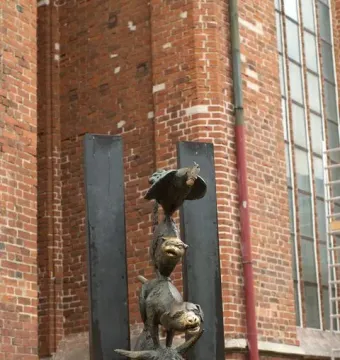
July 2024 © Greffono · CC BY-SA 4.0
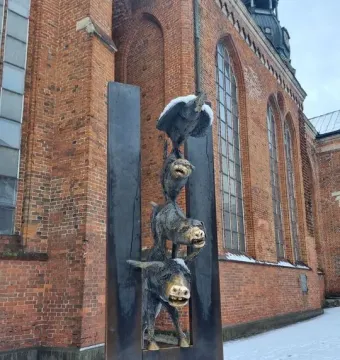
© Lee Vilenski · CC BY-SA 4.0
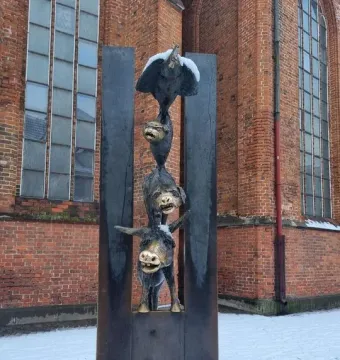
© Lee Vilenski · CC BY-SA 4.0
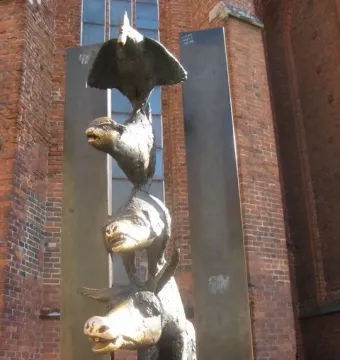
July 2019 © Contrast-Christian · CC0
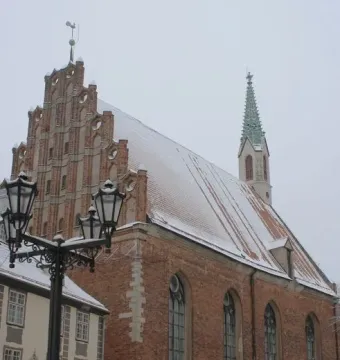
© Сергей Алексеев · CC BY 3.0
Identification | |
| Title | Die Bremer Stadtmusikanten |
| Type | Sculpture |
| Subject | The Bremen Town Musicians |
Historical context | |
| Date created | 1990 |
| Date installed | 1990 |
Creator | |
| Artist | Christa Baumgärtel |
Discovery and provenance | |
| Based on | A 1953 sculpture by Gerhard Marcks standing in front of Bremen Town Hall |
| Original referenced sculpture artist | Gerhard Marcks |
| Donor | City of Bremen |
| Gift recipient | Riga, the partner city |
| Original referenced sculpture year | 1953 |
Location and ownership | |
| Inscription language | Latvian and German |
| Current location | Old Town of Riga, Latvia |
| Specific location | Opposite the Convent Courtyard, in front of the yellow building of the Eck Convent, by the altar part of St. Peter's Church on Skarnu Street |
| Nearby landmark | St. John's Church is located to the northeast of the monument |
| German inscription donor wording | Free Hanseatic City of Bremen |
| Inscription content | Names the sculpture, the artist, and the donor; German text reads: "DIE BREMER STADTMUSIKANTEN / KÜNSTLERIN: CHRISTA BAUMGÄRTEL, 1990 / GESCHENK DER FREIEN HANSESTADT BREMEN" |
Physical characteristics | |
| Nose color | The animals' noses are golden-colored from repeated rubbing |
| Height | 3 meters |
| Base | Stone pedestal |
Materials | |
| Material | Bronze |
Appearance | |
| Formal arrangement | The animal group is arranged between two massive metal bands |
| Depicted figures | A donkey, a dog, a cat, and a rooster |
| Depicted moment | The moment when the Bremen Town Musicians are looking into the window at forest robbers |
| Composition | Four animals stacked one on top of another |
Iconography and meaning | |
| Symbolic interpretation | A playful interpretation says it symbolizes the end of the Cold War and the unification of the two blocs |
| Symbolic interpretation | The gap through which the animals look represents the unexpectedly opened Iron Curtain |
| Expressive qualities | The animals' facial expressions and posture convey surprise and emotions associated with the opening of the curtain and the new freedom it brought |
| Belief associated with the sculpture | Rubbing the animals' noses is believed to bring good luck; the higher one reaches, the more luck one is said to receive, with the rooster being the hardest to reach and granting the most secret wish |
| Ritual variation | Another version says each next animal increases the chances of one cherished wish coming true |
Significance | |
| Popularity | One of the most popular monuments in Riga's Old Town |
| Tourist significance | Part of the standard tourist program for visitors to Riga; tour guides recommend the nose-rubbing ritual |