
Lincoln Monument of Wabash, Indiana
Lincoln Monument of Wabash, Indiana, also known as The Great Emancipator, is a public sculpture by Charles Keck, a New York-born sculptor. The cast bronze statue was originally commissioned by prominent citizen Alexander New and donated to the city administration in 1932. Since then, it has remained on view at the northeast corner of the lawn of the Wabash County Courthouse in Indiana.
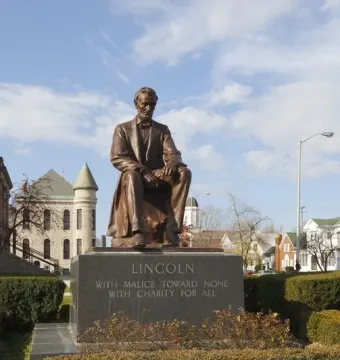
November 2012 © Diego Delso · CC BY-SA 3.0
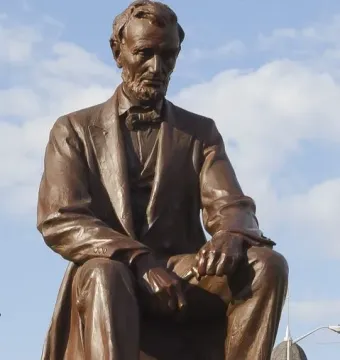
November 2012 © Diego Delso · CC BY-SA 3.0
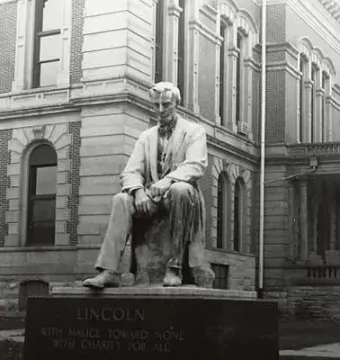
© SIRIS · Public domain
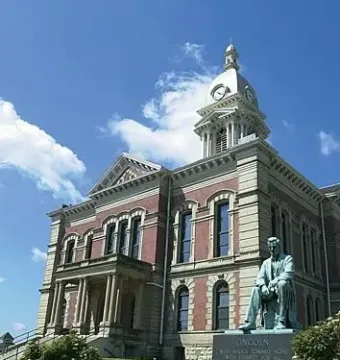
May 2002 © Regional Partnership · CC BY-SA 2.0
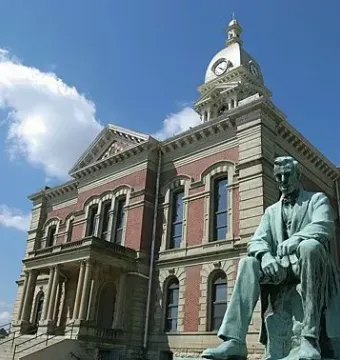
May 2002 © Regional Partnership · CC BY-SA 2.0
Identification | |
| Title | Lincoln Monument of Wabash, Indiana |
| Alternative name | The Great Emancipator |
| Type | Public sculpture |
Historical context | |
| Subject | Abraham Lincoln |
Creator | |
| Artist | Charles Keck |
| Artist birth date | September 9, 1875 |
| Artist death date | April 23, 1951 |
| Artist birthplace | New York City |
| Commissioned by | Alexander New, a native of Wabash who grew up there, studied law, and later built a large chain of stores with main offices in New York |
Discovery and provenance | |
| Donated to | The city of Wabash, Indiana |
| Donation year | 1932 |
Location and ownership | |
| Displayed since | 1932 |
| Current location | Northeast corner of the Wabash County Courthouse lawn, Wabash, Indiana |
Physical characteristics | |
| Depiction | A larger-than-life Abraham Lincoln sitting on a rock with his head slightly bowed forward and his arms resting on his knees |
| Hand pose | Both hands are closed except for the extended right index finger |
| Clothing | Beard, bow tie, vest, long coat, and boots |
| Boot detail | The right boot extends just beyond the edge of the base |
| Accessory detail | A watch chain is visible on the vest |
| Foundry mark | "Gorham Co. Founder" along the back proper left edge of the bronze base |
| Additional mark | Another indecipherable foundry mark or signature in black, raised letters just past the Gorham mark |
Materials | |
| Figure material | Cast bronze |
| Base material | Granite |
Iconography and meaning | |
| Commemorated persons | Isaac and Henrietta New |
| Front inscription | LINCOLN / WITH MALICE TOWARD NONE / WITH CHARITY FOR ALL |
| Back inscription | ERECTED IN LOVING MEMORY / OF HIS PARENTS / ISAAC AND HENRIETTA NEW / BY / ALEXANDER NEW / 1932 |
History and restoration | |
| Appearance around 1992 inspection | A black-and-white image taken around the time of the inspection shows the sculpture no longer having the even, dark patina seen in 1932 |
| Catalog record | An online record was created in the Smithsonian Institution Research Information System (SIRIS) |
| Unveiled and dedicated | May 31, 1932, Memorial Day |
| Appearance as of June 2008 | The sculpture appears to have a similar even, dark patina as in 1932, suggesting its appearance had recently been changed |
| Appearance in 2005 publication | Greiff's 2005 publication shows the sculpture with a similar appearance to the 1992 image |
| Survey reference | Save Outdoor Sculpture! survey |
| Inspection year | 1992 |
| Inspection program | Save Outdoor Sculpture! (SOS!) program |
| Appearance at unveiling | Even, dark patina |
| Unveiling context | Unveiled and dedicated a year after Alexander New's death |
| Unveiling location | Wabash, Indiana |
Other | |
| Historical photo source | Indiana Historical Society collections |
| Historical photo date | Taken on the day of the unveiling |
| Historical photo subject | Courthouse lawn with onlookers packed around the sculpture, including some seated on one of the porch roofs of the Wabash County Courthouse |
| Historical photo view | Looking southwest at the sculpture with the Wabash County Courthouse in the background |
| Identical version in Hingham | The town of Hingham, Massachusetts owns what appears to be an identical version of this sculpture, displayed on a granite base with the same front inscription, dedicated to the citizens of Hingham on September 23, 1939 |
| Maquette | A much smaller maquette of the sculpture is owned by President Lincoln's Cottage at the Soldiers' Home in Washington, D.C.; it shows Lincoln holding a book in his right hand and his hat visible near his right boot |
| Comparison versions appearance | The Hingham version and the maquette also show an even, dark patina |
| Installation account | Homer T. Showalter, mayor of Wabash at the time, provided a first-hand account of the sculpture's installation |