
Capitoline Wolf Statue in Cluj-Napoca
The Capitoline Wolf Statue in Cluj-Napoca is a monument in the Romanian city of Cluj-Napoca, located in the city center by the Someșul Mic River. It was installed on 28 September 1921 as a gift from the city of Rome in memory of the union of Transylvania and Bukovina with Romania in 1918. The statue was later moved for safety during the Second Vienna Award period, returned after World War II, and restored to public display in 1967 near Babes-Bolyai University. It was moved again in 1973, restored in 1994 and 2007, and is now set about 30 meters from its former position.
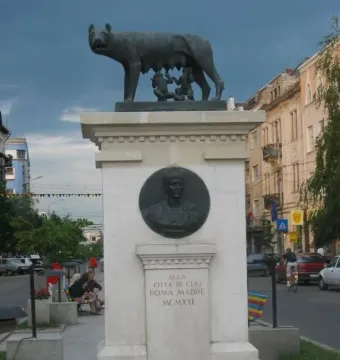
· Public domain
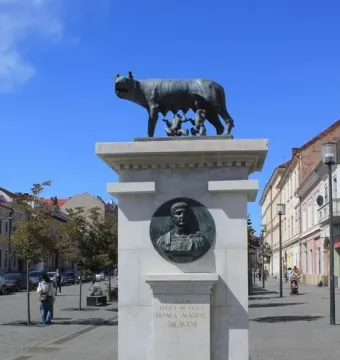
August 2011 © Alyn.blaga · CC BY-SA 3.0
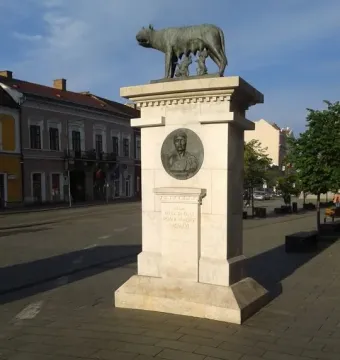
May 2013 © Teutorigos · CC BY-SA 3.0 ro
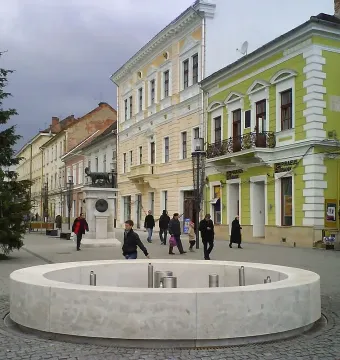
© Barbu p · Public domain
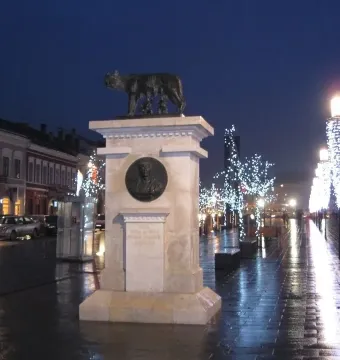
January 2009 © Cluj Napoca · CC BY 2.0
Identification | |
| Title | Capitoline Wolf Statue |
| Alternative title | Statue of the She-Wolf |
| Type | Monument |
| Type | Copy of the Capitoline Wolf monument |
Historical context | |
| Gift date | 1921 |
| Gift giver | The city of Rome; also described as the Italian state / government of Italy |
| Reason for gift | As a tribute to the Latin origin of the Romanian people |
| Commemorates | The union of Transylvania and Bukovina with Romania in 1918 |
| Related copies in Romania | Bucharest, Cluj-Napoca, Chișinău, and Timișoara received the four original Romanian copies in the first decades of the 20th century |
Creator | |
| Bas-relief added by | Ettore Ferrari |
Discovery and provenance | |
| Transported by | A delegation of 200 Italians, mostly students |
Physical characteristics | |
| Subjects depicted | The she-wolf with Romulus and Remus beneath her; a bas-relief of Emperor Trajan was also added |
Materials | |
| Material | Not specified in the text; described as a faithful copy |
Iconography and meaning | |
| Subject | The Capitoline Wolf (Lupa Capitolina), symbolically connected with the Latin origin of the Romanian people |
| Symbolism | Symbolised the unity of Romanians from all parts of the country and their Latinity |
Location and ownership | |
| Current location | On Eroilor Boulevard, in the city centre, on the banks of the Someșul Mic River, opposite the National Museum of Transylvanian History |
| Initial unveiling location | On the main square in Cluj, opposite an unspecified landmark or building |
| Original planned location | Unirii Square, in front of the Statue of Matthias Corvinus |
| Location | Cluj-Napoca, Romania |
History and restoration | |
| Post-restoration installation | After restoration in 2007, installed about 30 meters from its previous location |
| Restoration location | National Museum of Transylvanian History |
| Restored by | Liviu Mocan in 1994; Tiberiu Colozsi in 2007 |
| Removed for restoration | 1994 |
| Moved within Cluj | 1973, to the intersection of two unspecified streets |
| Reinstalled at university area | 1967, on Mihail Kogălniceanu Street in front of Babeș-Bolyai University; initiative by Professor Constantin Daicoviciu |
| Returned to Cluj | 1945, after the end of World War II |
| Moved during World War II | After the Second Vienna Award in 1940, the statue was taken to Sibiu for safekeeping |
| Unveiling attendance | More than 25,000 residents |
| Unveiled by | Iulian Pop, the first Romanian mayor of Cluj |
| Date installed | 28 September 1921 |
Significance | |
| Replacement monument | The Memorandum Signers' Monument / a monument to the Transylvanian Memorandum |
| Transylvanian Memorandum monument meaning | Commemorates the 1892 petition of the leaders of the Romanians in Transylvania to the Austro-Hungarian authorities, demanding equal rights with Hungarians, an end to Magyarization and persecution, and political rights for Romanians |
Other | |
| Associated inscription | Alla citta di Cluj, Roma Madre, MCMXXI ("To the City of Cluj, Mother Rome, 1921") |
| Reproductions made in Romania | Additional copies were made from the four statues and installed in several towns and villages in Romania, including Alba Iulia, Blaj, Brad, Brașov, Constanța, Dej, Galați, Eruț, Luduș, Năsăud, Săcele, Satu Mare, Sighișoara, Târgu Mureș, Târnăveni, Toplița, Turda, Zalău, Reghin, and Gherla |