
Gallo di Ramperto
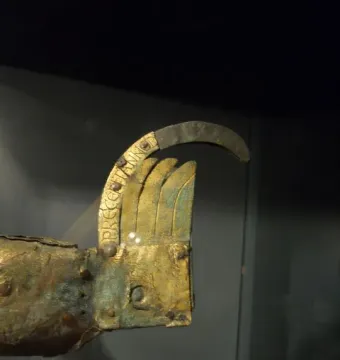
Gallo di Ramperto is a weather vane in copper sheet, originally gilded and silvered, made around 820 or 830 on the commission of Bishop Ramperto. It was created to crown the bell tower of the Church of Saints Faustino and Giovita in Brescia. The rooster remained in place for more than a thousand years before being removed in 1891 for restoration and conservation in the city museum, now the Museo di Santa Giulia. It is largely intact, with only the tail feathers missing; these originally bore the dedicatory inscription. Dating to the early 9th century, it is considered the oldest surviving weather-vane rooster, with an age of nearly 1,200 years.
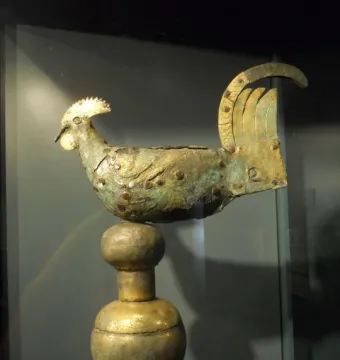
© RobyBS89 · Public domain
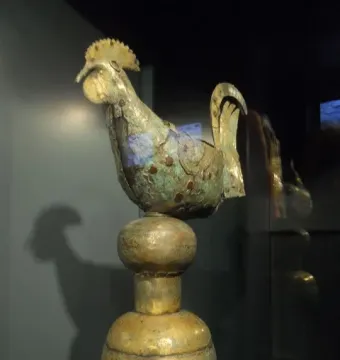
© RobyBS89 · Public domain
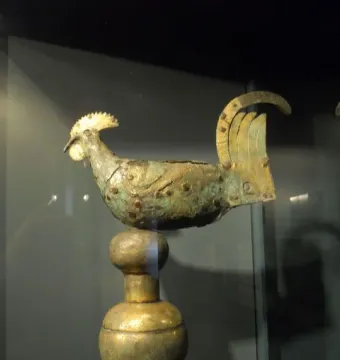
© RobyBS89 · Public domain
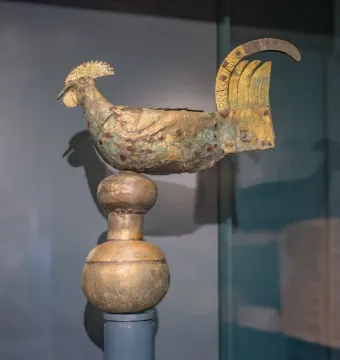
November 2020 · CC BY-SA 3.0
© RobyBS89 · Public domain
Identification | |
| Title | Gallo di Ramperto |
| Translated title | Ramperto's Rooster |
| Type | Weather vane rooster |
Historical context | |
| Date | Early 9th century, probably 820; some scholars proposed 830 |
| Commissioned by | Ramperto, Bishop of Brescia |
| Commission purpose | To adorn the top of the bell tower of the church of Santi Faustino e Giovita in Brescia |
| Historical context | Created in the context of the cult of Saints Faustino and Giovita and the renewal of their church complex under Bishop Ramperto, after the translation of the saints' relics to Santa Maria in Silva in 806 |
Creator | |
| Maker | Unknown; the object bears a damaged signature that has been read only as "M [...] OALDVS" |
Materials | |
| Material | Copper sheet over an iron framework |
| Support spheres | Two gilded spheres, 20 cm and 15 cm in diameter |
Technique | |
| Construction | Thin copper sheet, possibly double-layered, hammered and curved around the framework and fixed with numerous nails |
Physical characteristics | |
| Size | Slightly smaller than life-size |
Appearance | |
| Signature | A maker's signature at the base is heavily damaged and only partly legible as "M [...] OALDVS" |
| Inscription text | Fragmentary: "PRECEPIT ANNO D" and "O SEXTO" |
| Mounting | Not fixed, but pivoted on the spheres to turn in the wind |
| Inscription | A Latin dedicatory inscription was incised on both sides of the tail feathers, but only a few fragmented words survive |
| Form | Rooster with a wide, flattened tail |
| Surface finish | Originally gilded and silvered; traces of gilding still remain, especially on the wattles |
Location and ownership | |
| Original location | Top of the bell tower of the church of Santi Faustino e Giovita, Brescia |
| Current location | Museo di Santa Giulia, Brescia |
History and restoration | |
| Removal from tower | 1891 |
| Reason for removal | To be restored and preserved in the museum |
| Condition | Essentially intact, though the tail feathers are damaged and much of the inscription is lost |
| Restoration | Restored before being placed on permanent display in 1999 |
| Replica | A copy was made in 1938 and placed back on the bell tower |
Significance | |
| Historical significance | Considered the oldest surviving weather vane rooster today |
| Publication and scholarship | First published by Cosimo Lauri in 1572; later described by Ottavio Rossi (1624), Bernardino Faino (1670), Gian Andrea Astezati (1728), Gian Maria Biemmi (1748), Francesco Novati (1905), and Fedele Savio (1929) |
| Authenticity debate | Its date and authenticity were long disputed: Biemmi considered it a fake, Novati accepted a 9th-century date as plausible, and Savio argued that the inscription's indiction should point to 830 rather than 820 |
| Approximate age | Nearly 1200 years |