
Heidelberg Bridge Monkey
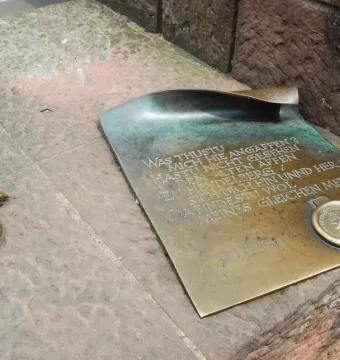
The Heidelberg Bridge Monkey was a 15th-century stone statue placed in the tower of Heidelberg’s Old Bridge, opposite the Old Town. The tower was meant to inspire fear and respect in arriving visitors, while the monkey served as a symbol of mockery. It showed the Electoral Palatinate Greeting by touching its bare backside, with the gesture directed toward Mainz to signal defiance toward the Bishops there. The monkey also held a mirror, intended to encourage critical self-reflection. The original statue was destroyed вместе with the tower during the Nine Years’ War. A poem by Martin Zeiller from the 17th century is still displayed beside the modern version.
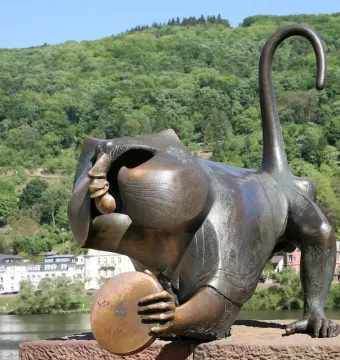
April 2011 © W. Bulach · CC BY-SA 4.0
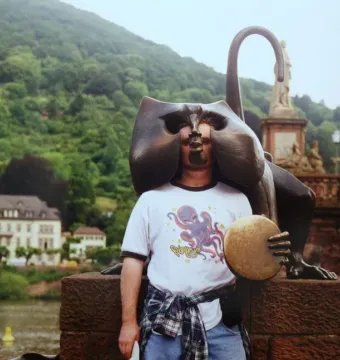
June 2001 © Gary Todd · CC0
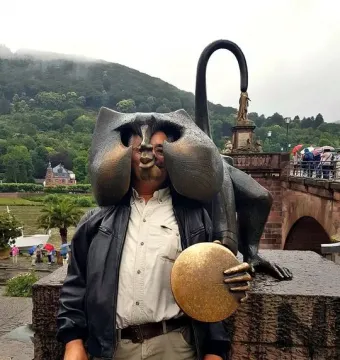
2016 © Altera levatur · CC BY-SA 4.0
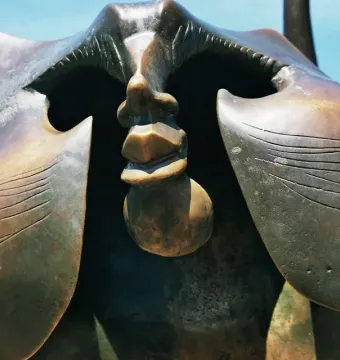
July 2014 © Q-ART · CC BY-SA 4.0
July 2010 © Wing · CC BY-SA 3.0
Identification | |
| Title | Heidelberg Bridge Monkey |
| German name | Heidelberger Brückenaffe |
| Type | statue |
Historical context | |
| Date | 15th century |
| First mention | 1481 |
| Destruction date | 1689 |
| Historical destruction | Destroyed during the Palatinate War of Succession, together with the bridge tower |
Creator | |
| Sculptor | Gernot Rumpf |
| Commissioned by | the association Alt-Heidelberg |
| Designed | 1977 |
| Installed | 1979 |
Discovery and provenance | |
| Original form | a sculptural stone figure |
| Historical placement | Already seated in one of the bridge towers in the 15th century |
Materials | |
| Material | stone |
| Material | bronze |
Physical characteristics | |
| Subject | a monkey |
| Subject | a monkey with a hollow head |
| Species depiction | original version resembled a vervet monkey; the current version depicts a baboon |
| Head | hollow |
| Gesture | the right hand shows the mano cornuta (horned hand) gesture |
| Mirror | holds a mirror out toward passersby |
Appearance | |
| Associated text | a poem by Martin Zeiller, from the 17th century, is still beside the sculpture |
| Chest emblem | a coat of arms on the chest |
| Chest emblem composition | a combination of the Electoral Palatinate coat of arms, the Baden coat of arms, and the German flag |
| Chest inscription | HEIDELBERG |
Iconography and meaning | |
| Former function | to evoke reverence and fear in arriving visitors |
| Symbolic meaning | mockery and satire |
| Gesture meaning | the Palatinate greeting, addressed to the Bishops of Mainz to show that they held no power over the Electors of the Palatinate |
| Backside orientation | facing toward Kurmainz, especially toward the Mainz bishops |
| Mirror meaning | intended to prompt critical self-reflection |
| Hand gesture meaning | to ward off the evil eye |
Location and ownership | |
| Current version | today's version of the monkey |
| Associated city | Heidelberg |
| Associated bridge | Old Bridge |
| Current location | at the Old Bridge in Heidelberg, next to the tower on the Altstadt side |
| Original location | in a niche above the gate in the north tower of the Old Bridge over the Neckar in Heidelberg, on the side opposite Heidelberg's Old Town, at the present-day Neuenheimer Ufer |
History and restoration | |
| Reason for current location | the north tower was not rebuilt after being blown up |
Significance | |
| Tourist status | popular tourist attraction today |
| Associated object | a plush toy version of the Heidelberg Bridge Monkey |
| Availability | available in several shops in Heidelberg's Old Town since May 2016 |
| Sizes | about 15 cm and about 20 cm |
| Popularity | a sought-after souvenir from Heidelberg, especially among children |
| Child-oriented design | a friendlier version for children that touches its mouth instead of showing the rear-end gesture or the mano cornuta |
| Inscriptions and emblem on plush toy | the word HEIDELBERG above a chest emblem combining the Electoral Palatinate coat of arms, the Baden coat of arms, and the German flag |
| Plush toy chest emblem | a coat of arms on the chest |