
The Fisherman’s Statue with a Fountain
The Fisherman’s Statue with a Fountain, also known as the Fisherman Fountain, is a spring fountain on the main roundabout of Kalemegdan park in Belgrade. It was created by the sculptor Simeon Roksandić in 1906, during a year-long stay in Munich and Rome. The work was first shown in 1907 at the LXXII International Art Exhibition in Rome, where it received positive attention, including from the Italian royal couple. The Serbian National Museum bought the plaster model in 1907, and the figure was later presented as a key artwork in the Serbian pavilion at the 1907 Balkan Exhibition in London. The composition of a fisherman fighting a snake became a symbol of the young Serbian state and its cultural progress.
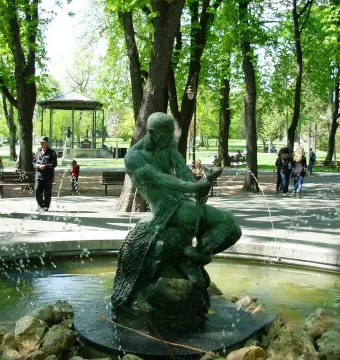
© Goldfinger · CC BY-SA 3.0 rs
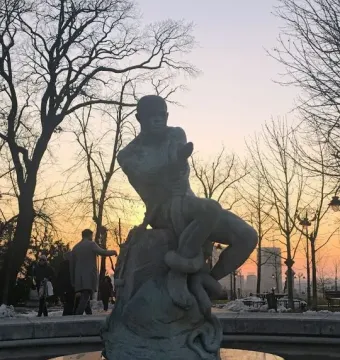
January 2026 © Helena Milosevic · CC BY 4.0
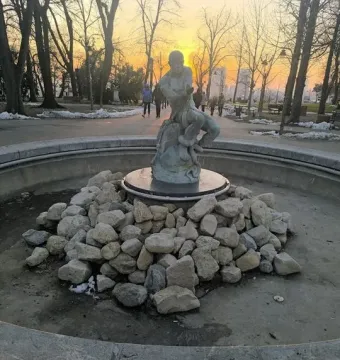
January 2026 © Helena Milosevic · CC BY 4.0
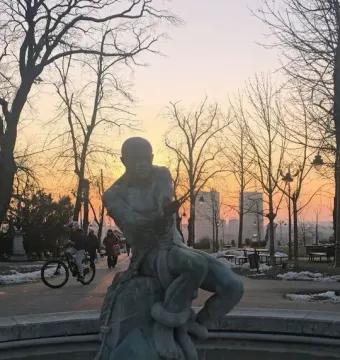
January 2026 © Helena Milosevic · CC BY 4.0
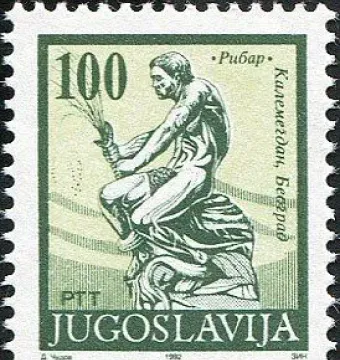
May 1992 © Dimitrije Čudov · Public domain
Identification | |
| Title | The Fisherman Fountain |
| Style | Classical European sculpture |
| Alternative titles | La fontaine du Pêcheur; Le Pêcheur malheureux; The Unfortunate Fisherman; El Pescador; Фонтана Рибар; Злосретни рибар |
| Type | Fountain sculpture |
Historical context | |
| Creation place | Munich and Rome |
| Created during | A one-year leave from his post as drawing teacher at the Kragujevac gymnasium |
| Creation date | 1906 |
Creator | |
| Training | Studied at the School of Arts and Crafts in Zagreb, attended sculpture courses at the Academy of Pest, and entered the Academy of Fine Arts in Munich in 1892 |
| Artist's interpretation | He said he made the Fisherman to symbolize the victory of man over nature |
| Artist nationality | Serbian |
| Artist | Simeon Roksandić |
| Munich professor | Syrius Eberle |
Materials | |
| Model material | Plaster model |
Appearance | |
| Depicted subject | A fisherman struggling with a snake |
| Composition of model | A fisherman and a snake |
Location and ownership | |
| London exhibition role | Displayed in the Serbian pavilion at the 1907 Balkan Exhibition in London as the pavilion's key or main artistic work |
| Heritage status | Classified as cultural heritage of great importance under Official Gazette of SRS no. 14/79 |
| Second cast location | Grič, now Jezuitski trg, in Zagreb's Upper Town |
| Second cast owner | Bought by the Zagreb municipality after the third Lada exhibition in Zagreb in 1908 |
| Second cast | After false news that the ship carrying the artworks had sunk, a second cast was made from the plaster model |
| Exhibition display position | The first and largest exhibition room |
| Museum acquisition | The plaster model was purchased by the National Museum of Belgrade in 1907 |
| Belgrade acquisition | The first plaster model was offered to and accepted by the Belgrade municipality in 1907 |
| Exhibition location | LXXII International Art Exhibition in Rome |
| Original intended location | Terazije Square, Belgrade |
| Specific site | The central roundabout of Great Kalemegdan Park, on an existing oval fountain with a rustic stone pedestal |
| Current location | Kalemegdan Park, Belgrade, Serbia |
History and restoration | |
| Later status in Belgrade | By 1911 it had become one of the most recognizable monuments of the city |
| Evidence for Belgrade installation | A 1911 photo illustration in Nova iskra confirms it was already in Kalemegdan Park |
| Belgrade installation date | Between 1908 and 1911 |
| Reception in Serbia | Recognized by the Serbian cultural elite and quickly became part of Serbian cultural life |
| Reception in Italy | Received very positive reviews, including praise from the Italian royal couple |
| First public presentation | 1907 |
Significance | |
| Symbolic meaning | An emblem of the young Serbian state and a metaphor for cultural progress, artistic development, and the victory of humanity over nature |
| Artistic significance | Described in the press as a work of universal artistic value with national distinctiveness |
Other | |
| Park context | Placed in a representative fin-de-siècle urban park modeled on the parks of European metropolises and conceived as a memorial promenade of national figures and events |
| Park planning background | The park layout grew out of Emilijan Joksimović's urban plan and was first developed architecturally by Milan Kapetanović in 1890; the original concept was maintained until 1914 |
| Park design feature | Kapetanović's solution emphasized a straight axis from Knez Mihailova Street to the central rotunda |
| Public sculpture in park | The installation of public sculptures in the park began in 1894 with the bust of Đuro Daničić |