
Cobblestone - a Weapon of the Proletariat
Cobblestone - a weapon of the proletariat is a bronze sculpture by Russian sculptor Ivan Shadr, created in 1927. It belongs to the collection of the Tretyakov Gallery in Moscow. Shadr made the work for the all-Russian exhibition of art celebrating the tenth anniversary of the October Revolution, drawing on his own memories of the 1905 revolution in Yekaterinburg. The figure of the insurgent worker is an allegory of revolution, conceived as a compressed spring ready to explode with destructive force. Shadr carefully modeled the body to show expressive movement from every side, with the broken cobblestones especially visible on the left and the motion of the worker beginning on the right.
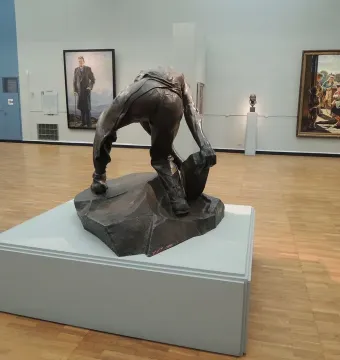
© Shakko · CC BY-SA 4.0
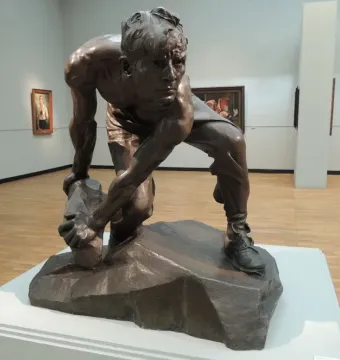
© Shakko · CC BY-SA 4.0
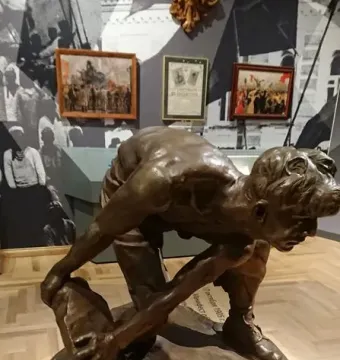
November 2021 © Stas Kozlovskiy · CC BY-SA 4.0
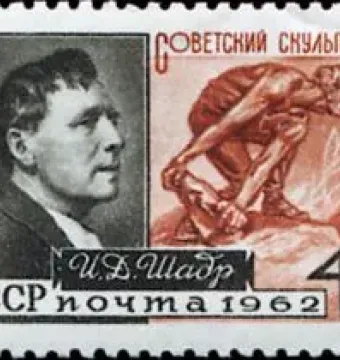
July 1962 © Василий Васильевич Завьялов · Public domain
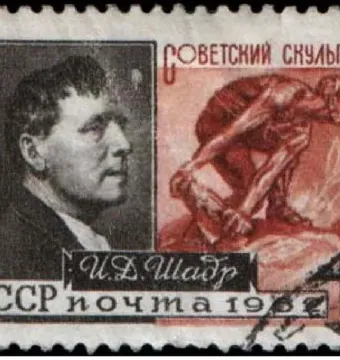
July 1962 © Василий Васильевич Завьялов · Public domain
Identification | |
| Title | Cobblestone - a weapon of the proletariat |
| Alternative title | Bruk – broń proletariatu |
| Type | Sculpture |
| Style | Socialist Realism |
| Original title | Булыжник — оружие пролетариата |
Creator | |
| Artist | Ivan Shadr |
| Artist nationality | Russian |
| Year created | 1927 |
Materials | |
| Material | Bronze |
| Original material | Plaster |
| Bronze casting year | 1947 |
Location and ownership | |
| Museum copy | A bronze copy made from the original of 1927 and held in the exhibition of the State Museum of Contemporary History of Russia |
| Moscow inscription | A bronze-letter quotation of V. I. Lenin: 'The feat of the Presnya workers was not in vain. Their sacrifices were not in vain.' |
| Heritage status | Included in the list of cultural heritage objects of Moscow |
| Shadrinsk composition | An architectural-sculptural composition in Shadr Square, Shadrinsk, installed in 1976; sculptor Yu. L. Chernov; architect G. G. Isakovich; center: a bust of I. D. Shadr; accompanying works: two bronze sculptures by Shadr, 'Cobblestone - a weapon of the proletariat' on the left and 'Seasonal Worker' on the right; cast at the Mytishchi Art Casting Plant |
| Kyiv copy | A copy of the sculpture was installed in Red Presnya Square, Kyiv, in 1982 as a gift from Moscow for the friendship of the labor collectives of Podolsk District of Kyiv and Krasnopresnensky District of Moscow; moved in 2006 to the square in front of the Zhovten Cinema; dismantled on 28 October 2016; current status: demolished; current location: decommunization museum in Nyvky |
| Moscow installation setting | Designed by M. N. Kazarnovsky and L. N. Matyushin |
| Plaster version location | Tretyakov Gallery |
| Bronze copy in Moscow | Installed in the Park of the December Uprising on Krasnaya Presnya, Moscow, in 1967 for the fiftieth anniversary of the October Revolution |
| Current location | Tretyakov Gallery, Moscow |
Historical context | |
| Interpretation | An allegorical representation of the revolution |
| Historical reference | A compressed spring ready to straighten with destructive force and unfold into the events of 1917 |
| Original concept | Shadr originally intended to use the image of a man breaking shackles, but later abandoned this idea to avoid romantic symbolism of the past |
| Inspiration | Shadr based the sculpture on his memories of the 1905 Revolution, when he saw demonstrations in Yekaterinburg |
| Historical context | Created as part of a memorial complex dedicated to the revolutionary events of 1905 on Presnya |
| Created for | The All-Russian Exhibition of Works of Art on the occasion of the tenth anniversary of the October Revolution |
Iconography and meaning | |
| Image type | Heroic image symbolizing the era of the early 20th century and the First Russian Revolution of 1905 |
| Figure characterization | Not a bowed slave, but a future victor |
| Action depicted | The worker is prying a cobblestone out of the pavement to use it as a weapon |
| Subject | An insurgent worker |
| Depicted figure | An idealized proletarian of the early 20th century, a fighter for revolutionary ideals and freedom |
| Overall meaning | Promises victory and summarizes all the Russian revolutions |
Physical characteristics | |
| Stylistic aim | To sculpt all expressive sides equally, inspired by the beauty of human body proportions and laconic form |
| Figure treatment | The body is modeled in a highly expressive, rigid, and highly relief manner |
| Composition | Highly dynamic, based on an unfolding spiral |
| View-specific composition | From the left side, the difficulty of breaking the cobblestone is visible; from the right side, the worker's movement has begun; from the front, the trajectory of the weapon's future flight is visible |
| Backdrop | Light-gray granite wall |
| Base | Low granite slab pedestal |
| Emotional state depicted | An uplifted spiritual state with concentration of spiritual and physical energy |
History and restoration | |
| Moscow inscription status | Erased after 1991, though traces of the letters can still be seen on close inspection |
Significance | |
| Reception | Gained popularity in the USSR and is considered a masterpiece of Soviet art of the Socialist Realism period |
| Artistic significance | One of the brightest phenomena of realist art of the 20th century |
| Critical reception | Critics traditionally note its high artistic quality and the artist's masterful craftsmanship |
| Associated phrase | Gave rise to the humorous-ironic winged expression 'Cobblestone — the weapon of the proletariat' |
| Commentary | Mikhail Nesterov noted that Shadr united 'the beauty of the spirit with the eternal beauty of form,' as the great masters of the Renaissance did |
Other | |
| Photography captions | Front view; right side; left side; rear view |
| Photo file date | 1927 |