
Stork Fountain
Stork Fountain is located in Amagertorv in the center of Copenhagen, Denmark. It was a gift to Crown Prince Frederick, later Frederick VIII, and Princess Louise on the occasion of their silver wedding anniversary in 1894. The fountain shows three storks poised to depart. Its design includes a nine-sided stone basin that collects water from a bronze bowl above, with three small cascades around the edges of a central pedestal. The pedestal is decorated with reliefs of aquatic plants and water jets, and one section features three large birds each turning in a different direction. Since 1950, it has been a tradition to dance around the fountain.
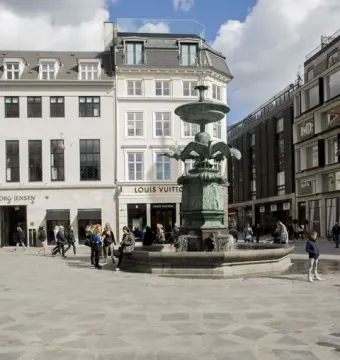
© Brian Jonsson · CC0
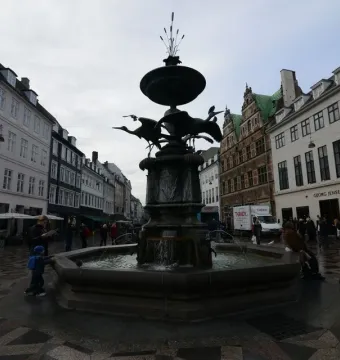
© Jorge Láscar · CC BY 2.0
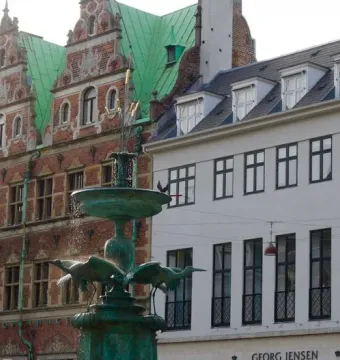
May 2016 © Marie Thérèse Hébert & Jean Robert Thibault · CC BY-SA 2.0
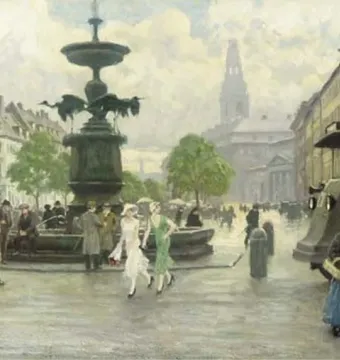
© Paul Fischer · Public domain
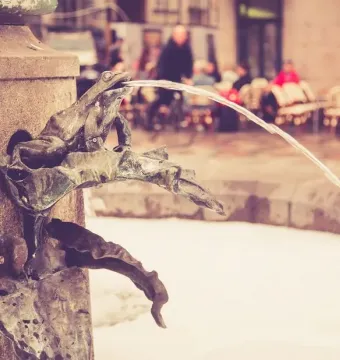
September 2014 © Tony Webster · CC BY 2.0
Identification | |
| Title | Stork Fountain |
| Original name | Storkespringvandet |
| Type | Fountain sculpture |
Historical context | |
| Commissioned by | Society for the Beautification of Copenhagen (Association for Beautifying the Capital) |
| Founded | 1885 |
| Competition announced | 1888 |
| Purpose | A fountain on the prominent square, intended as a gift from the city to Crown Prince Frederik (later Frederick VIII) and Crown Princess Louise of Sweden for their silver wedding anniversary in 1894 |
| Gift recipient | Crown Prince Frederik (later Frederick VIII) and Crown Princess Louise of Sweden |
| Occasion | Their silver wedding anniversary in 1894 |
Creator | |
| Sculptor | Vilhelm Bissen |
| Winning designers | Edvard Petersen and Vilhelm Bissen |
Location and ownership | |
| Legal status | Listed monument |
| Location | Amagertorv, central Copenhagen, Denmark |
Discovery and provenance | |
| Other competition entry | Dragon Fountain by Thorvald Bindesbøll and Joakim Skovgaard |
| Other entry location | Installed on Rådhuspladsen (City Hall Square) instead |
| Another proposed design | A fountain depicting a merry Amager farmer sitting on a cabbagehead, proposed by Peder Vilhelm Jensen-Klint |
History and restoration | |
| Experiment date | Early 2009 |
| Demolition threat | Fictitious; there was no real threat of demolition |
| Members after two weeks | 27,000 |
| Supporters after one week | 10,000 |
| Creator of protest group | Anders Colding-Jørgensen, lecturer from the University of Copenhagen |
| Associated event | A fictitious 2009 Facebook protest group against its demolition, created as a classroom experiment on viral communication, slacktivism, and social media |
| Popular as a meeting place | During the late 1960s, the fountain became a popular meeting place for members of the protest movements |
| Tradition | Since 1950, newly graduated midwives dance around the fountain |
| Inauguration date | 1894 |
| Associated protest song | Cæsar's protest song "Storkespringvandet" about police brutality, with lyrics by Thøger Olesen and tune based on the Scottish nursery rhyme "Ally Bally Bee" ("Coulter's Candy") |
Physical characteristics | |
| Basin decoration | Alternating groups of three water-spouting frogs sitting on leaves and three shell forms |
| Bird identification | The birds are storks, not herons |
| Upper bowl feature | A fountain bowl above from which cattails grow |
| Intermediate decoration | Motifs of reed plants |
| Pedestal decoration | Reliefs of aquatic plants |
| Main figure posture | With outstretched wings, appearing to take flight |
| Main figures | Three storks |
| Structure | A multi-part column rises from the basin |
| Base shape | Hexagonal |
| Basin shape | Nonagonal |
Materials | |
| Basin material | Stone |
| Base material | Granite |
| Upper bowl material | Bronze |
| Intermediate element material | Bronze |
Appearance | |
| Water feature | Water collects from the bronze bowl at the top and flows through three small cascades around the edges of the central pedestal; frogs also spout water from the basin decoration |
| Plant motifs | Reed plants and cattails are used as decorative elements |
| Depiction | Three storks about to set off, each in a different direction |
Significance | |
| Bird identification legend | A common urban legend says the birds depicted are herons |