
Immortality Overtaking Time
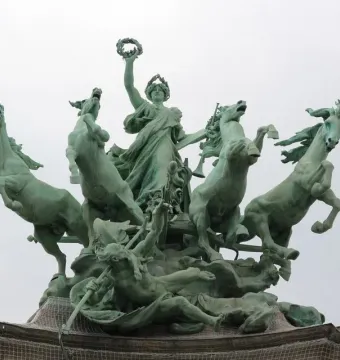
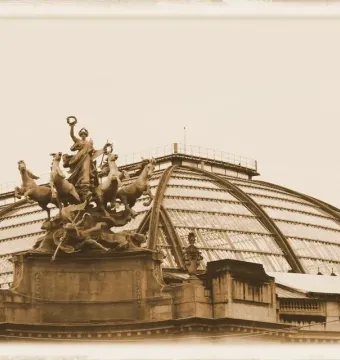
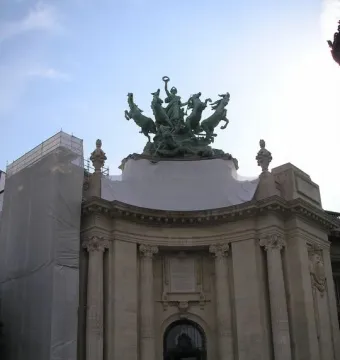
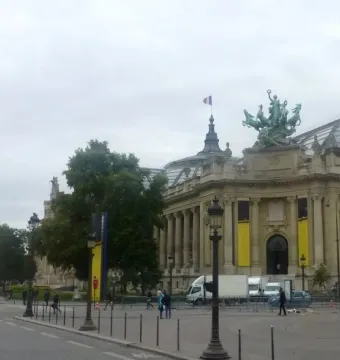
Immortality Overtaking Time is a 1900 allegorical sculpture in Baroque style, made of green-patinated copper by Georges Récipon (1860–1920). It crowns the roof of the Grand Palais on the Champs-Élysées side in Paris. The work depicts “Immortality” in an allegorical way and forms part of a pair of monumental sculptures celebrating the virtues of the French Republic. Its companion piece is L’Harmonie triomphant de la Discorde on the Seine side of the Grand Palais. Both sculptures were created for the 1900 Exposition Universelle in Paris.
© Fred Romero · CC BY 2.0
© Carl Campbell · CC BY 2.0
May 2006 © Gryffindor · Public domain
© giggel · CC BY 3.0
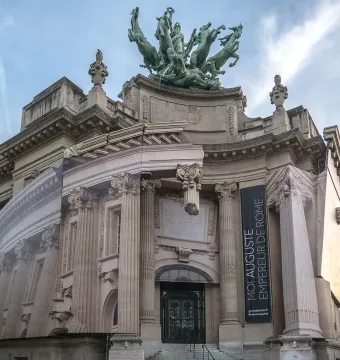
June 2014 © Yann Caradec · CC BY-SA 2.0
Identification | |
| Title | Immortality Overtaking Time |
| Style | Neo-Baroque |
| Original French title | L'Immortalité devançant le Temps |
| Type | Allegorical quadriga sculpture group |
Historical context | |
| Date of creation | 1898 to 1901 |
| Commissioning context | Promoted by the French state for the 1900 Paris Universal Exposition |
| Historical context | Created for the 1900 Exposition Universelle de Paris during the early years of the French Third Republic (founded in 1871) |
Creator | |
| Sculptor | Georges Récipon (1860–1920) |
Location and ownership | |
| Location | Champs-Élysées side of the roof of the Grand Palais, Paris, France |
| Associated building | Grand Palais |
| Associated urban axis | Avenue des Champs-Élysées |
| Paired sculpture | L’Harmonie triomphant de la Discorde on the Seine side of the Grand Palais |
| Part of | The sculptural decoration crowning the two end rotundas of the Grand Palais |
Appearance | |
| Composition | A quadriga drawn by four rearing horses at a gallop, driven by an allegorical charioteer |
| Direction | Rushes triumphantly toward the Avenue des Champs-Élysées |
| Artistic treatment of horses | Rendered with strong realism and dynamism |
| Realist details | Dilated and vibrating nostrils, muscular bodies with veins protruding under the skin, and strongly expressive heads |
Materials | |
| Decorative materials | Ceramic details |
| Surface patina | Green-gray verdigris patina formed by oxidation over time |
| Support structure | Metal armature/frame |
| Primary material | Copper |
| Exterior surface material | Hammered and repoussé copper sheets |
Physical characteristics | |
| Weight | About 12 tonnes per horse group |
| Number of groups | Two |
| Visible decorative locations | Wheel spokes of the chariots and the rear part of the sculptures |
Iconography and meaning | |
| Symbolism | The virtues of the French Republic |
| Mythological and symbolic references | The avenue is evoked as linked to the Elysian Fields, the eternal resting place of great virtuous heroes |
| Associated symbolism | Belle Époque ideals of progress, peace, and civic and human virtues |
| Related counterpart opposing figure | Eris, goddess of Discord |
| Related counterpart driver | Apollo |
| Related counterpart meaning | Harmony triumphing over Discord |
| Related counterpart | L’Harmonie triomphant de la Discorde |
| Depiction of Time | Shown defeated and plunged into emptiness by the rearing horses |
| Thematic interpretation | The scene expresses the victory of memory and celebration over the passage of time and the end of life |
| Main allegorical meaning | Public and perpetual glory triumphing over Time and Death |
| Personification of Time | Chronos, god of Time and Destiny |
| Attributes of the charioteer | A tablet inscribed with the names of the heroes and a trumpet proclaiming their worth |
| Charioteer figure | La Renommée (Fame), shown as a laurel-crowned messenger of victory and honor |
| Mythological subject | Greco-Roman mythology |
| Theme | Immortality overcoming Time |
Other | |
| Related exposition | 1900 Paris Universal Exposition |
History and restoration | |
| Restoration | Fully restored between 2001 and 2004, at the same time as the Grand Palais |