
The Three Graces
The Three Graces is a neoclassical marble group by the French sculptor of Swiss origin James Pradier. Created in 1831, it is carved in Carrara marble and is now preserved in the sculpture department of the Louvre Museum in Paris. The work depicts the three Graces—Aglaea, Euphrosyne, and Thalia—standing side by side, supporting one another and gazing into space. One central figure rests her foot on a box of jewels, while the other two hold a floral garland. The composition combines charm and soft execution with carefully rendered details, and its idealized forms place it in dialogue with earlier works on the same theme by Canova and Thorvaldsen.
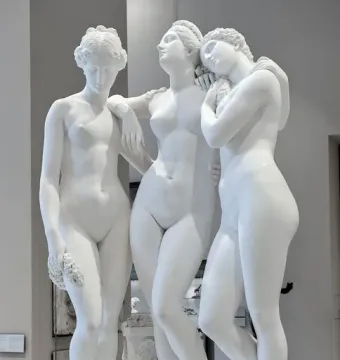
November 2024 © Romainbehar · CC0
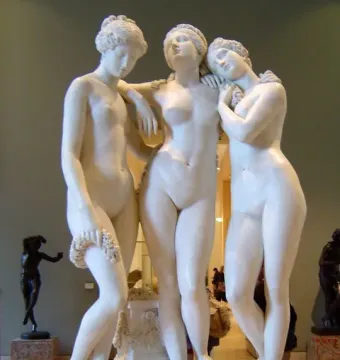
February 2006 © Miniwark · CC BY-SA 3.0
September 2009 © gadgetdude · CC BY 2.0
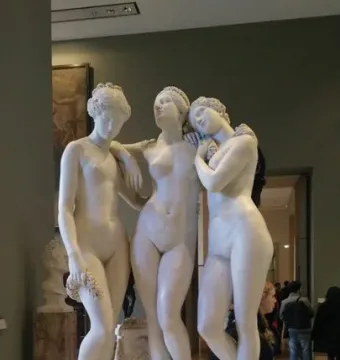
November 2014 © Nathanael Burton · CC BY-SA 2.0
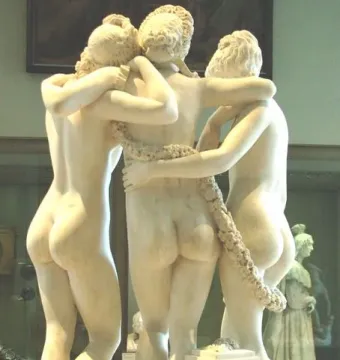
May 2015 © Gautier Poupeau · CC BY 2.0
Identification | |
| Title | The Three Graces |
| Original title | Les Trois Grâces |
| Italian title | Le tre Grazie |
| Type | Neoclassical sculptural group |
Historical context | |
| Critical reception | Praised by critics |
| Exhibited at | Paris Salon of 1831 |
| Model date | c. 1825 |
| Style | Neoclassical |
| Date created | 1831 |
| Relation to Neoclassicism | The subject had already been treated in Neoclassical sculpture by Antonio Canova and Bertel Thorvaldsen |
Creator | |
| Sculptor's nationality | French, of Swiss origin |
| Sculptor | James Pradier |
Materials | |
| Material | Carrara marble |
| Model material | Plaster |
Location and ownership | |
| Current location | Department of Sculptures, Louvre Museum, Paris |
| Previous location | Museum of the Palace of Versailles |
| Transferred to | Louvre Museum |
Discovery and provenance | |
| Purchase date | 27 September 1831 |
| Payment date | 24 October 1831 |
| Purchased by | Ministry of the King's Household |
Significance | |
| Award | Legion of Honour |
| Award reason | For this work |
| Artistic comparison | The composition and execution are compared to works by Antonio Canova and Bertel Thorvaldsen |
Iconography and meaning | |
| Subject | The Graces, daughters of Zeus and Eurynome |
| Figures depicted | Aglaia, Euphrosyne, and Thalia |
| Interpretation of nudity | Their nudity is presented without shame; purity is described as their main characteristic, and modesty as lying in the viewer's eye |
Physical characteristics | |
| Number of figures | Three |
| Detail rendering | Meticulous realistic rendering of details |
Appearance | |
| Pose | The three women stand next to one another, facing the viewer with their bodies turned toward the spectator and their gazes lost in the distance |
| Mood | They appear tired, probably after dancing, and seem to be trying to rest in the most comfortable pose |
| Nudity | Completely nude |
| Attributes | The central Grace rests her foot on a casket of jewels, and the other two hold a garland of flowers |
| Comparison with Canova | Compared with Canova's group, Pradier's version is more idealized to make the goddesses seem more divine |
Other | |
| Image details | Close-ups of the Graces' faces, the garland of the left Grace, and the jewel casket |