
Dolphin Fountain
The Dolphin Fountain was built in 1526, at the same time as the development of Via Pignolo in Bergamo. The street, formed in the 16th century alongside the Venetian walls, became one of the city’s most distinctive areas, lined with notable 16th-century palaces. The fountain stood at the crossroads connecting the old Pelabrocco and Cornasello areas, which led via Via Osmano toward the hill of Sant’Agostino. It was supplied by a Roman-origin aqueduct known as Prato Baglioni, named after its former owner and corresponding to the Colle Aperto area. The work is by an unknown author and was probably commissioned by one of the noble families already owning the nearby palaces in the early 16th century.
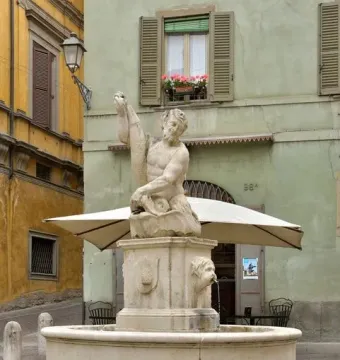
April 2015 · CC BY-SA 3.0
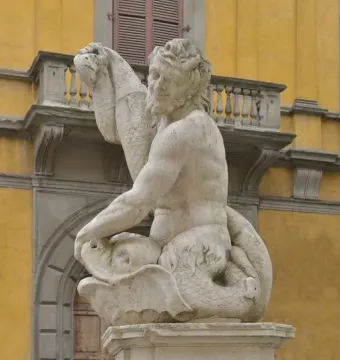
April 2015 · CC BY-SA 3.0
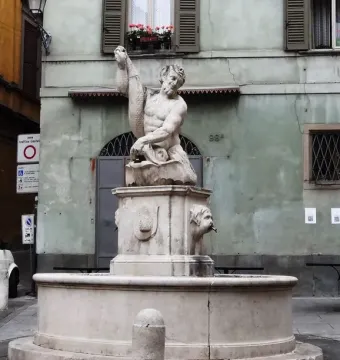
April 2015 © Rollroboter · CC BY-SA 4.0
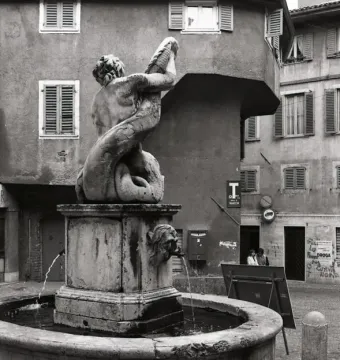
© Paolo Monti · CC BY-SA 4.0
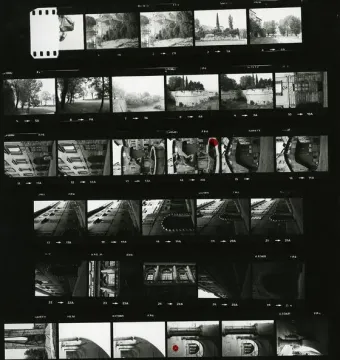
© Paolo Monti · CC BY-SA 4.0
Identification | |
| Title | Dolphin Fountain |
| Italian name | Fontana del Delfino |
| Original French name | Fontaine du Dauphin |
| Type | Fountain sculpture |
Location and ownership | |
| Location | Via Pignolo, Bergamo, Italy |
Historical context | |
| Construction date | 1526 |
| Construction period | Built at the same time as the formation and urbanization of Via Pignolo, and as part of the construction of the Venetian walls |
Creator | |
| Attribution | The work appears to be by an unknown sculptor of high artistic quality |
| Artist | Unknown |
| Commissioning | Probably commissioned by one of the families that owned the nearby palaces already in the early 16th century |
Discovery and provenance | |
| Aqueduct name origin | Named after its former owner |
| Aqueduct location reference | Corresponding to the area of Colle Aperto |
| Aqueduct route | It ran along Via Boccola after Piazza Mascheroni to the fara, reaching Via Pignolo |
| Water supply | Fed by the Roman aqueduct Prato Baglioni |
Physical characteristics | |
| Stele | A square stele with curved corners placed inside the basin |
| Basin shape | Oval |
| Basin placement | On a step |
| Size | Not large |
Materials | |
| Stele material | White Zandobbio marble |
Appearance | |
| Mascarons subject | Marine deities |
| Mascarons hair | Hair shaped like leaves |
| Main sculptural group | A triton with two fish tails riding a dolphin with a long tail |
| Movement | Dynamic plastic movement |
| Water feature | Water flows from the mouths of the mascarons and the dolphin |
| Additional sculpted element | A large pine cone carved on the stele |
| Stylistic quality | Highly refined sculptural workmanship |
| Visibility | The triton's forms are clearly recognizable from any viewpoint |
| Side ornaments | Two mascarons on opposite sides of the pillar |
Iconography and meaning | |
| Symbolism of the pine cone | An ancient symbol of the street, representing the former conifer forest that gave rise to the toponym |