
Cavalcanti Annunciation
The Cavalcanti Annunciation is a sculpture by Donatello, made around 1435 in gray sandstone, with some areas polychromed and gilded. Measuring 218 x 168 cm, it is located in the right nave of the Basilica of Santa Croce in Florence. It is one of the few works by the great sculptor still in its original place. The scene is set within a richly decorated Renaissance tabernacle with Cavalcanti coats of arms, terracotta cherubs, and ornate gilded details. The Annunciation itself is rendered in high relief, with the Angel and the Virgin shown at the moment after the angel’s appearance in a calm and intimate exchange.
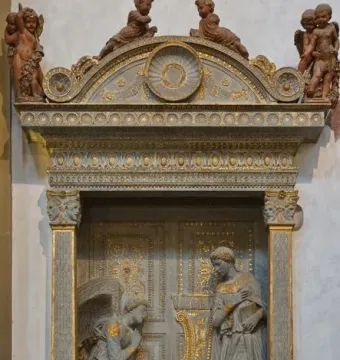
September 2021 © MenkinAlRire · CC BY-SA 4.0
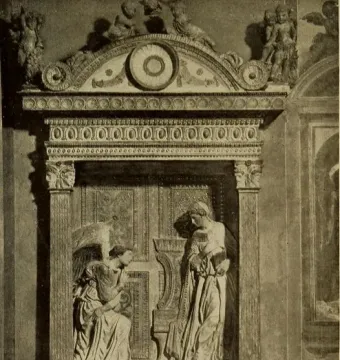
1911 © Internet Archive Book Images · No restrictions
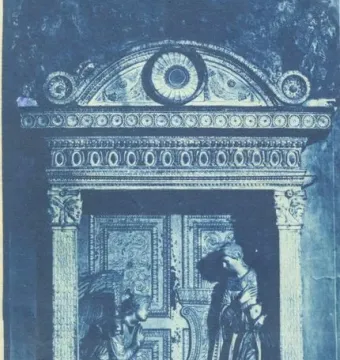
© William Henry Goodyear · Public domain
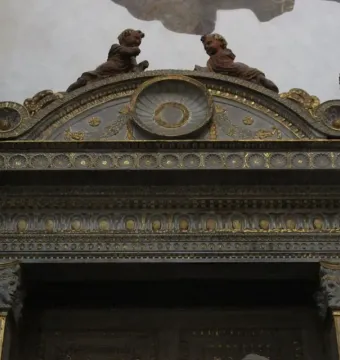
July 2015 © Miguel Hermoso Cuesta · CC BY-SA 4.0
December 2017 © Sailko · CC BY 3.0
Identification | |
| Original Italian title | Annunciazione Cavalcanti |
| Title | Cavalcanti Annunciation |
Historical context | |
| Date | Probably carved between Donatello's return from Rome in 1433 and his departure for Padua in 1443; the exact date has been much disputed, with a 1430s dating first proposed by Schmarsow in 1886 and accepted by Semper in 1887 after revising his earlier attribution |
| Commissioned by | Niccolò Cavalcanti |
| Named after | The Cavalcanti family, for whom it was made |
Creator | |
| Artist | Donatello |
Discovery and provenance | |
| Original location | Niccolò Cavalcanti's funerary chapel in the Basilica of Santa Croce, Florence |
| Current location | Right nave of the Basilica of Santa Croce, Florence |
| Original chapel status | The funerary chapel no longer exists and cannot be reconstructed with certainty |
| Possible Medici involvement | A Medici role in commissioning the work cannot be excluded because Lorenzo il Vecchio, brother of Cosimo de' Medici, was married to Ginevra Cavalcanti |
Physical characteristics | |
| Setting | Inserted in a Renaissance tabernacle |
| Type | Relief sculpture / tabernacle ensemble with an Annunciation scene |
| Dimensions | 420 x 274 cm |
Materials | |
| Material | Gilded pietra serena |
| Additional material | Terracotta cherubs with traces of polychromy |
| Surface treatment | Partly polychromed |
| Surface treatment | Partly gilded |
Technique | |
| Relief level | High relief |
Appearance | |
| Putti | Six terracotta putti with traces of polychromy supporting festoons, arranged as two reclining at the apex and two standing pairs at the sides |
| Angel | Kneeling before Mary, looking at her timidly and gently with a slight turn of the head, large eyes, and a slightly parted mouth |
| Virgin Mary | Seated or rising from a lyre-shaped backless throne, startled but controlled, with one hand on her chest and her face turned toward the angel |
| Main scene | The Annunciation is placed at the center against a richly ornamented, flat background with gilded frames and scrolling motifs |
| Setting style | The background avoids the complex illusionistic architecture typical of many painted Annunciation scenes |
| Upper termination | A semicircular cymatium with rosettes on the sides and a central fluted rosette or rose window with garlands and rosettes in relief |
| Pilasters | Two rectangular, highly original decorated pilasters with volutes and lion paws at the bases, scale-like leaves on the shafts, and mascarons or masks at the capitals |
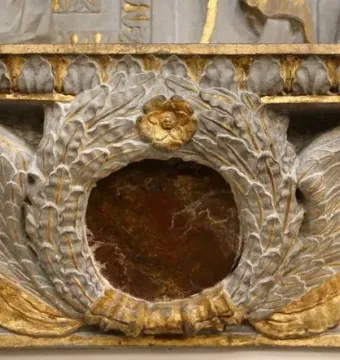
| Central base ornament | A winged crown containing a smooth black granite disk, apparently added to receive an inscription |
| Base | Supported by two corbels bearing the Cavalcanti coats of arms |
| Structure | The tabernacle is framed by a base, decorated pilasters, an entablature, and a semicircular upper termination |
| Entablature | Composed of several moldings and cornices with gilded decoration, including dentils, small leaves, ovules, and rosettes |
Iconography and meaning | |
| Virgin's attribute | A book, the typical Marian attribute, recalling the fulfillment of the prophets' Scriptures |
| Associated background element | A lectern appears behind Mary |
| Missing angelic attribute | The angel does not carry the traditional lily or olive branch |
| Missing iconographic element | The Holy Spirit dove is absent |
| Hortus conclusus reference | The enclosed garden symbol is suggested by a closed door in the background |
| Visual relationship | The angel and Virgin engage in a close visual dialogue that makes the scene light and lively |
| Virgin's modeling | Modeled according to ancient anatomical ideals, but surpassing ancient art in the expression of deep emotions |
| Virgin's expression | A serene expression of amazement, humility, gratitude, intelligence, and virtue |
| Moment depicted | Immediately after the angelic appearance |
| Subject | The Annunciation |
| Artistic interpretation | Wirtz described the Virgin as having animated interiority and abstract spirituality not known to the ancients |
Style | |
| Style | A departure from Donatello's usual solemn and dynamic style, presenting a scene of great sweetness, tenderness, and measured beauty |
History and restoration | |
| Predella date | Some scholars, including Janson, believe the predella was made about twenty years later |
| Later frescoes fate | They were whitewashed and only fragments remain |
| Later frescoes subject | A canopy with putti |
| Later frescoes | Frescoes by Alessandro del Barbiere from the last quarter of the 16th century once stood above the tabernacle |
| Cherubs removed in 1884 | Luigi del Moro, architect of the Opera of Santa Croce, found and removed the two damaged cherubs above the crowning element |
| Predella identification | It may be identifiable with the predella now in the Casa Buonarroti museum |
| Historical sources | Sixteenth-century sources reported the presence of a predella with stories from the life of Saint Nicholas |
| Cherubs reintegrated | The two cherubs were restored and put back in 1900 |
| Condition before restoration | The state of preservation was excellent |
| Restoration | In 1884 the gilding and polishing were restored with light interventions |
Significance | |
| Historical note | One of the rare works by Donatello still in its original position today |
| Comparative reference | The architectural decoration was used to support a 1430s dating and has been compared with Donatello's tabernacles at Orsanmichele, including the Parte Guelfa tabernacle and the tabernacle of Saint George |