
The Last Judgement
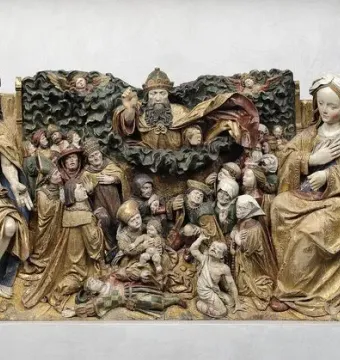
The Last Judgement, also called the Scene of Intercession, is a relief from an altarpiece probably made between 1510 and 1520 in Biberach, Swabia. It is attributed to the Master of the Holy Kinship of Biberach or his workshop and is now displayed at the Musée des Beaux-Arts de Lyon. Carved in limewood in a long horizontal format, it is thought to have been a predella, forming the lower part of an altar retable. The work combines the devastation of plague with the imagery of the Last Judgement, showing Christ, the Virgin Mary, Heaven, and Hell, and was intended as a support for Christian prayer.
© Master of the Biberach Holy Kinship · CC BY-SA 4.0
March 2015 © Kikuyu3 · CC BY-SA 4.0
© Master of the Biberach Holy Kinship · CC BY-SA 4.0
March 2015 © Kikuyu3 · CC BY-SA 4.0
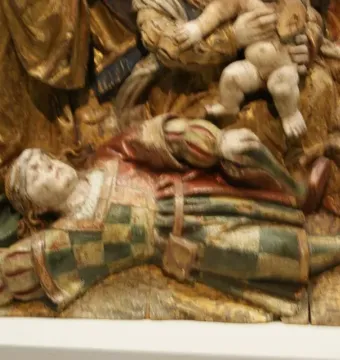
March 2015 © Kikuyu3 · CC BY-SA 4.0
Identification | |
| Title | The Last Judgement |
| Type | Predella of an altarpiece |
| Alternative name | Scène d'Intercession |
Historical context | |
| Historical context | The plague was viewed as God's punishment on Europe in response to the sins of men |
| Interpretation of plague | The plague is seen as God's punishment for the sins of humans in Europe |
| Date | Probably created between 1510 and 1520 |
| Place of creation | Biberach, Swabia |
Creator | |
| Artist attribution | Attributed to the Master of the Holy Kinship of Biberach or his workshop |
Location and ownership | |
| Current location | Museum of Fine Arts of Lyon |
| Display status | Exhibited at the Museum of Fine Arts of Lyon |
Physical characteristics | |
| Form | Horizontal elongated relief |
Materials | |
| Material | Linden wood |
Function | |
| Function | Lower part of an altarpiece located behind the altar of a church; intended as a support for prayer addressed to Christians |
Iconography and meaning | |
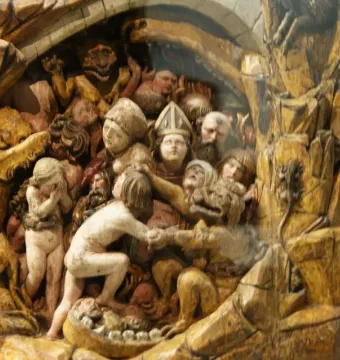
| Judgment outcome | The pious and moral are assigned to Paradise, while sinners are assigned to Hell |
| Theological interpretation | Humanity's failure to make its own justice effective enough in God's eyes is presented as the reason God chose to restore natural justice through punishment |
| Human justice theme | Human positive law or human justice is portrayed as powerless in the face of the plague and unable to establish equality |
| Equality theme | Divine punishment restores equality among people |
| Mortality theme | No mortal can escape death, and this mortality makes divine punishment possible |
| Relation to natural justice | Because all humans are mortal, the work is presented as an example of natural justice |
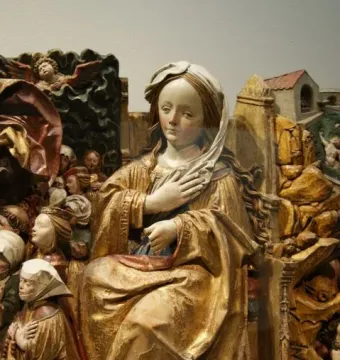
| Behind Mary | Hell divided into several registers to represent the range of punishments awaiting sinners |
| Depicted idea | Divine judgment ignores social or natural privilege and takes into account only human actions |
| Theme | The equitable administration of divine justice by God |
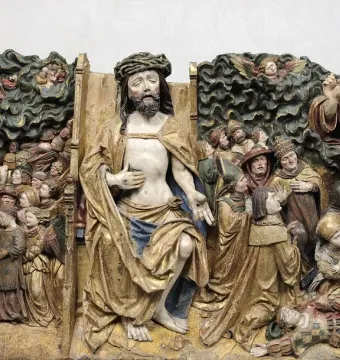
| Behind Jesus | Paradise, awaiting those who were pious and good |
| Attributes of Jesus | Attributes of the Passion, including a crown of thorns and stigmata |
| Figure on the left | Jesus |
| Figure on the right | The Virgin Mary, with a hand on her heart |
| Depiction of God | God placed above the men, overseeing the execution of the punishment of plague against sinners |
| Central depiction | The plague striking humanity, shown through deformed faces and gestures of supplication directed to God |
| Subject | The ravages of the plague in the Middle Ages combined with a representation of the Last Judgement |
| Moral framework | The work contrasts divine justice, natural justice, and human justice |