
Firemen's Memorial
Firemen's Memorial is a 1913 monument on Riverside Drive at 100th Street in Manhattan, New York City. It was created to honor firefighters who died in the line of duty, following the death of fire department subchief Charles W. Kruger in 1907. The memorial was designed by architect Harold Van Buren Magonigle, with sculptures by Attilio Piccirilli. The site includes a grand staircase, a plaza with balustrades, and a Knoxville marble monument. Its central feature is a large bas-relief of a horse-drawn engine rushing toward a fire, flanked by sculptural groups representing Duty and Sacrifice.
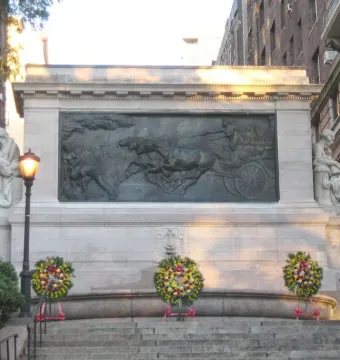
October 2008 © Jim.henderson · Public domain
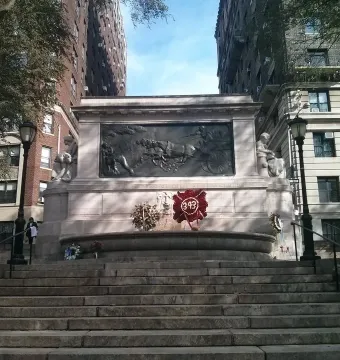
September 2014 © Pburka · CC BY 3.0
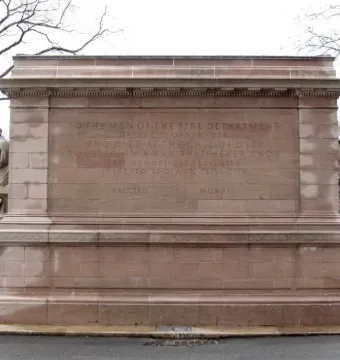
December 2008 © Jim.henderson · Public domain
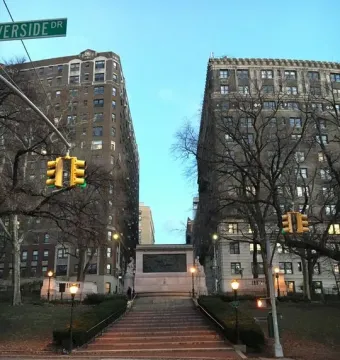
December 2017 © Deansfa · CC BY-SA 4.0
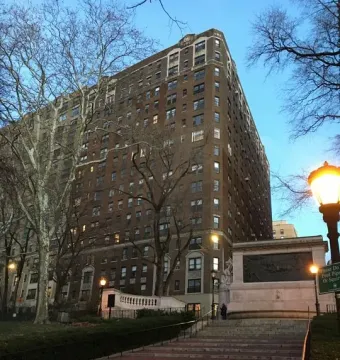
December 2017 © Deansfa · CC BY-SA 4.0
Identification | |
| Title | Firemen's Memorial |
| Type | Memorial monument |
| Original Spanish name | Monumento conmemorativo a los bomberos |
Historical context | |
| Date | 1913 |
| Purpose | To commemorate firefighters who died in the line of duty |
| Inspiration | The deaths of firefighters in New York, especially the 1907 drowning death of Deputy Fire Chief Charles W. Kruger in a flooded basement on Canal Street |
| Historical context | New York had suffered major fires in the 18th and 19th centuries, and firefighting remained dangerous despite improvements in fire safety in the late 19th and early 20th centuries |
Creator | |
| Related work | Study of a Head |
| Architect's other works | McKinley Memorial Mausoleum in Ohio; Liberty Memorial in Missouri |
| Sculptor's training | Studied marble carving in his father's studio in Italy before moving to the United States in 1888 |
| Prior collaboration | Magonigle and Piccirilli had previously collaborated on the USS Maine National Monument in Central Park |
| Model used for female figures | Audrey Munson |
| Same model used for | The female figures in both the Firemen's Memorial and the USS Maine National Monument |
| Architect's background | A New Jersey native and successful architect of monuments |
| Architect | Harold Van Buren Magonigle |
| Sculptor | Attilio Piccirilli |
Discovery and provenance | |
| Funding | The Board of Estimate and Apportionment granted $40,000 on July 17, 1911, and an additional $50,500 was raised through public subscription |
| Originally planned location | Union Square |
| Committee leadership | Bishop Henry C. Potter established and chaired the committee to build the monument; he was succeeded as chairman by Isidor Straus, co-owner of Macy's |
| Main advocate | Bishop Henry C. Potter |
Location and ownership | |
| Inscription location | On the reverse of the monument |
| Location of related work | The Metropolitan Museum of Art |
| Current location | Riverside Drive at 100th Street, Manhattan, New York City, United States, beside Riverside Park |
| Setting | Fashionable Riverside Drive beside Frederick Law Olmsted's English-style rustic Riverside Park |
Physical characteristics | |
| Site composition | A grand staircase rising from the west, a balustraded plaza, and a box-like monument structure |
| Water feature | A fountain extending from the monument structure |
Materials | |
| Material | Knoxville marble |
Technique | |
| Sculptural technique | Bas-relief |
Appearance | |
| South group | The same woman holding a child, presumably the widow and child of the dead firefighter |
| North group | A woman cradling the lifeless body of a firefighter |
| Stylistic feature | Simple, classical drapery rather than contemporary costume |
| Flanking sculptural groups | Sculptural groups to the north and south representing Duty and Sacrifice |
| Relief scene | A large bas-relief of a horse-drawn engine rushing to a fire |
Iconography and meaning | |
| Critical reception | Dianne Durante described the southern group as "wrenching" |
| Art-historical comparison | Dianne Durante compared the northern group to Michelangelo's sculpture of a grieving Madonna |
| Artistic device | The horse-drawn engine was chosen instead of an unemotional motorized engine to convey urgency and drama |
| Subject matter | Firefighters and the death of a fireman, with mourning figures including a widow and child |
| Dedication theme | Firefighting service and sacrifice |
History and restoration | |
| Dedication date | September 5, 1913 |
| Annual ceremony | An autumn ceremony is held at the memorial every year to honor firefighters who died in the line of duty; the mayor, the fire commissioner, and thousands of firefighters attend |
| September 11 commemoration | Since the September 11, 2001 attacks, the annual ceremony has also been held on September 11 each year |
| Bronze plaque | Installed in 1927 in the plaza below the monument by the American Society for the Prevention of Cruelty to Animals; dedicated to the horses that once pulled firefighters' wagons |
| Bronze tablet | Installed in 1927 in the plaza beneath the memorial by the American Society for the Prevention of Cruelty to Animals; dedicated to the horses which, in earlier years, pulled the fire department's engines |
Significance | |
| Post-2001 significance | The memorial gained greater importance after the September 11, 2001 attacks, when 343 New York City firefighters died responding to the attacks and the collapse of the World Trade Center; in the weeks after the attacks, the memorial became a shrine for them |