
Monument to General Espartero (Madrid)
The Monument to General Espartero in Madrid, Spain, stands at the junction of Alcalá and O'Donnell streets, on the border of the Salamanca and Retiro districts. It depicts the politician and military leader Baldomero Espartero (1793–1879) mounted on horseback and dressed in campaign uniform. The monument was financed by national subscription and solemnly inaugurated in 1886. It is also known for a popular saying referring to the horse’s prominent testicles, used to describe courage or boldness. In 1931, it narrowly escaped destruction when a group of young men tried to pull it down, and in 1988 Mecano composed a song inspired by the statue from the horse’s point of view.
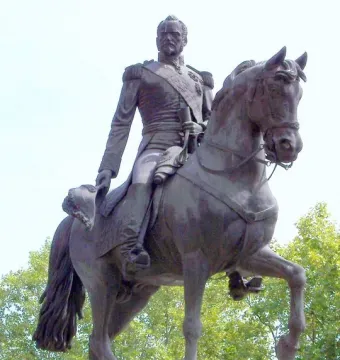
September 2007 © Philmarin · CC BY-SA 3.0
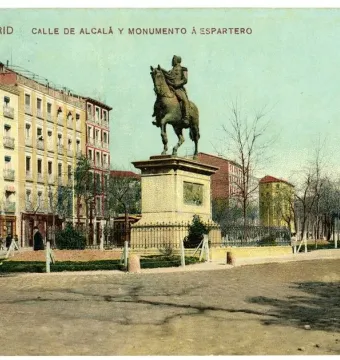
© Biblioteca Virtual del Patrimonio Bibliográfico · CC BY 4.0
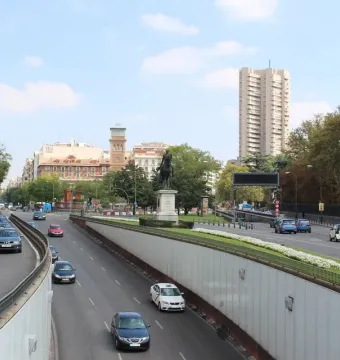
© tiger rus · CC BY 3.0
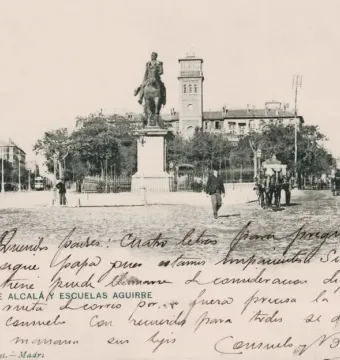
June 1903 © Desconocido (Impresa por Hauser y Menet, Madrid) · Public domain
November 2009 © Zaqarbal · CC BY-SA 3.0
Identification | |
| Title | Monument to General Espartero |
| Alternative title | Monument to General Espartero (Madrid) |
Historical context | |
| Commissioning context | Commissioned during the Spanish Restoration in the context of defining national unity along Liberal bourgeois lines, in conflict with Carlist forces |
| Subject significance | Espartero was one of the champions in the struggle against Carlism |
| Symbolic meaning | Intended to embody peacemaking |
Creator | |
| Sculptor | Pablo Gibert |
| Artist full name | Pablo Gibert Roig |
| Artist profession | Painter and sculptor |
| Artist origin | Tarragona, Spain |
| Artist lifespan | 1853–1914 |
| Artist training | Trained in the workshop of Andrés Aleu in Barcelona |
| Competition winner | Pablo Gibert's preliminary project Gloria al Pacificador ("Glory to the Peacemaker") |
| Competition award year | 1884 |
Discovery and provenance | |
| Unveiling date | 5 August 1886 |
| Inauguration | Inaugurated with full ceremony |
| Construction start year | 1885 |
| Inauguration date | 1886 |
| Foundry | J. Comas y Hermanos' foundry, Barcelona |
| Funding | Paid for by national subscription |
Physical characteristics | |
| Depicted person | Baldomero Espartero |
| Depicted person occupation | Politician and military leader |
| Depicted person lifespan | 1793–1879 |
| Statue height | 5 metres |
| Pedestal height | 5 metres |
| Weight | 11.5 tonnes |
Appearance | |
| Pedestal reliefs | Two lateral reliefs by Gibert |
| Differences from Logroño replica | The right hand position differs, and in Logroño the bicorne is on the general's head |
| Front inscription meaning | "To Espartero the Peacemaker. 1839. The grateful nation" |
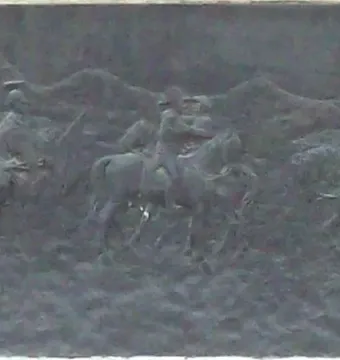
| Relief subjects | The Battle of the Bridge of Luchana and the Embrace of Vergara |
| Depiction | Espartero mounted on a horse in campaign attire |
| Bronze statue description | Espartero triumphantly entering the city while riding his horse and greeting with a hand that holds a bicorne |
Materials | |
| Inscription on statue base | "J. Comas y Hermanos. Fundids y Constrs.Barcelona" and "Pablo Gibert. Escultor. Madrid año 1885" |
| Pedestal material | White marble from Novelda |
| Front inscription on pedestal | "A Espartero el pacificador. 1839. La Nación agradecida" |
| Main material | Bronze |
Location and ownership | |
| Current location | Junction of Alcalá Street and O'Donnell Street, on the border between the Salamanca and Retiro districts, Madrid, Spain |
| Related replica | Near-replica in Logroño |
Other | |
| Symbolic interpretation of the horse | The horse's testicles are associated with the origin of Spanish-language popular aphorisms |
| Associated aphorisms | "tiene los cojones como el caballo de Espartero"; "tienes más huevos que el caballo de Espartero"; "le ha echado más huevos que el caballo de Espartero" |
| Meaning of the aphorisms | They compare a person's testicles or courage to those of Espartero's horse, and are used to describe courage or bravery in a difficult situation |
| Pop culture reference | Mecano recorded a song about the statue in 1988, narrated from the horse's point of view, but it was never officially included on any of the trio's albums |
History and restoration | |
| Attempted destruction date | Early morning of 16 April 1931 |
| Attempted destruction method | Young people tied the statue with a steel cable to pull it down |
| Intervention | Miguel Maura, then Minister of the Interior of the Second Spanish Republic, intervened while returning home on Príncipe de Vergara at about 5:00 a.m. |
| Outcome of attempted destruction | The statue suffered no damage |