
Burnham Pavilions
Burnham Pavilions were temporary public sculptures by Zaha Hadid and Ben van Berkel in Millennium Park, located in Chicago’s Loop community area. Both pavilions stood in Chase Promenade South and were privately funded. They were created to mark the 100th anniversary of Daniel Burnham’s Plan of Chicago and to symbolize the city’s continuing pursuit of that plan’s architectural vision through contemporary architecture and planning. The pavilions were originally scheduled to be unveiled on June 19, 2009. Hadid’s pavilion faced construction delays and a team change, and only its skeleton was shown on the scheduled date before completion and unveiling on August 4, 2009. The van Berkel pavilion was briefly closed from August 10 to 14 due to wear and tear.
© TonyTheTiger · CC BY-SA 3.0
July 2009 © Flickr user wjcordier · CC BY 2.0
August 2009 © TonyTheTiger · CC BY-SA 3.0
Identification | |
| Title | Burnham Pavilions |
| Italian title | I padiglioni Burnham |
| Type | Two temporary public pavilion sculptures / architectural installations |
Historical context | |
| Historical reference | The 1909 Plan of Chicago drafted by Daniel Burnham |
| Purpose | Created for the centennial celebration of the Plan of Chicago and to symbolize Chicago's continued pursuit of Burnham's architectural vision through contemporary architecture and planning |
| Context | Part of the Burnham Plan Centennial celebration in Chicago |
Creator | |
| Hadid other temporary work | Created a mobile temporary work for Chanel displayed in Hong Kong, Tokyo, and New York in 2008 |
| Hadid prior pavilion work | Previously commissioned for the Serpentine Gallery in London in 2000 |
| Hadid later projects mentioned | Will design the London Aquatics Centre for the 2012 Summer Olympics and the Guangzhou Opera House in China |
| Collaborating organizations | City of Chicago Department of Cultural Affairs; the Art Institute of Chicago; Millennium Park Inc. |
| Artists | Zaha Hadid and Ben van Berkel |
| Designers | Zaha Hadid and Ben van Berkel (UNStudio) |
| Commissioned by | Burnham Plan Centennial Committee |
Discovery and provenance | |
| Designs unveiled | April 7, 2009 |
| Planned display period | Until October 31, 2009; delays may have kept the pavilions on exhibit until November 2009 |
| Possible alternate placement | The Hadid pavilion may have been situated in a different part of the park for part of 2010 |
| Funding | Privately funded |
| Planned opening date | June 19, 2009 |
| Number of pavilions | Two |
| Initial announcement | June 2008 |
Location and ownership | |
| Location | Chase Promenade South, Millennium Park, Chicago, Illinois, United States |
| Community area | The Loop |
| Current status | In Millennium Park |
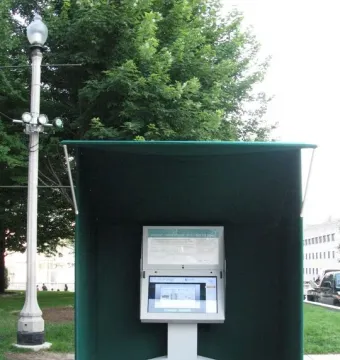
| Nearby installation | Interactive touch-screen public kiosk installation on the ground near the pavilions |
Physical characteristics | |
| Intended duration | Temporary structures |
| Number of pavilions | Two |
| van Berkel site | Raised platform |
History and restoration | |
| van Berkel durability issue | Did not prove durable enough for the interactive environment of Millennium Park |
| Hadid construction transfer | Construction responsibilities were transferred from TenFab Design to Fabric Images of Elgin, Illinois in July 2009 |
| van Berkel pavilion closure | Temporarily closed from August 10 to 14 due to unanticipated wear and tear |
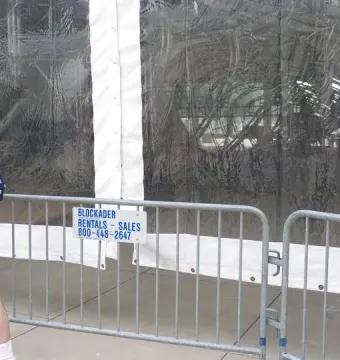
| Hadid public opening | Unfinished work was visible on June 19, 2009; the pavilion was tented the following Monday while being completed; it opened to the public on August 4, 2009 |
| Hadid revised opening date | August 1, 2009 |
| Hadid pavilion construction management | TenFab Design of Evanston, Illinois worked nearly five months with structural engineers before construction could begin |
| Hadid pavilion construction problems | Delayed by construction problems and a construction team change; only the skeleton was available to the public on the scheduled date |
Materials | |
| Hadid materials | Aluminum and tensile fabric |
| Hadid donation | Aluminum donated by Marmon/Keystone Industries, a member of the Marmon Group |
| van Berkel materials | Steel donated by Chicago-based ArcelorMittal |
Technique | |
| van Berkel lighting | 42 computer-controlled LED lights on the underside of the roof |
| van Berkel floor | Cantilevered floor slab sliced by a ramp entrance, making it ADA accessible |
| van Berkel skin | Glossy white plywood that develops from right angles into double curves of bent plywood |
| van Berkel structure | Steel frame |
| Hadid revised design | A cloth shell supported by aluminum ribs of different sizes |
| Hadid structure | Tensioned fabric shell over a curving aluminum framework of more than 7,000 individually bent pieces |
| Hadid shell panels | 24 custom-made fabric panels |
| Hadid original design | The original proposal emphasized greater angularity and incorporated wood and aluminum hard surfaces |
| van Berkel form | Two parallel rectangular planes joined by curving scoops |
Appearance | |
| Hadid original bid issue | The original proposal sent out for bid was way over budget |
| van Berkel criticism | Kamin felt the pavilion was designed more for veneration, like indoor museum works of art and outdoor sculpture on pedestals |
| van Berkel roof | Floating roof with eye-like openings |
| Hadid shape and features | Elliptical structure with strategic light-availing gashes and pod-like openings |
| Hadid inner walls | Projection surfaces for a film about Chicago by Thomas Gray |
| Hadid appearance | Resembles a futuristic camping tent |
| Hadid multimedia content | A theme presentation about Chicago's transformation as a result of Burnham's plan, created by London-based, Chicago-trained filmmaker Thomas Gray, accompanied by a multi-channel soundtrack by Lou Mallozzi of Experimental Sound Studio |
| Hadid final form during construction | A canvas stretched across the frame formed a structure resembling a cocoon |
| Hadid structural concept | Based on tension altering the appearance of fabric when pulled taut or twisted |
| Hadid plan reference | Diagonal lines reflect Burnham's 1909 city plan, which envisioned a fanned grid of streets radiating diagonally from Chicago's city center into the suburbs |
| Hadid interior use | Centennial-themed audio and video presentation on the interior fabric walls |
Iconography and meaning | |
| Hadid multimedia theme | Chicago's transformation as a result of Burnham's plan |
| Hadid intended post-exhibition disposition | Upon completion of the temporary exhibition, the pavilion will be deeded to the city to lend or rent out to other cities |
| Hadid structural warning | Not designed to withstand snow loads of a Chicago winter |
| van Berkel intended fate | Intended to be deconstructed and recycled |
| Interpretation / symbolism | The pavilions symbolized the city's continued pursuit of Burnham's architectural vision through contemporary architecture and design |
Significance | |
| Associated concert | Concerts by the Grant Park Orchestra |
| Hadid Serpentine impact | That pavilion was considered such a success that the gallery has added annual temporary pavilions every year since |
| Location of partners' activities | The Chicago metropolitan area |
| Number of Centennial Program Partners | More than 250 |
| Role of the pavilions | A focal point for public attention and a guide toward Centennial Program Partners' exhibits, events, and activities |
| Ongoing related activities | Lectures, walking tours, and art exhibitions throughout the calendar year |
| Concert repertoire | World premiere of Michael Torke's symphony and chorus work Plans, paired with Rachmaninoff's Piano Concerto No. 3 |
| Orchestra director | Carlos Kalmar |
| van Berkel criticism by Kamin | Kamin felt the pavilion was designed more for veneration, like indoor museum works of art and outdoor sculpture on pedestals |
| Associated event | A citywide centennial celebration |
| Description by The Wall Street Journal | Unrivaled in its elegance and ambition for urban planning; Chicago is a monumental manifestation of the plan |
| Significance of the Burnham Plan | Credited with guiding the transformation of Chicago from an industrial center to a leading contemporary city |
| Related urban planning plan | The Burnham Plan |
| Public protection measures | Stanchions were required to curb human nature |
| Kamin concern | He was wary of the public damaging the pavilion |
| Kamin interpretation | He felt the pavilion succeeded in enticing viewers to envision a better future for Chicago in a manner similar to Burnham himself |
| Kamin viewing note | By daylight the pavilion is enticing, but sunlight limits the multimedia effect to dusk and until the park's closing, when the 7.5-minute video can be seen on the inner surface |
| Kamin shape comparison | Resembled a conch shell with openings like shark's mouths |
| Media attention | The Hadid pavilion delay received nationwide coverage in publications such as The New York Times and The Wall Street Journal |
| Critical reception | Chicago Tribune critic Blair Kamin praised the pavilion upon completion on August 4, 2009 and described it as 'a virtuoso display of structure, space and light' with an 'arresting combination of naturalistic forms and alien shapes, plus a dazzling video installation' |