
Osorkon II Triad
The Osorkon II Triad is an elaborate pendant made by Egyptian goldsmiths during the Third Intermediate Period of ancient Egypt, between 945 and 715 BC. Crafted in solid gold and lapis lazuli, it is an exceptional work of ancient jewelry and depicts the divine triad of Osiris, Isis, and Horus. Osiris is shown with the uraeus and braided beard, Isis with a tripartite wig, and Horus wearing the pschent crown. Although it includes the great god of the dead, the object is considered more likely a temple treasure than a funerary jewel.
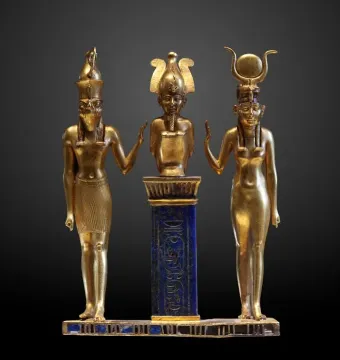
© Rama · CC BY-SA 3.0 fr
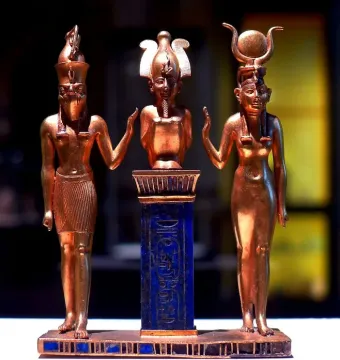
© Unknown artistUnknown artist · CC BY 3.0
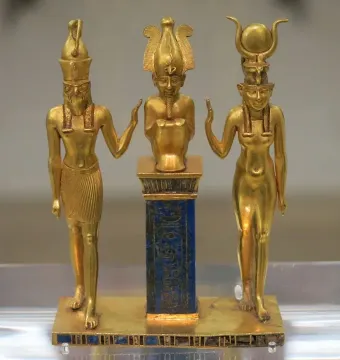
October 2017 © Tangopaso · Public domain
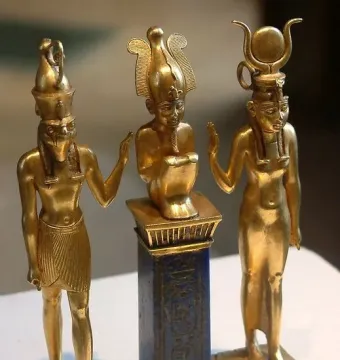
© Unknown artistUnknown artist · CC BY-SA 3.0
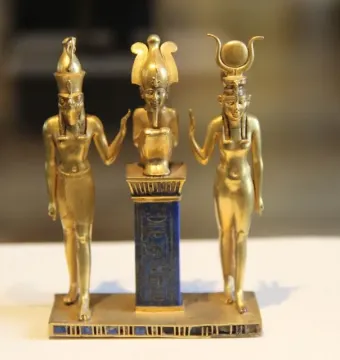
July 2016 © Gary Todd · CC0
Identification | |
| Title | Osorkon II Triad |
| Alternative name | Osorkon's triad |
| Original-language name | La tríada de Osorkon II |
| Type | Pendant; jewel |
Historical context | |
| Date | c. 945 to 715 BC |
| Historical period | Third Intermediate Period of Egypt |
| Dynasty | Twenty-second Dynasty |
| Dynastic origin | One of the two Libyan-origin dynasties |
| Related dynasty | Twenty-third Dynasty |
Creator | |
| Creator | Egyptian goldsmiths |
| Chronology source | According to Grimal, Arnold, and Shaw |
Discovery and provenance | |
| Named ruler | Osorkon II |
| Ruler title | Pharaoh of Egypt's 22nd Dynasty |
| Reign | 874 to 850 BC |
| Inscription | The jewel is engraved with the name Usermaatra Setepenamón Osorkon, or Osorkon II |
Materials | |
| Material | Solid gold and lapis lazuli |
Physical characteristics | |
| Description | An extremely precious piece of jewelry and an authentic masterpiece of ancient goldsmithing |
Iconography and meaning | |
| Depicted figures | Osiris, Isis, and Horus |
| Mythological grouping | Osirian triad |
| Mythological interpretation | They represent three gods of Egyptian mythology; the sculpture is described as the family of the god of the dead, called the Osirian triad |
| Depiction | Represents the divine triad of the family of Osiris |
| Osiris role | God of resurrection |
| Isis role | Goddess of maternity and birth |
| Horus role | Sky god; "the elevated"; celestial god |
| Osiris attributes | Uraeus and braided beard |
| Isis attributes | Tripartite wig, originally inlaid |
| Horus attributes | Wears the pschent crown |
| Back inscription | Hieroglyphic inscriptions on five columns; the leftmost column contains the names Sa-Rê and Nesout-bity side by side |
| Other inscriptions | Inscription on pillar mentioned, but no text is provided in the fragment; inscription under the base mentioned, but no text is provided in the fragment |
Location and ownership | |
| Current location | Louvre Museum |
| Current display location | Sully Wing, level 1, room 643, "From the year 1000 to the first Persian domination," case 1 |
History and restoration | |
| Acquisition date | 1872 |