
Hahn/Cock
Hahn/Cock is a sculpture by German artist Katharina Fritsch showing a giant blue cockerel. Made of fibreglass, it was unveiled in London’s Trafalgar Square on 25 July 2013 and displayed on the vacant Fourth Plinth as the sixth work commissioned for the site. It remained there until 17 February 2015. The work is in an edition of two. One version was later acquired by Glenstone and shown at the National Gallery of Art in Washington, DC, after its 2016 reopening; in March 2021, Glenstone permanently donated it to the National Gallery. The second version is installed in the sculpture garden of the Walker Art Center in Minneapolis, where it is known as The Blue Rooster.
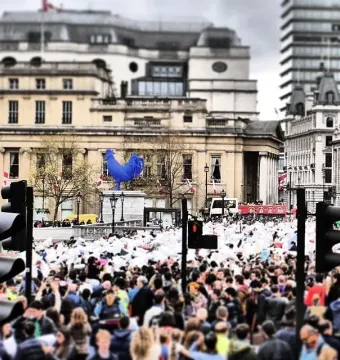
April 2014 © Tim Parker · CC BY 2.0
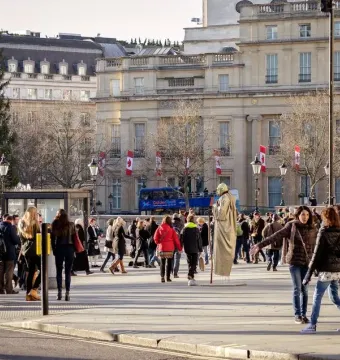
December 2013 © Garry Knight · CC BY 2.0
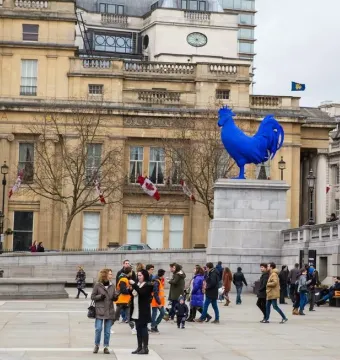
February 2014 © Terry Robinson · CC BY-SA 2.0

April 2014 © Tim Parker · CC BY 2.0
Identification | |
| Title | Hahn/Cock |
| Subject | A giant blue cockerel |
| Type | Sculpture |
Creator | |
| Artist | Katharina Fritsch |
| Artist nationality | German |
Materials | |
| Material | Fiberglass |
Physical characteristics | |
| Height | 4.72 meters |
| Scale | Giant |
Appearance | |
| Color and appearance | Big, blue |
| Style | Lifelike and other-worldly; joyful, irreverent, funny, weird, and surreal |
Location and ownership | |
| Second version location | Sculpture garden of the Walker Art Center, Minneapolis, Minnesota |
| Later exhibition | Exhibited at the National Gallery of Art in Washington, DC, after its 2016 reopening |
| Edition | Edition of two |
| Display location | The fourth plinth in Trafalgar Square, London, England |
| Second version pedestal | Pedestal designed by the artist |
| Second version nickname | The Blue Rooster |
| Commission | Fourth Plinth commission |
| Plinth | Vacant fourth plinth |
| Previous owner | Glenstone, a private museum |
| Current owner | National Gallery |
History and restoration | |
| Order in Fourth Plinth series | Sixth work displayed on the plinth |
| Donation | Glenstone permanently donated the piece to the National Gallery in March 2021 |
| Display period | 25 July 2013 to 17 February 2015 |
| Unveiled by | Mayor of London Boris Johnson |
| Unveiled on | 25 July 2013 |
| Creation time | Two and a half years |
| Commissioning body | Fourth Plinth Commissioning Group |
Iconography and meaning | |
| Symbolism | Represents strength and regeneration |
| National association | An unofficial national emblem of France |
| Interpretation | Described by Fritsch as a feminist sculpture that reverses the historical norm of men depicting women; she also said it has both humorous and serious meanings |
| Wordplay | The title has a sexual double entendre in English and is intentionally a play on words |
| Site interpretation | Fritsch said Trafalgar Square has a somewhat phallic, male character associated with posing and showing power |
| Historical irony | Placed in a square commemorating a famous British victory over the French |
Significance | |
| Reception | Generally positive reviews from art critics; visitors interviewed by the London Evening Standard also gave it a thumbs up |
| Notable critical views | Adrian Searle praised the scale, modelling, and detail; Serena Davis said it was less impressive than some previous Fourth Plinth works but one of the jolliest; Rebecca Jones said it would put a smile on many people's faces |
| Opposition | The Thorney Island Society objected, saying it was unrelated to Trafalgar Square and added nothing but a feeble distraction |
| Artistic effect | Intended to lighten the mood, lift the spirit, and cheer viewers up |