
Ruhender Verkehr
Ruhender Verkehr is an action sculpture by Wolf Vostell, created in 1969. It consists of a fully concreted-in car, an Opel Kapitän, whose outlines remain roughly simplified and which satirizes the idea of “parked traffic” in public space. After being made between 2 and 13 October 1969, it was shown at several sites, including in Paris and at Berlin’s Neue Nationalgalerie, before moving to Cologne’s Hohenzollernring in 1989. The work is about 15 tons in weight and remains one of Cologne’s best-known public artworks. A restoration was carried out in 2023, while a planned move to a new parking space was delayed.
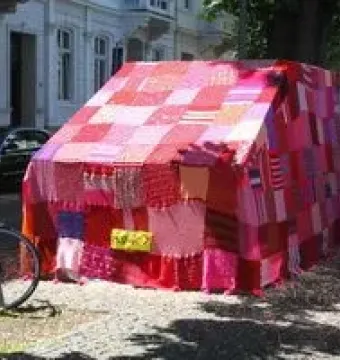
May 2012 © VringsveedelerJung · CC BY-SA 3.0
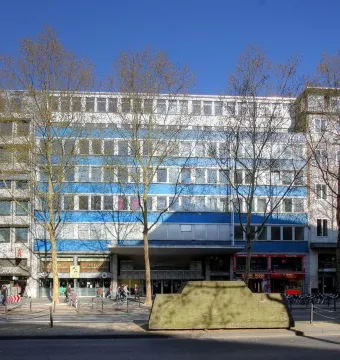
April 2010 © Raimond Spekking · CC BY-SA 4.0
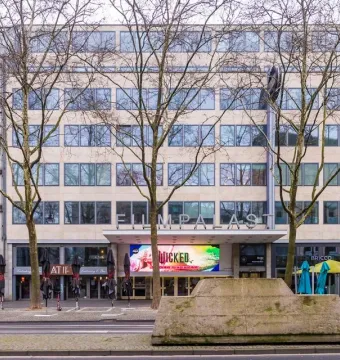
January 2025 © Raimond Spekking · CC BY-SA 4.0
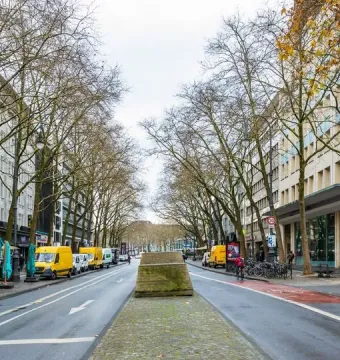
December 2024 © Raimond Spekking · CC BY-SA 4.0
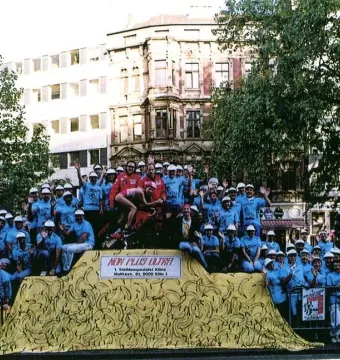
May 1993 © W.H. Reichel, Köln · CC BY-SA 3.0
Identification | |
| Title | Ruhender Verkehr |
| Type | Public sculpture / action sculpture / plastic |
Creator | |
| Artist | Wolf Vostell |
| Construction process | A first concrete base was poured, the drivable car was parked on it, then boxed in with wooden plank formwork and reinforced steel, followed by a second concrete pour; on 13 October 1969 a parking meter was placed beside it and the formwork was removed |
Historical context | |
| Jubilee event | For the 50th anniversary of the artwork’s completion, several artists held a birthday celebration on 26 January 2019 with happenings, a video installation, a champagne reception, and a tour of Cologne locations where the sculpture had previously stood |
| First public announcement | 2 October 1969 |
| Creation period | 2 October 1969 to 13 October 1969 |
| Date created | 1969 |
Discovery and provenance | |
| Original location | Parking space on Domstraße in front of the Art Intermedia gallery, Cologne |
| Later location | Central reservation of Hohenzollernring, Cologne |
| Earlier exhibition location | In front of the Kölnische Kunsthalle / Museum of Fine Arts Cologne at Josef-Haubrich-Hof, Cologne |
| Other exhibition location | In front of the Musée d’Art Moderne de la Ville de Paris, 1974–1975; in front of the Neue Nationalgalerie in Berlin |
| Intended purpose | Originally intended to occupy a parking space |
| Moved to current site | 1989 |
Materials | |
| Materials | Reinforced concrete, steel, wood formwork, and an embedded drivable Opel Kapitän automobile |
| Car model | Opel Kapitän P 2,6 (also given as Opel Kapitän L), built in 1960 |
| License plate | K-HM 175 |
Physical characteristics | |
| Condition of car at installation | In running condition |
| Weight | 15 tons |
Appearance | |
| Form | The car’s contours were roughly simplified but remained recognizable |
| Surface color | Dark blue background |
Iconography and meaning | |
| Concept | An ironic reference to stationary traffic (Ruhender Verkehr) that turns a parking-space situation into an artwork |
Location and ownership | |
| Current location | Central reservation of Hohenzollernring, Cologne, Germany |
| Parking meter | A parking meter stands beside the sculpture |
History and restoration | |
| Archive donation | The tarp (catalogue no. 93-34138) and photo documents were donated to the Historical Archive of the City of Cologne, inventory no. 1545 |
| Subsequent cover action by Thomas Baumgärtel | He later covered the sculpture with a 6 × 10 m yellow cloth sheet printed with 3,333 black bananas for the installation Kunst auf Kunst, first on 16 May 1993 and repeated in 1994 and 1995 |
| Later intervention by Thomas Baumgärtel | On 17 March 1993, Thomas Baumgärtel sprayed hundreds of bananas on the sculpture; Vostell protested, and the bananas were later removed |
| Restoration status | The restoration was carried out, but the relocation initially did not take place because the new location was too narrow |
| Restoration and relocation plan | For autumn 2023, restoration and a move to a parking space in front of the Kölnischer Kunstverein on Hahnenstraße were planned |
Significance | |
| Cultural significance | Described by Deutschlandfunk Kultur’s Kompressor as the most famous public artwork in Cologne |
| Public reception | Football fans also celebrate at the monument and stop traffic |
Other | |
| Related work | Concrete Traffic (1970) by Wolf Vostell in Chicago, inspired by Ruhender Verkehr; it contained a Cadillac embedded in 20 cm of concrete and was first shown between parked vehicles near the Museum of Contemporary Art, later in the Sculpture Garden of the University of Chicago, and since 2016 on a parking area in a public parking garage on the University of Chicago campus |
| Related works by Vostell | Zwei Beton-Cadillacs in Form der nackten Maja (1987) in Berlin’s Rathenauplatz; VOAEX (1976) in the Museo Vostell Malpartida, Malpartida de Cáceres, Spain |
| Related homage work | In 2007 Cornel Wachter cast an A-Class Mercedes in a concrete shell as a homage to Vostell; it stands in front of the Rheinisches Landesmuseum Bonn |
| Related performance | Vostell later repeated the performance in Chicago in 1970 under the name Concrete Traffic |