
Sea Organ
Sea Organ is a municipal architectural installation created in Zadar in 2005. Unlike ordinary organs, it produces sound under the influence of waves and tides. Designed in 2004 by Croatian architect Nikola Bašić with a team of specialists, it is located near the ferry port in the western part of the old town. The installation consists of stone steps leading into the sea, divided into seven ten-meter sections, with 35 polyethylene tubes of different lengths, diameters, and slopes built underneath. It opened on 15 April 2005 and is one of the city’s most popular tourist attractions and a frequent meeting place. In 2006, it received the European Prize for Urban Public Space.
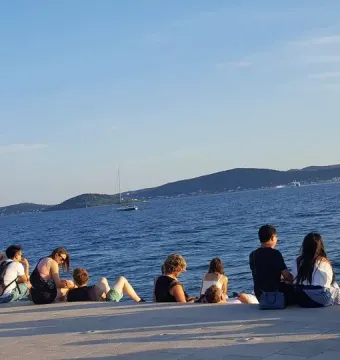
June 2018 © Rpuljiz · CC BY-SA 4.0
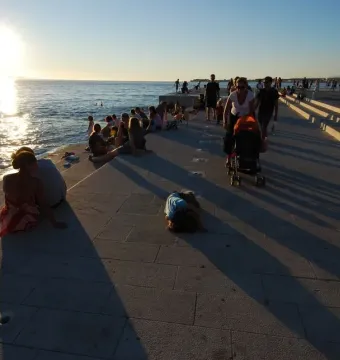
August 2008 © PJL · CC BY 2.5
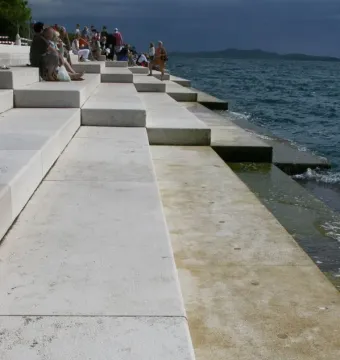
September 2007 © Tess · CC BY 2.0
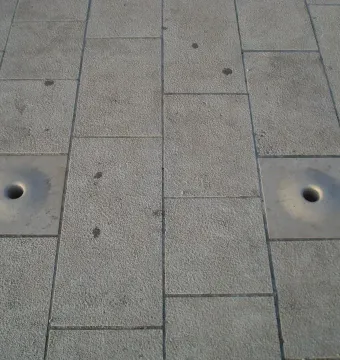
June 2008 © Andrej Šalov · CC BY-SA 3.0
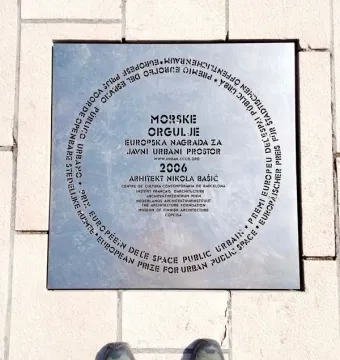
April 2025 © Piwiki314 · CC0
Identification | |
| Title | Sea Organ |
| Original name | Morske orgulje |
| German name | Meeresorgel |
| French name | L'Orgue des mers |
| Russian name | «Морско́й орга́н» |
| Portuguese name | O Órgão do Mar |
| Type | Architectural and musical installation |
Historical context | |
| Project context | Part of the Nova Riva waterfront redesign project in Zadar |
| Historical context | Built after World War II reconstruction had turned much of Zadar's seafront into a monotonous concrete wall |
Creator | |
| Designer | Nikola Bašić |
| Collaborators | Ivan Stamać (sound and acoustics), Vladimir Andročec (hydraulics), Tomislav Heferer (pipe design and tuning), Matija Galošić (design) |
| Design year | 2004 |
Discovery and provenance | |
| Creation year | 2005 |
| Opening date | 15 April 2005 |
| Award | European Prize for Urban Public Space, ex aequo prize |
| Award year | 2006 |
Location and ownership | |
| Placement | Built into the seafront promenade and beneath the steps descending to the water |
| Site | North-west corner of the quay around the historic center, near the ferry pier |
| Location | Zadar, Croatia |
Physical characteristics | |
| Length | 75 meters |
| Sections | 7 sections, each 10 meters long |
| Pipes | 35 pipes of varying length, diameter, inclination, shape, and pitch |
| Form | Stone steps descending into the sea |
| Location relative to sea level | Below sea level |
Materials | |
| Hidden structure material | Plastic pipes and resonance chambers |
| Alternative pipe material considered | PVC, with a stainless-steel section proposed for the part not in contact with seawater |
| Pipe material | Polyethylene |
| Steps material | White marble |
Technique | |
| Operating principle | Sea waves and tides push water and air through the pipes, generating sound |
| Sound outlets | Openings in the stone and on the sidewalk through which the sound emerges onto the promenade |
| Tuning | The pipes were tuned by the Heferer workshop according to Bašić's wishes |
| Musical structure | Seven sound groups based on two alternating chords, G major and C sixth, with variation depending on tide strength |
Appearance | |
| Sound character | Produces continually changing, somewhat random but harmonic sounds with varying strength and duration |
Iconography and meaning | |
| Interpretation | A loosely defined musical instrument that excludes a human performer |
Significance | |
| Popularity | One of Zadar's most popular tourist attractions and a frequent meeting place for locals |
| Relationship to the city | Restored the city's relationship with the sea |
| Associated work | The Greeting to the Sun |