
Brescia Casket
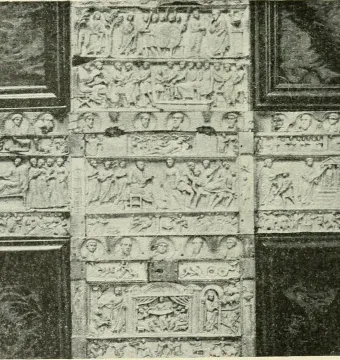
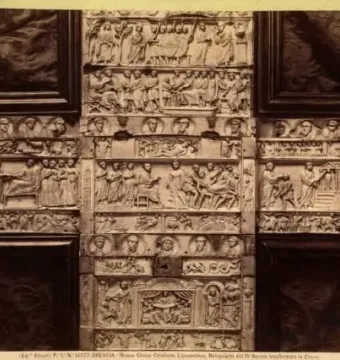
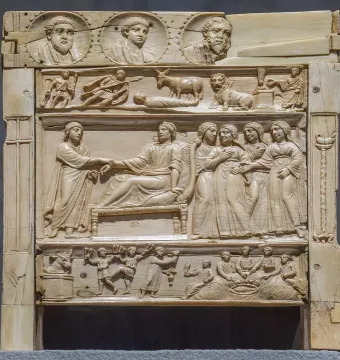
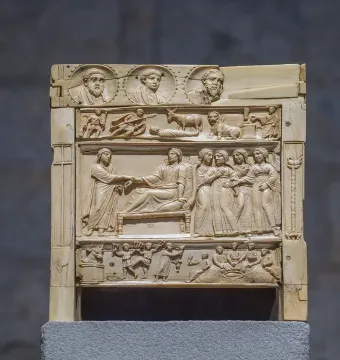
The Brescia Casket, also called the lipsanoteca of Brescia or the relicary of Brescia, is an ivory box, perhaps a reliquary, from the late 4th century. It is kept in the Museum of Santa Giulia in the church of San Salvador in Brescia, Italy. The casket is a virtually unique surviving example of a complete early Christian ivory box in generally good condition. Its 36 represented themes cover a wide range of imagery found in Christian art of the period, and their identification has prompted extensive scholarly debate. Despite differing interpretations, the quality of the carving is not in doubt.
1903 © Internet Archive Book Images · No restrictions
December 2012 © Alinari Brothers · Public domain
November 2020 · CC BY-SA 3.0
November 2020 · CC BY-SA 3.0
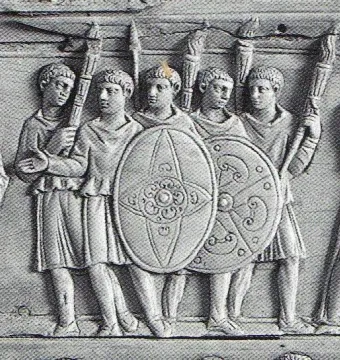
© RobyBS89 · CC0
Identification | |
| Title | Brescia Casket |
| Alternative names | lipsanoteca of Brescia; lipsanotheca of Brescia; reliquary of Brescia; lipsanoteca di Brescia; Caixão de Brescia; Relicário de Brescia |
| Type | Rectangular ivory casket, possibly a reliquary |
Historical context | |
| Date | Late 4th century, possibly shortly after 386 |
| Origin | Probably Milan, northern Italy |
| Historical context of origin | Associated with Saint Ambrose, bishop of Milan, and the struggle against Arian heresy |
Creator | |
| Probable workshop | A workshop in northern Italy, probably in Milan |
Discovery and provenance | |
| Current location | Museo di Santa Giulia, Brescia, Italy |
| Transfer history | Transferred in 1798 to the Biblioteca Queriniana in Brescia after the convent was suppressed following the Napoleonic invasion; transferred in 1882 to the museum collection |
| Monastic custody | Kept by the convent of San Salvatore, Brescia; it is not known when it entered the convent, but it may have done so soon after the convent was founded in 753 by Desiderius, the last Lombard king |
| Reason for medieval name | Possibly because it contained a stone taken from the Holy Sepulchre in Jerusalem |
| Medieval name | sepulcrum eboris ('ivory sepulchre') |
| Medieval function | Used as a reliquary in the Middle Ages |
| Relics history | Their remains were translated in Ambrose's time, according to one of his letters; this was one of the earliest recorded translations |
| Associated relics | Relics of Gervasius and Protasius, Milanese Roman martyr saints |
| Original function | Possibly made to hold the relics of Gervasius and Protasius |
Physical characteristics | |
| Dimensions | 22 × 32 × 25 cm |
| Shape | Rectangular, with five faces: four sides and a lid |
| Panels | Five panels |
| Condition | A virtually unique survival of a complete Early Christian ivory box in generally good condition |
| Decoration count | 36 or 37 biblical images |
| Missing elements | Two busts are missing |
Materials | |
| Added elements in restoration | Short ivory feet added in 1928 |
| Additional material | Walnut wood frame |
| Later metal components | A silver lock plate, probably from the 8th century; later metal hinges removed in 1928 |
| Primary material | Ivory |
Technique | |
| Carving technique | Carved ivory reliefs and engraved plaques attached to a frame |
| Restoration | Restored and reassembled in 1928, with missing fragments integrated using smooth ivory inserts |
| Alteration history | At some point it was dismantled and displayed as a cruciform plaque laid flat on a board with a frame |
Appearance | |
| Main decorative program | Covered with a profusion of small religious scenes from the Old and New Testaments |
| Lid decoration | Five Passion scenes arranged in two registers, with a small upper frieze of birds |
| Side decoration scheme | The four sides have a middle register with New Testament scenes and narrower upper and lower registers with Old Testament scenes |
| Corner decoration | The narrow corners contain vertical images, mostly symbolic objects |
| Upper side register | Busts of male figures in slightly flattened round frames (clipea) |
| Original number of busts | 17 busts in total: five on the front, four on the back, and four on each side |
Iconography and meaning | |
| Disputed scene identification | A scene on the back panel has been identified variously as the Call of Andrew and Peter by Jesus or as the Transfiguration of Jesus; the key issue is whether the wavy lines beneath the figures represent clouds or water |
| Number of represented themes | 36 |
| Scholarly interpretation | Scholars have proposed liturgical, theological, and political readings of the iconographic program, including connections with Milanese Lent and Easter lectionary readings, Ambrose's struggle against the Arians, and the typological unity of the Old and New Testaments |
| Depicted subjects | Biblical scenes and figures, including Jesus, the Twelve Apostles, Saint Paul, Saints Peter and Paul, and the Four Evangelists |
| Interpretation of scenes | Many scenes remain uncertainly identified; several rare scenes were reidentified in the late 20th century |
| Back busts | The four busts on the back may represent the Four Evangelists or other saints |
| Front bust identification | A youthful beardless Jesus occupies the center of the front panel, probably flanked by Saints Peter and Paul and surrounded by the Twelve Apostles with Saint Paul replacing Judas |
Significance | |
| Artistic significance | An important monument of Early Christian art and one of the most precious testimonies of early Christian iconographic art in ivory |
| Scholarly significance | According to one scholar, its date, use, provenance, and meaning remain among the most formidable and enduring enigmas in the study of early Christian art |
| Historical importance | An especially important source for studying the evolution of Christian theology in the first centuries of the spread of Christianity |
| Craftsmanship | The high quality of the carving has never been questioned |
| Rarity | A practically unique survival |