
Monument to the Women of World War II
The Monument to the Women of World War II is a British national war memorial on Whitehall in London, beside the Cenotaph at the end of Downing Street. Sculpted by John W. Mills, it honours the wartime contributions of more than seven million women, including 650,000 who joined the military services. The tall hollow bronze sculpture resembles a coat rack, reflecting Winston Churchill’s call for women to come forward and the idea that they left their normal lives to take on whatever role was needed for survival. It was unveiled by Queen Elizabeth II in July 2005, marking the 60th anniversary of VE Day.
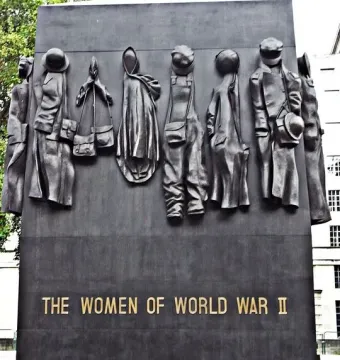
September 2010 © Jaume Meneses · CC BY-SA 2.0
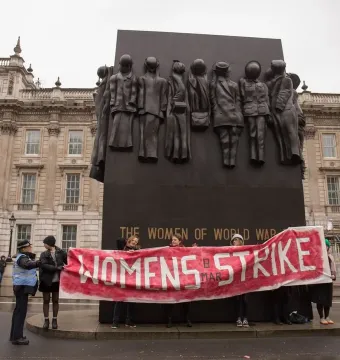
January 2018 © subetheric · CC BY 2.0
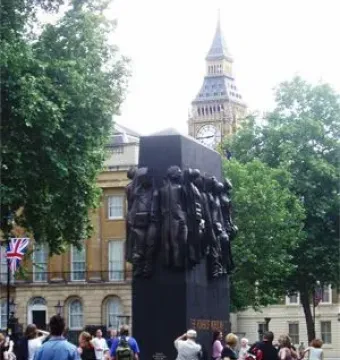
© Dylanmills · Public domain
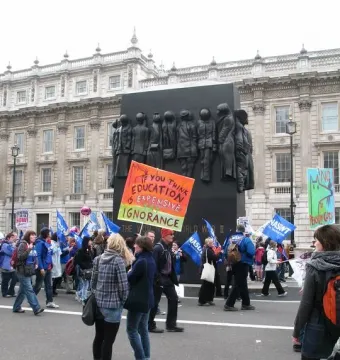
March 2011 © Alan Stanton · CC BY-SA 2.0
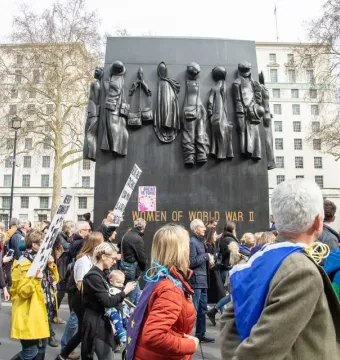
March 2019 © John Lubbock · CC BY-SA 2.0
Identification | |
| Title | Monument to the Women of World War II |
| Type | British national war memorial |
| French title | Le Monument aux femmes de la Seconde Guerre mondiale |
Historical context | |
| Country | United Kingdom |
| Location | Whitehall, London, next to the Cenotaph at the end of Downing Street |
| Subject | The wartime contributions of women during World War II in the United Kingdom |
| Purpose | To commemorate and celebrate the work that women undertook during World War II in the UK |
Creator | |
| Sculptor | John W. Mills |
| Sculptor background | He was a wartime evacuee when his mother joined the fire service |
Discovery and provenance | |
| Fundraising organization | Memorial to Women of WWII charitable trust |
| Remaining funds source | Memorial to the Women of World War II Fund in York |
| Additional amount raised by Baroness Boothroyd | Over £300,000 |
| Baroness Boothroyd donation | £800,000 |
| National Heritage Memorial Fund grant | £934,115 |
| Funding source | A charitable fund created to establish the memorial, with a grant from the National Heritage Memorial Fund and money raised by Baroness Boothroyd |
| Earlier campaign focus | Raising funds for a plaque in York Minster |
| Vice-patrons | Dame Vera Lynn, the Princess Royal, John Grogan, Hugh Bayley, Baroness Finlay of Llandaff, and Robert Crawford |
| Trust patron | Baroness Boothroyd |
| Fundraising trust founders | Edna Storr, Mildred Veal, Bill Moralee, and Peri Langdale |
| Earlier campaign leaders | Edna Storr and Mildred Veal |
| Reason for proposing the monument | He was told that many countries had a national monument to women's wartime work in World War II, but the United Kingdom did not |
| Year the idea arose | 1997 |
| Idea first proposed by | Major David McNally Robertson |
| Media coverage | Journalist Peri Langdale followed the campaign for eight years and made two programmes for ITV Tyne Tees about the project |
Physical characteristics | |
| Dimensions | The monument is described as tall, long, and wide; exact measurements are not given in the source fragment |
| Form | A tall hollow bronze structure resembling a coat rack |
Materials | |
| Material | Bronze |
Appearance | |
| Composition | Made up of 17 sets of clothing and uniforms in relief around the monument |
| Inscription style | The lettering on the sides reproduces the typeface used on wartime ration books |
| Included clothing and uniform types | Women's Army uniform, Women's Royal Naval Service uniform, a nursing cape, a police uniform, and a welding mask |
Iconography and meaning | |
| Symbolism | Represents Winston Churchill's call 'Let the Women Come Forward' and the idea that women left their normal lives to fight for survival in any role necessary |
| Relief symbolism | The 17 clothing and uniform sets symbolize the hundreds of different jobs women undertook during World War II and later handed back to men returning home |
| Honored group | Women who participated in the war effort during World War II by taking on jobs performed by men |
Location and ownership | |
| Location | Whitehall, London, north of the Cenotaph |
| Country | United Kingdom |
History and restoration | |
| Dedication message | Future generations are asked what sort of women they were and to look at history for the answer |
| Related unrest | At least 17 people were arrested following clashes in Whitehall |
| Official reaction | Downing Street described the damage as despicable |
| Vandalism | In May 2015, the memorial was vandalised with red graffiti reading 'Tory scum' after the Conservative Party won a majority in the general election |
| Ceremony attendees | Baroness Boothroyd, Baroness Thatcher, Dame Vera Lynn, Defence Secretary John Reid, and female war veterans including Nancy Wake |
| Dedication | Baroness Boothroyd dedicated the monument to all the women who served the country and to the cause of freedom, in uniform and on the home front |
| Military flypast | A flypast of five military helicopters and two Panavia Tornado ADVs, with female crews and female pilots respectively |
| Unveiling context | Unveiled two days after the 7 July 2005 London bombings as part of the 60th anniversary of the end of World War II |
| Unveiling date | 9 July 2005 |
| Unveiled by | Queen Elizabeth II |
Other | |
| Related legal case | Social media comments led to the 2017 libel case Monroe v Hopkins, which Hopkins lost |
Significance | |
| Classification | Monument in London |
| Classification | Building and structure in Westminster |
| Classification | Completed in 2005 |
| Classification | United Kingdom in World War II |
| Classification | British Empire in World War II |