
Broken Obelisk
Broken Obelisk is a sculpture designed by Barnett Newman between 1963 and 1967 and fabricated from three tons of Cor-Ten steel, which develops a rust-colored patina. It is the largest and best known of his six sculptures. The first multiples were made by Lippincott, Inc. in 1966–67 and displayed in New York and Washington, DC, where it drew controversy as a possible reference to a broken upside-down Washington Monument. Later multiples were installed at the Rothko Chapel in Houston, the University of Washington in Seattle, the Museum of Modern Art in New York, and Storm King Art Center in New Windsor, New York.
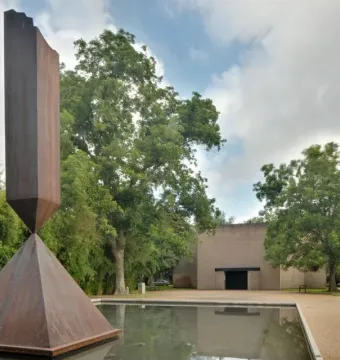
August 2010 © Ed Uthman · CC BY 3.0
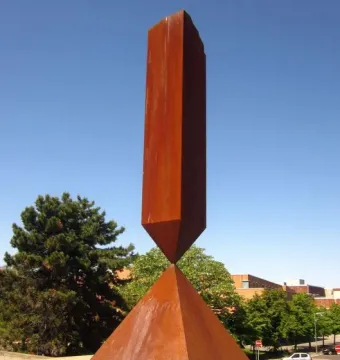
May 2012 © Jörg Zägel · CC BY-SA 3.0
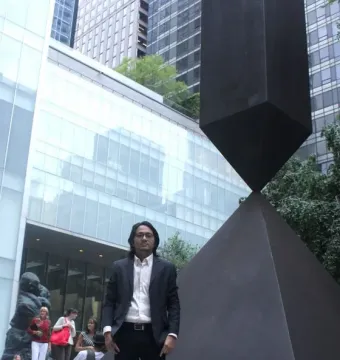
August 2014 © Aung Myat Htay · CC BY-SA 4.0
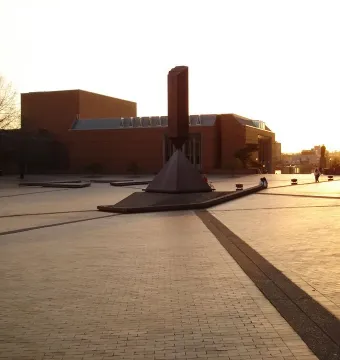
© Barnett Newman · Public domain
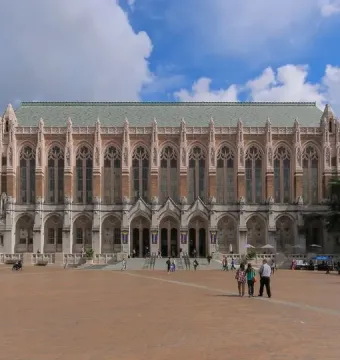
September 2013 © Martin Kraft · CC BY-SA 3.0
Identification | |
| Title | Broken Obelisk |
| French title | Obélisque brisé |
| Type | Sculpture |
| Original Spanish title | Obelisco Roto |
Creator | |
| Artist | Barnett Newman |
Historical context | |
| Creation period | 1963–1969 |
| Design period | 1963–1967 |
| Number of versions | Four versions exist |
| Number of sculptures in the series | Six |
| Original versions | Three originals were fabricated in the 1960s during the artist's life |
| Size significance | Largest and best known of Newman's six sculptures |
Materials | |
| Material | Three tons of Corten steel |
| Surface | Cor-Ten steel acquires a rust-colored patina |
| Surface appearance | Oxidized surface color |
Appearance | |
| Height | Approximately unspecified in the fragment |
| Base | It rests on a square base |
| Bottom end | The pointed foot is broken and points upward |
| Top | The top rests on a pyramidal pedestal |
| Depicted form | An overturned obelisk |
Other | |
| Art critic commentary | Robert Hughes wrote about Broken Obelisk in 1971 |
Exhibition and display | |
| Temporary exhibition location in 2003 | In front of the Neue Nationalgalerie, Berlin |
| Summer 2014 display locations | Rothko Chapel, Houston; Red Square, University of Washington, Seattle; Museum of Modern Art, New York City; and Storm King Art Center, New Windsor, New York |
| Temporary exhibition permission | With permission of the Barnett Newman Foundation |
| 1969 exhibition location | Museum of Modern Art, New York City |
| Other works in the exhibit | Tony Smith's Smoke and Ronald Bladen's The X |
| Exhibit date | 1967 |
| Exhibit title | Scale and Content |
| First exhibition locations | In front of the Seagram Building in New York City and outside the Corcoran Gallery of Art in Washington, D.C. |
| First exhibited | 1967 |
Discovery and provenance | |
| Houston multiple funding | With a matching grant from the National Foundation for the Arts and Humanities |
| Fourth multiple later acquired by | Storm King Art Center |
| Fourth multiple fabricated by | Lippincott, Merrifield, and Roberts |
| Fourth multiple completed | 2005–2006 |
| Fourth multiple commission date | 2003 |
| Seattle multiple secured by | Virginia Wright |
| First two multiples fabricated by | Lippincott, Inc. |
| Houston multiple acquired by | John de Menil |
| Third multiple collection | Permanent collection of the Museum of Modern Art in New York City |
| Third multiple feature | Included internal structural improvements |
| Third multiple fabricated by | Lippincott, Inc. |
| Third multiple completed | 1969 |
| First two multiples fabricated date | 1966–1967 |
| First two multiples fabricated in | North Haven, Connecticut |
Location and ownership | |
| Permanent installation locations | Red Square on the University of Washington campus in Seattle; in front of the Rothko Chapel in Houston |
| Seattle installation date | 1971 |
| Seattle installation location | Red Square on the University of Washington's main campus in Seattle |
| Washington controversy | Generated controversy in Washington because it appeared to reference a broken upside-down Washington Monument during a time of civil unrest |
| Houston sculpture acquisition | Initially acquired by the Corcoran Gallery of Art in Washington, D.C. in 1971 |
| Washington location | Corner of New York Avenue and 17th Street |
| Houston dedication | Dedicated to Martin Luther King Jr. as a condition set by de Menil |
| Houston installation feature | Surrounded by a reflecting pool |
| Houston installation date | 1970 |
| Houston installation location | Grounds of the Rothko Chapel in Houston |
History and restoration | |
| Removal | Barnett Newman had the sculpture removed when Corcoran director James Harithas resigned in 1969 |
| Temporary arrangement | For a short period in 1969–70, the first three multiples sat side by side at the Lippincott, Inc. foundry in North Haven |
Significance | |
| Controversy | Generated controversy in Washington because it was seen as a reference to a broken upside-down Washington Monument during civil unrest |
| Size ranking among Newman's sculptures | Largest of six sculptures made by Newman |
| Notability ranking among Newman's sculptures | Best known of six sculptures made by Newman |