
Pillar of Shame
Pillar of Shame is a series of sculptures by Danish artist Jens Galschiot commemorating deaths from specific events in history. Each sculpture is a statue made of bronze, copper, or concrete. The first was unveiled at the NGO Forum of the United Nations Food and Agriculture Organization summit in Rome in 1996. Three more pillars were later erected in Hong Kong, Mexico, and Brazil. The Hong Kong sculpture was first installed in Victoria Park in 1997 to mark the eighth anniversary of the 1989 Tiananmen Square protests, then moved to Hong Kong City University in 1998. Its symbolism displeased the Chinese government, and the sculpture was later destroyed.
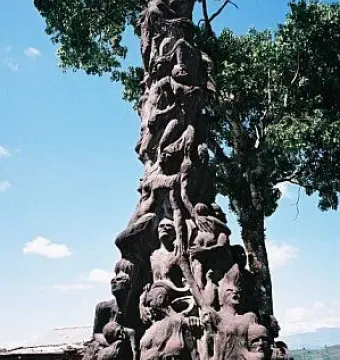
May 2008 © MattSoerens · CC BY 2.0
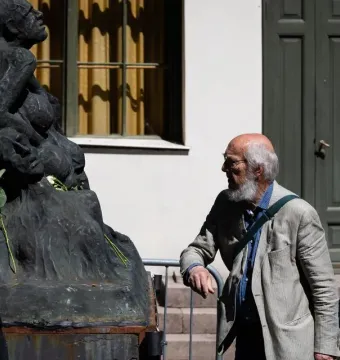
June 2022 © Tore Sætre · CC BY-SA 4.0
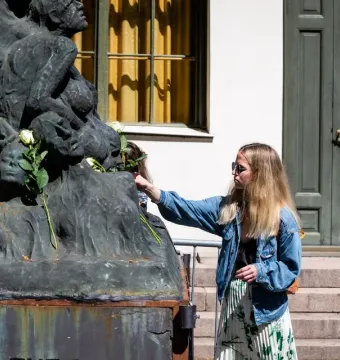
June 2022 © Tore Sætre · CC BY-SA 4.0
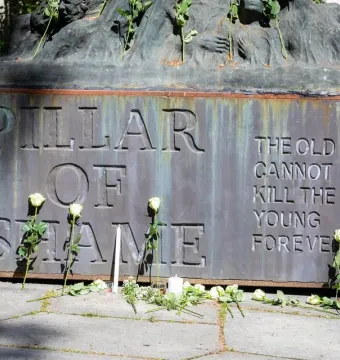
June 2022 © Tore Sætre · CC BY-SA 4.0
Identification | |
| Title | Pillar of Shame |
| Other names | Pilier de la honte; Colonne de l'infamie; Pilar de la vergüenza; A Coluna da Infâmia; Säule der Schande; Schandmal |
| Type | Series of sculptures |
Creator | |
| Artist | Jens Galschiøt |
| Artist nationality | Danish |
Historical context | |
| Subject | Victims of the 1989 Tiananmen Square massacre |
| Purpose | Memorial to deaths during the Tiananmen Square massacre and a reminder that the event must never happen again |
| Event commemorated | 1989 Tiananmen Square massacre |
| Location of commemorated event | Beijing, China |
| Responsible party mentioned | The Chinese Communist Party |
Physical characteristics | |
| Form | Tall statue in the shape of an obelisk made of twisted human bodies |
| Depicted figures | 50 torn, twisted or writhing bodies |
| Height | 8 meters each |
| Weight | 2 tonnes |
Materials | |
| Material | Bronze, copper, and concrete |
| Surface decoration | Bronze plaques |
Appearance | |
| Color | Black |
| Additional elements | Fragments of organic roots and reptiles intertwined with the human bodies |
Iconography and meaning | |
| Representation | The victims of the crackdown, expressing pain and despair |
| Symbolism of bodies | Degradation, devaluation, and lack of respect for the individual |
| Symbolism of roots and reptiles | Destruction, devaluation, and lack of respect for the individual |
| Symbolism of color | Mourning and loss |
| Artist’s interpretation | A reminder of a shameful event that must not recur |
| Use in conflict situations | Can be used by either side in complicated conflict situations where it is difficult to identify the guilty party |
Discovery and provenance | |
| Small-scale models | Several smaller-scale models made in the 1990s were exhibited outside the European Parliament in March 2024 |
| Mexico version | Installed in Acteal, Mexico, in 1999 to commemorate the Acteal massacre |
| Replica display | A replica was publicly displayed at the University of Oslo in May 2022 for about a month |
| Berlin plan | A pillar planned for Berlin in 2002 was not realized because of funding and other problems |
| Brazil version | Installed in Brasília, Brazil, in 2001 |
| Number planned | 10 |
| Hong Kong later locations | University of Hong Kong; Chinese University of Hong Kong; Lingnan College; Hong Kong Baptist University; Hong Kong University of Science and Technology; Hong Kong Polytechnic University; City University of Hong Kong |
| First installation in Hong Kong | Victoria Park, Hong Kong, 1997 |
| Other locations | Hong Kong; Mexico; Brazil; Berlin (planned) |
| Number erected | 4 so far |
| First unveiled | 1996 at the NGO Forum of the FAO summit in Rome, Italy |
| Hong Kong purpose | To mark the eighth anniversary of the 1989 Tiananmen Square protests |
Location and ownership | |
| Hong Kong initial location | Victoria Park |
| Hong Kong temporary relocation | Haking Wong Building podium, University of Hong Kong |
| Hong Kong permanent location | Haking Wong Podium, University of Hong Kong |
History and restoration | |
| 1999 commemoration display | Displayed again at Victoria Park for the 10th anniversary vigil |
| 2021 ownership dispute | Galschiøt claimed the sculpture as his property; the university’s lawyers treated the Alliance as presumed owner and threatened to treat the memorial as ownerless property if not removed |
| 2021 removal | Dismantled and removed in the night of 22–23 December 2021; disappeared by daylight on 23 December 2021 and was reportedly put into storage in Kadoorie Centre |
| 2021 removal request | Requested by the University of Hong Kong in October 2021 on legal-risk grounds under the Hong Kong national security law |
| 2008 repainting | Painted orange on 30 April 2008 as part of The Color Orange project to raise awareness of human rights violations in China during the 2008 Olympic Games |
| Hong Kong temporary move | Moved to the University of Hong Kong around 3:00 a.m. after the 1997 vigil; parts were not assembled at first because the floor was considered too weak |
| Hong Kong permanent relocation date | 3 December 1998 |
| Hong Kong student vote | 24–25 September 1998; 1,629 of 2,190 votes in favor of keeping it at the University of Hong Kong |
| Hong Kong vandalism | Two buckets of red paint were thrown on it before the 31 May 1998 vigil |
| Hong Kong returned to Victoria Park | 31 May 1998 for the ninth anniversary vigil |
| Hong Kong installation date | 3 June 1997 |
| 2023 seizure | Seized from storage in May 2023 by Hong Kong's National Security Department, reportedly as evidence in a subversion case |