
Marine Corps War Memorial
Marine Corps War Memorial is a bronze monument located near Arlington National Cemetery in the Washington, D.C. metropolitan area. It honors the memory of American Marines who, since 1775, have given their lives in defense of the country. Created by Felix de Weldon, the memorial depicts the moment six soldiers raised the flag atop Mount Suribachi on Iwo Jima on February 23, 1945, during the Battle of Iwo Jima. The scene is based on Joe Rosenthal’s Pulitzer Prize-winning photograph. The memorial was unveiled by President Dwight D. Eisenhower on November 10, 1954, the 179th anniversary of the United States Marine Corps.
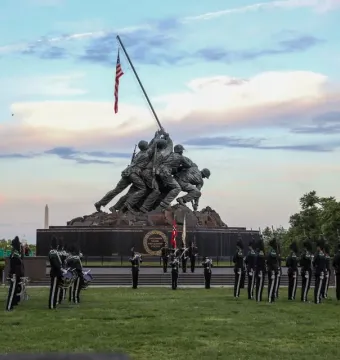
May 2025 © 3d U.S. Infantry Regiment (The Old Guard) · Public domain
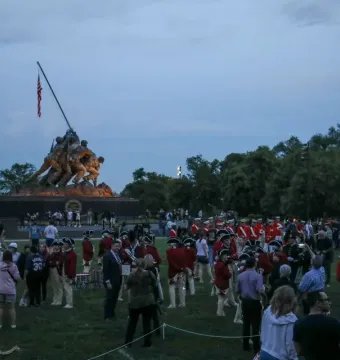
May 2025 © 3d U.S. Infantry Regiment (The Old Guard) · Public domain
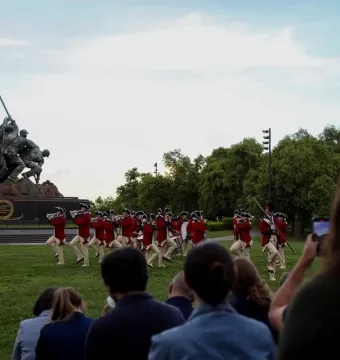
May 2025 © 3d U.S. Infantry Regiment (The Old Guard) · Public domain
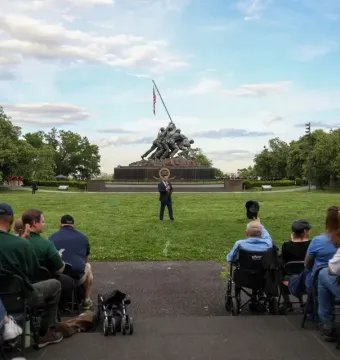
May 2025 © 3d U.S. Infantry Regiment (The Old Guard) · Public domain
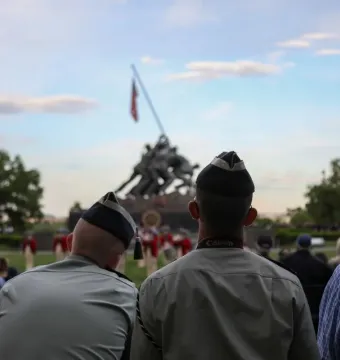
May 2025 © 3d U.S. Infantry Regiment (The Old Guard) · Public domain
Identification | |
| Title | Marine Corps War Memorial |
| Alternative names | United States Marine Corps War Memorial; Iwo Jima Memorial; USMC War Memorial; monument of Iwo Jima |
| Original-language name | Memorial of the United States Marine Corps |
| Type | National memorial; memorial sculpture; war memorial; military monument; colossal sculpture group |
Historical context | |
| Dedicated to | All members of the United States Marine Corps who died in defense of the United States since 1775 |
| Dedication date | 10 November 1954 |
| Dedication occasion | 179th anniversary of the founding of the United States Marine Corps |
Creator | |
| Designer and sculptor | Felix de Weldon |
| Architect | Horace Peaslee |
Discovery and provenance | |
| Fundraising | A federal foundation was established in 1947 to raise funds; the memorial was financed by donations from active-duty and reserve Marines, Navy personnel, former Marines, Marine Corps friends, and other private supporters, with no public funds used |
| Commission | Commission awarded to Felix de Weldon in 1951, selected by the Marine Corps League |
| Maquette | Felix de Weldon created a full-sized plaster maquette in a single weekend at Patuxent River Naval Air Station, Maryland |
| Photographer affiliation | Associated Press |
| Photographer | Joe Rosenthal |
| Depicted battle | Battle of Iwo Jima |
| Depicted event date | 23 February 1945 |
| Depicted event | The raising of the second U.S. flag on Mount Suribachi during the Battle of Iwo Jima |
| Inspired by | Joe Rosenthal's Associated Press photograph 'Raising the Flag on Iwo Jima' |
Physical characteristics | |
| Figures depicted | Six servicemen: five U.S. Marines and one U.S. Navy sailor |
| Named figures | Sergeant Michael Strank; Corporal Harlon Block; Privates First Class Ira Hayes, Franklin Sousley, and Rene Gagnon; Chief Petty Officer John Bradley |
| Height | 23.77 m |
| Bronze sculpture height | 9.8 m |
| Flagpole length | 20 m |
| Pedestal height | 4.5 m |
Materials | |
| Sculpture material | Bronze |
| Pedestal material | Granite, specifically black diabase granite / Lönsboda granite from southern Sweden |
Technique | |
| Foundry | Bedi-Rassy Art Foundry, Brooklyn, New York |
| Casting method | The plaster master model was disassembled and each piece separately cast in bronze |
| Model material | Plaster |
Appearance | |
| Depicted location | Mount Suribachi, south end of Iwo Jima |
| Base and inscriptions | The granite pedestal has two inscriptions, with the dates and locations of Marine Corps battles engraved around its circumference |
| Subject depicted | The six servicemen raising the second and larger of two U.S. flags atop Mount Suribachi, Iwo Jima |
Iconography and meaning | |
| Inscribed quotation | "Uncommon Valor was a Common Virtue" |
Location and ownership | |
| Transferred to | National Park Service |
| Transfer date | 1955 |
| Location | Arlington Ridge Park, Arlington County, Virginia, United States, near Arlington National Cemetery and the Netherlands Carillon in the Washington metropolitan area |
| Site context | On a high ridge overlooking the national capital, within the George Washington Memorial Parkway |
History and restoration | |
| Construction and transport | The bronze pieces were cast in Brooklyn over about three months, reassembled into a dozen pieces, and transported to Arlington, Virginia, in a three-truck convoy with the flagpole added during transport |
| Controversy | The proposed nearby United States Air Force Memorial drew criticism because it was thought a large monument would overshadow the Marine Corps memorial |
| Rosenthal plaque | A plaque honoring Joe Rosenthal was added several years after the memorial's original installation |
| Use | Used by Marines from Washington Marine Corps Base for the weekly Sunset Parade, featuring the Drum and Bugle Corps and the Silent Drill Platoon |
| Flag used | A modern U.S. flag is flown, with the number and arrangement of stars prescribed at the time it is raised |
| Flag display status | One of the few public places in the United States where this flag rule applies |
| Presidential flag proclamation | In 1961, President John F. Kennedy issued Proclamation No. 3418 requiring the U.S. flag to fly on the memorial flagpole 24 hours a day |
| Total cost | $850,000 including site development |
| Opened by | President Dwight D. Eisenhower |
| Opening ceremony | A U.S. flag was raised after the remarks and the ceremony ended with taps |
| Opening presentation | General Lemuel Shepherd presented the monument to the people of the United States |
| Opening remarks | Remarks were given by Robert Anderson, Colonel J.W. Moreau, Orme Lewis, and General Lemuel Shepherd; Richard Nixon gave the dedicatory address; Felix de Weldon also spoke |
| Opening participants | Vice President Richard Nixon; Secretary of Defense Charles E. Wilson; Deputy Secretary of Defense Robert Anderson; Assistant Secretary of the Interior Orme Lewis; General Lemuel C. Shepherd |
| Opening date | 10 November 1954 |
| Completion time | Three years |
| Construction began | September 1954 |
| Groundbreaking date | 19 February 1954 |
Significance | |
| Recognition | One of the most important military memorials in the United States |