
Monument to the Revolution of the People of Moslavina
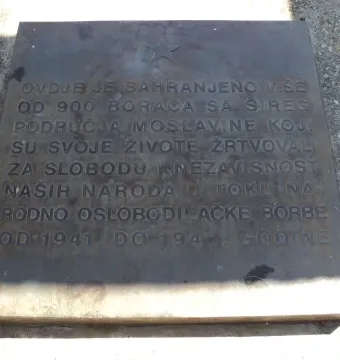
The Monument to the Revolution of the People of Moslavina is a commemorative World War II sculpture by Dušan Džamonja, located in Podgarić, Berek, Croatia. Inaugurated in 1967, it honors the people of Moslavina for their resistance against the occupying forces during the Second World War. The monument features a large aluminum “eye” set on a winged structure, with the graves of soldiers surrounding it. A plaque notes that 900 soldiers from the Moslavina region are buried there, having given their lives for freedom and independence during the National Liberation Struggle from 1941 to 1945.
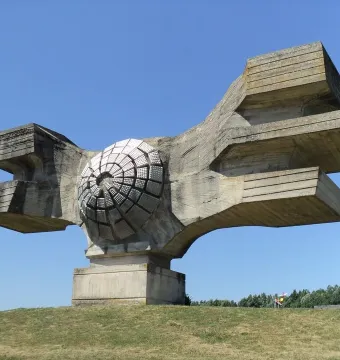
© Plamen · Public domain
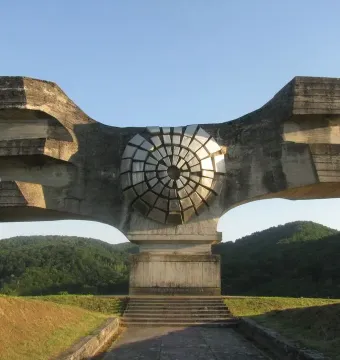
August 2018 © Marijabelch · CC BY-SA 4.0
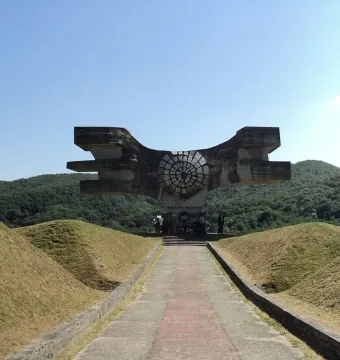
© Plamen · Public domain
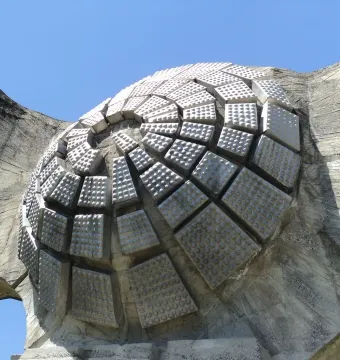
© Plamen · Public domain
© Plamen · Public domain
Identification | |
| Title | Monument to the Revolution of the People of Moslavina |
| Original-language title | Spomenik revoluciji; Spomenik Revolucije Naroda Moslavine; Le monument à la Révolution |
| Original-language | Serbo-Croatian |
| Type | Monument; commemorative sculpture; World War II memorial sculpture; abstract sculpture; brutalist abstract sculpture |
| Alternative title | Monument to the Revolution |
Historical context | |
| Hospital complex | Two partisan hospitals were located in the forest near Podgarić and served mainly about 6,000 soldiers of the 10th Zagreb Partisan Corps |
| Dedicated to | The people of Moslavina and their struggle for independence during the National Liberation Struggle and World War II |
| Purpose | To remember the 900 soldiers who died in the hospitals of the area |
| Casualties | About 900 partisans were killed in attacks on the hospital complex |
| Enemy attacks | The hospital complex was attacked by the Ustaše |
| Hospital operation began | 27 January 1942 |
| Partisan activity | From winter 1941, Podgarić became an important center of partisan activity and of the Central Committee of the Communist Party of Croatia |
| Reason for local resistance | The Ustaše aimed to create a nationally homogeneous Croatian state, which caused opposition among part of the inhabitants of Moslavina |
| Related wartime events | In April 1941, the Kingdom of Yugoslavia was defeated by the Axis powers and Moslavina was incorporated into the Independent State of Croatia (NDH) |
| Political context | The monument commemorates anti-fascist resistance against the German Wehrmacht and the Ustaša after the occupation of April 1941 |
| Commemorated event | The local revolutionary and partisan struggle in Moslavina during World War II |
| Subject | The people of Moslavina's resistance against the occupying forces during World War II |
| Historical period commemorated | World War II |
Creator | |
| Artist | Dušan Džamonja |
| Nationality | Croatian; Yugoslav |
| Origin | Macedonian origin |
| Life dates | 1928–2009 |
| Assistance | Vladimir Veličković assisted with the construction; described as a painter and architect |
Discovery and provenance | |
| Related work | Very similar to Džamonja's 1967 metal relief The Sun at Youth Center Belgrade, designed by Momčilo Belobrk; it is unclear whether the two works were planned together or whether one was a precursor to the other |
| Postage stamp | The monument was the motif of a Yugoslav postage stamp |
| Media recognition | In 2014, CNN named it one of the ugliest monuments in the world |
| Commissioning | Regional politicians, local authorities, and regional veteran groups pushed for and initiated the monument in the 1960s; Dušan Džamonja won the competition and was commissioned to design it |
| Inaugurated by | Josip Broz Tito, President of the Socialist Federal Republic of Yugoslavia |
| Completion year | 1967 |
| Construction period | 1965–1967 |
| Inauguration date | 7 September 1967 |
Location and ownership | |
| Location | Podgarić, Berek municipality, Croatia |
| Site features | A path leads to the monument; crypts and a mass grave are located along the path; the graves of the soldiers are around the monument |
| Landscape feature | A small artificial lake lies at the foot of the monument complex |
| Lake creation | The lake was created by building a small dam on the Kamenjače River |
Physical characteristics | |
| Features | Two wings and a central eye; the wings are divided into two plates on one side and three on the other |
| Central motif | A central honeycomb-like core formed by a centrally mounted aluminum ornament in the shape of an eye or circle |
| Width | about 20 meters |
| Form | A hovering abstract object with side wing-like forms |
| Height | about 10 meters |
Materials | |
| Primary material | Reinforced concrete |
| Cladding | Aluminum panels |
| Additional material | Aluminum elements |
| Alternative material wording | Concrete |
Iconography and meaning | |
| Symbolism | The central core symbolizes life, expressing the victory of life over death |
Appearance | |
| Inscription | Here are buried 900 soldiers from the Moslavina region who gave their lives for the freedom and independence of our nation during the National Liberation Struggle, from 1941 to 1945. |