
Bust of Pushkin in Kharkiv
Bust of Pushkin in Kharkiv was a bronze monument dedicated to the Russian poet Aleksandr Sergeevič Puškin. It was erected in May 1904 on a granite pedestal in Teatral'nyj majdan, or Theatre Square, in Kharkiv, then part of the Russian Empire. The sculpture was created by Boris Vasil'evič Ėduards. After an attempted bombing in 1904, it remained in place until 1935, when it was moved to face Pushkinska Street near Poetry Square, while the bust of Gogol' took its former position. In November 2022, amid the Russian invasion of Ukraine, the bust was dismantled and placed in storage. The pedestal was removed on 5 June 2024.
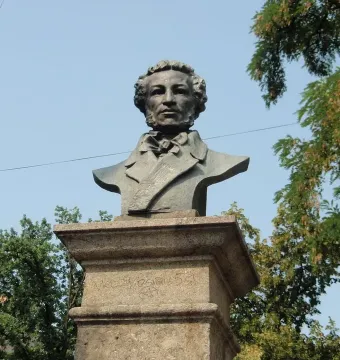
July 2016 © Tala tamila · CC BY-SA 4.0
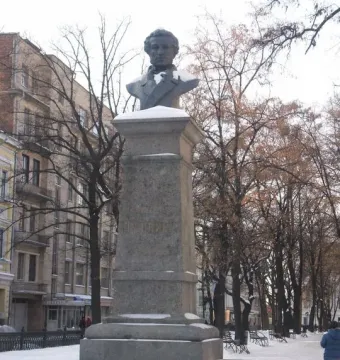
January 2012 © Григорий Ганзбург · CC BY-SA 3.0
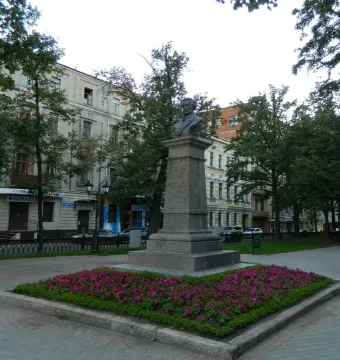
September 2012 © Олег К · CC BY-SA 3.0
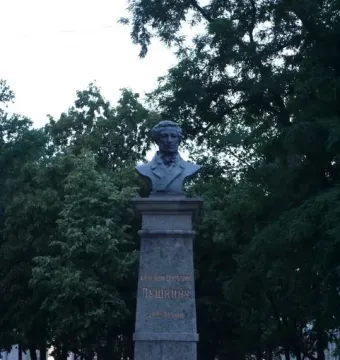
June 2018 © Posterrr · CC BY-SA 4.0
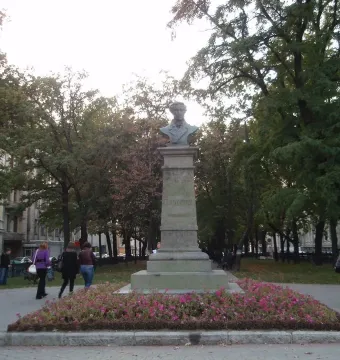
October 2014 © Tala tamila · CC BY-SA 4.0
Identification | |
| Title | Bust of Pushkin in Kharkiv |
| Alternative name | Monument to Aleksandr Pushkin |
| Type | Bust |
| Original-language title | Пам'ятник Олександрові Пушкіну в Харкові |
Creator | |
| Sculptor | Boris Vasilyevich Eduards |
Historical context | |
| Subject | Alexander Pushkin (1799–1837), Russian poet and man of letters |
| Erected for | The centenary of Pushkin's birth in 1899 |
| Historical context | Kharkiv was part of the Russian Empire at the time of installation |
| Funding | Funds were raised in Kharkiv to erect the monument after the 1899 centenary, but city treasury money was not found immediately |
| Street renamed for the monument | Nemetskaya Street in Kharkiv was renamed Pushkinska Street in 1899 |
Physical characteristics | |
| Material | Bronze |
| Pedestal material | Granite |
| Base | The bust stood on a pedestal |
Location and ownership | |
| Installed while theater was named after Pushkin | The drama theater in front of the monument was then also named after Pushkin |
| Installation date | May 1904 |
| Later location | Facing Pushkinska Street in Poetry Square (Teatralnyi Square / Teatralnyi Garden), Kharkiv, on the side of the square's exit to Pushkinska Street |
| Original location | In front of the drama theater at the beginning of Teatralnyi Square in Kharkiv, opposite Sumskaya Street |
History and restoration | |
| Relocation | Moved in 1935 when the drama theater was renamed Shevchenko Theatre |
| Replacement after relocation | A bust of Gogol took its place at the original site |
| Attempted bombing | On the night of 31 October 1904, activists from the underground group 'Defense of Ukraine' attempted to blow up the monument on the initiative of Mykola Mykhnovskyi |
| Damage from bombing attempt | The bust was not damaged; only part of the pedestal/base was broken off, and nearby windows were shattered by the blast wave |
| Wartime status | During the German occupation of Kharkiv in 1941–1943, the monument survived and remained in place |
| Removal | Dismantled from its pedestal and removed on 9 November 2022 for storage |
| Reason for removal | Removed during decolonization in the context of Russia's full-scale invasion of Ukraine; Pushkin was seen as a symbol of the invading state |
| Pedestal removal | The pedestal was dismantled on 5 June 2024 |
| Heritage register status | In November 2023, the Cabinet of Ministers of Ukraine decided to remove the monument from the State Register of Immovable Monuments of Cultural Heritage of National Significance under number 63-101-0672 |
Significance | |
| Commemorative use | Poetry readings are held around the statue on the writer's anniversary days |
| Political significance | In the 2000s, demonstrations in support of keeping Russian language in education, administration, and public life were held in front of the monument |
| Possible association with Pushkin | Pushkin is said to have stopped in Kharkiv on his return from the Caucasus and stayed with the Shcherbynin family |
| Related sculpture | Boris Eduards also created a bust of Nikolai Gogol in 1909 at the other end of Theatre Square |